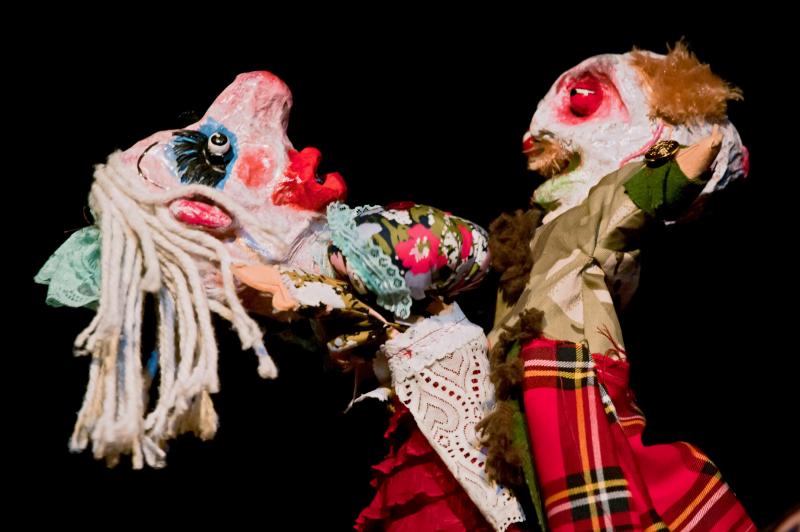
Although Paper Cut has a strong "the personal is political" theme - it mercilessly deconstructs the oppression of 1950s' ideals of femininity and the tyranny of glamour - it isn't a political work in the manner of, say, Kieran Hurley's Hitch. Yet it provides a moment that cracks open a matter that has concerned me since Bathsheva Dance were boycotted in the Edinburgh International Festival: one of the most thrillingly uncomfortable moments of manipulate that is all the more profound for being so unexpected.
Yael Rasooly is an Israeli artist, but Paper Cut is set in a notional America. At least, the main character, a downbeat secretary, is surrounded by American films and music. Her rich fantasy life is filled with lantern-jawed men and simpering women and her ambitions at the beginning are little more than reflections of a romantic Hollywood happy ending.
In a particularly detailed dream, Rasooly's secretary ("the bulldog") lists her honeymoon destinations. From Paris through Egypt to Edinburgh, her husband takes her around the world, allowing her to soak up the ambience while he steps, repeatedly, in dog shit. She flips over the next postcard and... it's Palestine.
Embarrassed, she pauses. Instead of her usual eulogy to the beauties of the location, she looks ashamed and says that this one is difficult, and that she'll talk about it later. Then, with a swift movement, the next postcard arrives and the bulldog is back in the fantasy.
There has been plenty of debate about Israel's activity in Palestine within the arts: most notably, the call to boycott Batsheva dance last August, and the infiltration of the audience by protestors who then disrupted the choreography by chanting. Boycotts do have a degree of political legitimacy, thanks to the boycott of South Africa during the 1980s, and campaigning against violations of human rights is probably more important than going to the theatre.
Yet the specific activity of the protestors in August did not necessarily prove their moral superiority, not advance their claim. While I am very big on the importance of theatre as a location for public discussion, I tend to see it more in terms of creating artist works that convey an idea emotionally and intellectually. Appealing for a ban on a certain company is a different dialogue and while it might bring the theatre out of the building, it has that awkward overtone of censorship.
Paper Cut doesn't actually address the Palestinian question - it just admits that it is there. There are artists who are actively engaged in the debate (David Greig has been out there, and written about his experiences) but Rasooly merely raises the matter. It's cunning - offending neither side in the argument but showing that it is important. Theatrically, it is jarring enough to break open the smooth narrative of the bulldog's fantasy (a reminder that reality might have been set to one side, but it is still waiting), but is quickly smoothed back into place.
Just a moment, and hardly the whole point of this wonderful one women show, but worth noting.
Showing posts with label manipulate 2013. Show all posts
Showing posts with label manipulate 2013. Show all posts
Sunday, 10 February 2013

Bi-social By Jove
Last night, I found myself embroiled in a vigorous discussion with a puppeteer about "suspension of disbelief." I firmly believe that this is an unhelpful way to describe an audience's response to performance. We'd just been watching Neville Tranter's puppet Hitler, and suspending disbelief would have meant thinking that Hitler and his crazy pals were in front of us. Tranter might have lent his puppets some degree of humanity - certainly, against the ranting anti-christ in Downfall, this Hitler was almost human - but I hope that should I ever believe that the most notorious mass-murderer of the twentieth century is standing in front of me, I'll do a little more than applaud him after ninety minutes.
Suspension of disbelief seems very demanding: how do I switch off my natural inclination to believe or disbelieve? Is it the performer's responsibility to suspend my belief, or do I need to do a spot of yoga before the show to make me gullible? And even more worrying - I don't think suspending disbelief is a good thing. Sure. Mr Cameron, let me suspend my disbelief in your willingness to help the socially excluded. I'll believe every word you say, Mr Obama. I didn't actually see you in bed with my best friend, lover with a track record of infidelity.
After a week of manipulate, I am still scrambling around for something to replace this idea. I came up with the suggestion that the magic of theatre resides in the audience's ability to see two things at the same time: the literal presence (say, of a man with his hand up a Hitler puppet's back) and the suggested presence (the man is Hitler's servant, and this is the speech Adolf made in the bunker). I never lose either perspective.
I have experienced moments in which I have believed a performance to be literally real. There was that time during Audience when the actor abused an audience member. I thought it was not a plant, and I threw my shoe at the stage.
Then there was that time when I was frightened of The Tiger Lilies. They had sung a song about crucifying Jesus for a laugh, and I really did think they were that evil. Seeing the band in the bar after I show, I ran away in a miasma of fear.
Those were pretty intense moments. Having experienced it twice in ten years of theatre, however, suggests that if the success of a show depends on it, there's very little art that is going to work.
However, once this is replaced by the idea of bisociation, success becomes easier. Inevitably, the big concept I thought was going to be my contribution to critical theory had already been described. And, inevitably, it comes from a writer on the fringes of respectable academic philosophy. Arthur Koestler defined bisociation to explain how the human mind can hold two contrasting ideas about the same thing at the same time.
I discovered his definition in a book about conspiracy thinking. Oh, my impeccable sources.
Back to puppet Hitler - or the Live Art influenced work in progress by Sarah Hopfinger during Buzzcut@manipulate - the viewer's ability to read each moment in two ways ought to account for the power of their presence. Does a double perception of an image mean that twice as much information is being taken in?
And does a piece like Paper Cinema's Odyssey, which deliberately shows its workings and it surface, use bisociation to make tears come to my eyes?
Suspension of disbelief seems very demanding: how do I switch off my natural inclination to believe or disbelieve? Is it the performer's responsibility to suspend my belief, or do I need to do a spot of yoga before the show to make me gullible? And even more worrying - I don't think suspending disbelief is a good thing. Sure. Mr Cameron, let me suspend my disbelief in your willingness to help the socially excluded. I'll believe every word you say, Mr Obama. I didn't actually see you in bed with my best friend, lover with a track record of infidelity.
After a week of manipulate, I am still scrambling around for something to replace this idea. I came up with the suggestion that the magic of theatre resides in the audience's ability to see two things at the same time: the literal presence (say, of a man with his hand up a Hitler puppet's back) and the suggested presence (the man is Hitler's servant, and this is the speech Adolf made in the bunker). I never lose either perspective.
I have experienced moments in which I have believed a performance to be literally real. There was that time during Audience when the actor abused an audience member. I thought it was not a plant, and I threw my shoe at the stage.
Then there was that time when I was frightened of The Tiger Lilies. They had sung a song about crucifying Jesus for a laugh, and I really did think they were that evil. Seeing the band in the bar after I show, I ran away in a miasma of fear.
Those were pretty intense moments. Having experienced it twice in ten years of theatre, however, suggests that if the success of a show depends on it, there's very little art that is going to work.
However, once this is replaced by the idea of bisociation, success becomes easier. Inevitably, the big concept I thought was going to be my contribution to critical theory had already been described. And, inevitably, it comes from a writer on the fringes of respectable academic philosophy. Arthur Koestler defined bisociation to explain how the human mind can hold two contrasting ideas about the same thing at the same time.
I discovered his definition in a book about conspiracy thinking. Oh, my impeccable sources.
Back to puppet Hitler - or the Live Art influenced work in progress by Sarah Hopfinger during Buzzcut@manipulate - the viewer's ability to read each moment in two ways ought to account for the power of their presence. Does a double perception of an image mean that twice as much information is being taken in?
And does a piece like Paper Cinema's Odyssey, which deliberately shows its workings and it surface, use bisociation to make tears come to my eyes?
Tuesday, 5 February 2013
Piano Tuner of Earthquakes (Part 1)
The Piano Tuner of Earthquakes does have more than a passing resemblance to Jan Svenkmajer's dystopian visions of a world gone mechanical and soulless, but the Brothers Quay have their own style that owes as much to Tarkovsky and David Lynch. If Terry Gilliam has expressed an enthusiasm for their work, his cinematography could do with a little more of their imaginative manipulation of colour and tone: they evoke a sinister, brooding atmosphere less by unearthing dark themes than by interfering with the very fabric of the film.
 The trompe l'oeil effects, especially in the scenes of Droz's asylum, make it clear that Piano Tuner is not interested in the documentary realism of film. The conversations between Droz and his former lover are freighted with meaning that disappears between dark erotic displays.
The plot alludes to early fairy-tales and fantasies - most notably Copelia, with its insane doctor and beautiful female victim - but twists them through a thoroughly contemporary alienation. The automatons, who provide the titular piano tuner with enough work to be dragged into the doctor's insanity, are musical monsters, created by the malevolent Dr Droz as part of his vaguely motivated campaign to "punish" a world that has ignored his music.
A comparison to Angela Carter's way with the fairy-tale from The Guardian is telling: but where Carter often rescues her heroines from the patriarchy, the brothers capture their antagonists in a mechanical hell of repressed sensuality and unexpressed desire. And while the story is reasonably coherent - Droz is the baddie, Malvina the singer is the female victim and Felisberto, the piano tuner, a failed hero - the stop motion interludes, the half whispered dialogue and the heavy, hot atmosphere transform the content into a more elusive allegory.
Felisberto is the double of Malvina's fiancé. Malvina is declared dead but rises to sing again. Droz's former lover spies on the developing romance between Felisberto and Malvina, trying to seduce the piano tuner while he becomes more entangled in Droz's machinery.
 The trompe l'oeil effects, especially in the scenes of Droz's asylum, make it clear that Piano Tuner is not interested in the documentary realism of film. The conversations between Droz and his former lover are freighted with meaning that disappears between dark erotic displays.
And death comes, only not to be death but a static preservation...
Manipulate (Live Blog on the Bus): Buzzcut
The opening night of manipulate was an
appropriately post-modern take on the cabaret format: the audience found
themselves in four different spaces, moving from the intimate one-to-one of Five Minutes To Move Me through the
longer performances of Sarah Hopfinger, Murray Wason and Harry Wilson, to the
finale with Carles Casallachs’ Por Sal Y
Samba. The emphasis on physical theatre reflects the influence of curators
Buzzcut, who have spent the past year garnering a reputation for taking
performance into unfamiliar places, although Por Sal Y Samba has enough funky choreography to count as dance.
Five
Minutes To Move Me has become Buzzcut’s signature
strand: a series of one-on-one pieces, lasting five minutes, it has turned up
at youth days and international visual art festivals alike. Bringing together
artists both new (Corrie McKendrick is still studying at the RCS) and familiar
(Ian Nulty has graced both Glasgay! and Arches Live!), it challenges the
artist to condense an idea into a short, intimate routine.
The longer pieces, meanwhile, mark
Buzzcut’s ongoing relationship with emerging artists. Both Hopfinger and Wason
are graduates of the Contemporary Performance Practice degree at the RCS, and their
work is personal and bears the traces of Live Art’s enthusiasm for community
and performance theory. Running towards the hour, they have space to explore
their ideas and display their wide range of performance techniques.
Por
Sal Y Samba, coming in at around twenty minutes and
finishing off the evening comes from a very different tradition. Deconstructing
the sensuality of samba, and exposing the violence lurking behind the sway of
the hips, it shifts rapidly from entertaining display to a no-holds barred
battle of the sexes.
Establishing physical theatre’s place within
the visual theatre festival, Buzzcut @Manipulate takes advantage of
Summerhall’s multiple venues and, by using old lecture theatres, brings out
something of physical theatre’s academic bent. Wason’s Automaton includes a brief history of robotics and Hopfinger’s
performance with even year old Carragh McLiven is framed by two white boards
that highlight the mutual learning processes that are happening within Age Old.
The loose format of the evening is
appropriate to the content: there are plenty of “works in progress” and both
Wason and Hopfinger are hinting at ideas, both theatrical and intellectual,
rather than pursuing a specific argument.
It is a gentle introduction to the
festival, questioning rather than demonstrative, encouraging an intimacy
between performers and audience, and refusing to make any grand declarations
about performance. Situated within a festival that has its roots in puppetry, Buzzcut@Manipulate
recasts physical theatre - in itself a relatively recent genre within a broader
tradition.
Saturday, 2 February 2013
Puppetry as Technology
Technology gets a bad press. Ironic, really, considering that most of that press has been enabled through advances in technology. I can't resist taking a chance in my blog to have a pop at the way the internet has undermined traditional journalism, replacing it with a diversity of voices, and I am sure that the invention of the printing press was greeted with a similar disdain: if you can just read it, why would you bother to memorise it?
It seems a bit rich for humans to be so uptight about the impact of technology on our emotional lives. The ability to use tools, although not unique, has been important in the success of homo sapiens and the arts have been pretty much reliant on technology ever since the Greeks worked out how to design an auditorium that amplified the human voice.
The speed of invention in the last few decades has been staggering - even in the 1990s, Hollywood films would feature computers that seemed to consist of a big button and a screen flashing EMERGENCY in a decayed font as if that was the cutting edge - and the accessibility of the internet has offered at least the potential for everyone to get on-line. But now that stories of mothers discovering how to use Facebook are not played for surprise, it's time to accept that the dividing line between cyborg and human is getting vague.
Puppetry isn't just an ancient an art form: even some worthy traditions, like bunraku in Japan, only date back to the 1600s. The isolated evidence of puppets turning up in ancient Egypt or in Herodotus ("The festival of Dionysus is observed by the Egyptians much as it is by the Greeks... but in place of the phallus, they have invented the use of puppets two feet high moved by strings, the male member nodding and nearly as big as the rest of the body" Book II, chap. 48) emphasises that puppets were enlisted as performers early on in written history, but the development into its contemporary diversity has been the product of a consistent technological development.
Unsurprisingly, the self-consciousness of modern theatre has seen contemporary object manipulation deconstruct its own tricknology. Neville Tranter carries around his Hitler puppet on stage, making it very clear that this is not a person: Vox Motus' use of "black box" puppetry was exceptional for trying to hide the puppeteers but Leggy Pee's duets with Charlie Montgomery (a rod puppet) are more typical, playing on the inanimate object's obvious manipulation for humour and drama.
Puppetry's development and format is, perhaps surprisingly, relatively modern. The rise of Mr Punch in Britain came after the Civil Wars, and for every tradition like the Vietnamese Water Puppet (dating back around a thousand years), there are several traditions like Black Light which have only become possible in the post-industrial era.
As for technology's bad press: perhaps it has enabled vicious warfare, the rise of online pornography and the destruction of traditional print newspapers, but it helped surgery along and precipitated the revolution of object performance.
John Bell's argument that the very material of the puppet makes the form spiritual could be countered by noting that its relationship to technology makes it a fundamentally progressive art. Certainly, it has the quality of blurring boundaries, so beloved of the twenty-first century avant-garde thinker and artist.
If the relationship between human and machine has become a hot topic - mostly thanks to the unstinting books of science fiction that angst about the danger of robots ruling the world - and the influence of the internet is a matter of worry - thanks to the articles from endangered print authors - it is a reiteration of themes that have bothered philosophers for about as long as directors have been putting puppets in their plays.
It seems a bit rich for humans to be so uptight about the impact of technology on our emotional lives. The ability to use tools, although not unique, has been important in the success of homo sapiens and the arts have been pretty much reliant on technology ever since the Greeks worked out how to design an auditorium that amplified the human voice.
The speed of invention in the last few decades has been staggering - even in the 1990s, Hollywood films would feature computers that seemed to consist of a big button and a screen flashing EMERGENCY in a decayed font as if that was the cutting edge - and the accessibility of the internet has offered at least the potential for everyone to get on-line. But now that stories of mothers discovering how to use Facebook are not played for surprise, it's time to accept that the dividing line between cyborg and human is getting vague.
Puppetry isn't just an ancient an art form: even some worthy traditions, like bunraku in Japan, only date back to the 1600s. The isolated evidence of puppets turning up in ancient Egypt or in Herodotus ("The festival of Dionysus is observed by the Egyptians much as it is by the Greeks... but in place of the phallus, they have invented the use of puppets two feet high moved by strings, the male member nodding and nearly as big as the rest of the body" Book II, chap. 48) emphasises that puppets were enlisted as performers early on in written history, but the development into its contemporary diversity has been the product of a consistent technological development.
Unsurprisingly, the self-consciousness of modern theatre has seen contemporary object manipulation deconstruct its own tricknology. Neville Tranter carries around his Hitler puppet on stage, making it very clear that this is not a person: Vox Motus' use of "black box" puppetry was exceptional for trying to hide the puppeteers but Leggy Pee's duets with Charlie Montgomery (a rod puppet) are more typical, playing on the inanimate object's obvious manipulation for humour and drama.
Puppetry's development and format is, perhaps surprisingly, relatively modern. The rise of Mr Punch in Britain came after the Civil Wars, and for every tradition like the Vietnamese Water Puppet (dating back around a thousand years), there are several traditions like Black Light which have only become possible in the post-industrial era.
As for technology's bad press: perhaps it has enabled vicious warfare, the rise of online pornography and the destruction of traditional print newspapers, but it helped surgery along and precipitated the revolution of object performance.
John Bell's argument that the very material of the puppet makes the form spiritual could be countered by noting that its relationship to technology makes it a fundamentally progressive art. Certainly, it has the quality of blurring boundaries, so beloved of the twenty-first century avant-garde thinker and artist.
If the relationship between human and machine has become a hot topic - mostly thanks to the unstinting books of science fiction that angst about the danger of robots ruling the world - and the influence of the internet is a matter of worry - thanks to the articles from endangered print authors - it is a reiteration of themes that have bothered philosophers for about as long as directors have been putting puppets in their plays.
Manipulated Path: Are We Human?
Manipulated objects don't have free will, by definition. Although my interest in determinism is mainly to see whether I can blame external forces for my inability to complete the novel, a more thoughtful analysis can be found in manipulate. Murray Wason, one of Glasgow's dynamic wave of Live Artists, is wondering whether the Automaton is a better description of the human, Cloud Eye Control have a vision of the cyborg and Aalterate ponders the boundaries of the body.
The relationship between human and robot ties in nicely with the whole free will versus determinism routine. Philip K Dick tried to question the exact line between human (being a Christian, of sorts, Dick saw the possession of a soul as being crucial) and machine in Do Androids Dream of Electric Sheep. In the film version, the robots are sometimes more compassionate and more lively than the humans building them, and if consciousness of death is a distinctly human quality... hang on... that's another essay...
Wason's Automaton sets its course for a putative future, where the machine takes over the mundane tasks and the body is stuffed full of mechanical contraptions. The tag-line "how do we know this heart is real?" hits the sweet spot between heart as biological organ and metaphor for love, with Wason considering the role of the emotions in a world dominated by mechanistic innovation.
Cloud Eye Control are a little more optimistic. Two of their pieces look at triumphs of technology: Ocean Flight recasts Charles Lindenbergh's trans-Atlantic journey into a collaboration between human and machine. Lindenbergh becomes an early version of the cyborg, his relationship to his airplane becoming transformative. Here, the machine enables human achievement and lends transcendence in an almost spiritual ritual.
Aalterate, part of the FAST FILM reel isn't quite so directly interested in the man-machine line, but it does provide a rapid glimpse at the problems of maintaining physical boundaries. And that's a theme within the analysis of the human-robot dualism.
I'm sorry. When I think about the differences between humans and machines, I am always trying to find the line between what counts as human, that is biological, and robotic - mechanical.
There's a traditional idea that the human is easy to define: born through sexual reproduction, made from organic materials, likes a drink, feeds on more organic material: throw in a few ideas about spirituality, maybe a specific relationship to the divine, or the ability to make free choices. And the robot - they might look human, but they are made in a factory, get confused by contradictions (the best way to face down a killer robot is to ask it what love is) and don't have a soul or any of that gubbins. Every so often, they try to take over the world, releasing that humans are inferior.
Unfortunately, the post-modernists got in on the act. The previously simple demarcations were blurred. Once organ replacements could be mechanical, and computer programmes had a degree of AI, making decisions for themselves, the boundary between human and robot blurred. We are all cyborgs when we use a mobile phone, man.
Going the other way, biologists suggested that the way the human body works makes it pretty much an automaton. On the one hand, we are transforming into cyborgs, which is kind of cool. On the other, we always were robots, which sucks.
Then Hunter S got in on the act, wondering whether humans were being trained by society, and were losing free will.
All of which is grand for thinking about, and gives me a blog that reads like a wikipedia entry on freewill written by someone who took too much LSD in the 1960s. However, there are human organisations that rely on a clear definition of what it means to be human. The Law, for example, assumes that a person has complete agency and is responsible for their actions.
If we are robots, the legal system is punishing people for actions that they have no control over.
Understanding whether our mechanical future is liberating, as Ocean Flight implies, or slightly more confusing, pace Wason, is more than just an intellectual exercise. It provides the foundation for social change. A clear grounding in the nature of humanity is crucial for the ongoing evolution of the species within society.
The votes aren't in yet, but the debate is too serious to leave to academics - they are good, but have their own bias towards reason. Art, fortunately, has the capacity both to bring people together and present an argument in emotional and intellectual terms.
Manipulated Path: What is Love?

Por Sal Y Samba (Summerhall, Sunday 3 February) begins like a slinky samba: a summer dress and a smart dressed man getting down to a groove only they can hear. Of course, it turns sour - the arrival of the salt is not easy on the eyes - and Carles Casallachs dissects the violence implicit in the soothing sounds of samba sensuality. This is love tested in the crucible of conflict, and Casallachs unapologetically presents the brutality inevitable when the need for possession becomes a battle for power.
To The End of Love (4 - 8 February, various venues) does not make it easier. Jealousy, the ghost of past lovers, the secret chamber in the heart of the man and the quest for truth in the heart of the woman lead this modern Mr and Mrs Bluebeard towards pain. Like Por Sal, there are moments are beauty juxtaposed against the anguish: the psychological world is animated by swirling costumes and a precise allegorical narrative.
Meanwhile, Paper Cuts goes for the comedy: a secretary is seduced by the romance of the cinema, before being reminded that danger is an important part of even the romantic comedy. Where Por Sal has sex and TTEoL has petticoats, Rasooly's monodrama has magazine cut-outs and humour.
All three shows share an interest in how desire can lead an individual (or a couple) deeper into unknown territory, where the consequences can be deadly and passion compromised by other needs. At the heart of desire is the problem of control - who has it? where does it fit? - and I tend to use the arts as essays on aspects of life I am not sure how to explain. Follow this path through manipulate and I might start to understand how love can end in hate or fear.
Friday, 1 February 2013
Puppetry is Dead...
Although I have had plenty of art-crushes in my life, I have had far fewer philosophy crushes. Generally, old philosophers, like Plato or Nietzsche, have managed to express ideas that inspired me alongside the sort of gender politics that would make Jim Davidson blush. Fortunately, I haven't managed to delve into the biography of John Bell too far, and I think he is my current "philosophy of puppetry" crush.
Apart from having an obvious love of puppetry that comes through even in his most academic texts, Bell is unafraid of offering big answers. Death and Performing Objects, which is where I first fell for his mind, looks at the history of puppetry and concludes that it is fundamentally a spiritual process. Once a member of Bread and Puppet Theatre, and currently holding a post named after a Jesuit, Bell chases after the essence of puppetry, concluding that it has been used within ritual thanks to the specific qualities of the materials used in its creation.
Death and Performing Objects has the bold energy of popular criticism rather than the precise detail of the academic essay: kicking off by establishing the dualism between the living and the inert (and noticing how life itself comes from non-living matter), he sees inspiration for the arts coming from performers' willingness to look towards death.
Citing both Heinrich von Kleist's 1810 On the Marionette Theater and Edward Gordon Craig's 1906 The Actor and the Ubermarionnete, Bell separates object manipulation from both scripted and physical theatre by emphasising how the object can replace the human presence (he quotes Craig's sardonic "the body of man is by nature utterly useless as a material for an art"). He then promotes an alternative: the 'elevated prop' can work together with the actor to offer a more comprehensive representation of reality, one where the profound question of live against death is implicit in the very fabric of the performance.
Like McLuhan's declaration that the medium is the message, object manipulation draws attention to the function of art by its format. Vox Motus' Slick has human heads atop puppet bodies, mirroring the slapstick humour of the script in the actor's (suddenly diminished) presence. Paper Cut surrounds Yael Rasooly with fragments of the magazines that maintain her character's rich fantasy life. And Cloud Eye Control explore the contemporary interface between human and technology on a stage set by projections and software.
Bell insists that there is a difference between actors' theatre which "can talk about death and show death with living bodies pretending to be dead" and object theatre: "When puppeteers, maskers, object performers, political demonstrators, machine operators, web site designers, film directors, multi-media producers, and advertising agencies work, they constantly create and modify relationships between living human beings and dead matter: wood, stone, metal, plastic, leather, bone. This makes for a profound reckoning with death on a constant subconscious or symbolic level."
The drama of Bell's essay is that he presents an essentialist vision of object theatre, before linking the idea back to its history. He's good on the global history too - Mongolian rituals bash heads with more contemporary experiments, and there is a generosity in his inclusive analysis. That uncanny moment of recognition, the magic of the puppet, is given a grounding in its very material. And even better, he offers a possible appreciation of the purpose of art that can be seen as consistent across time and place.
Wednesday, 30 January 2013
Transcript of Buzzcut Chat....
On the announcement of their participation in this year's manipulate, I contacted Buzzcut's founders - "two artists making space for other artists" to see how their own vision integrated with that of Puppet Animation Scotland. As we race towards the opening night, a few words from Nick Anderson and Rosana Cade explain how emerging artists can get visual...

What made you decide to hook up with a visual theatre festival?
Following Buzzcut festival last year, we were approached by Simon Hart, who was keen to hear more about what we were up to over here in Glasgow. One of our aims with Buzzcut is to always be bringing Live Art to new audiences, and we saw working with Manipulate as an exciting way to bring great work to a new group of people who may not have come along to Buzzcut in March.
It felt like an appropriate way to be broadening and strengthening the performance community within Scotland. Perhaps Visual Theatre and Live Art mean different things to a lot of people, and we are interested in exploring the parallels and intricacies of these distinctions by placing the work alongside each other in the same programme.
Does manipulate share anything with your own ethos in terms of how they programme?
Manipulate has a core purpose of showcasing an alternative form of work that has less of a platform in Britain, not least Scotland. This is an ethos that we'd find parity with as we both believe in the importance of the work we're passionate about having a supportive home. The work that interests both of us is contemporary and less likely to be seen regularly by audiences, and it's clear we are both inspired by the chance to see this work in Scotland.
When we met up last May to speak about this collaboration, Simon shared our excitement about blurring the barriers that might exist between Glasgow and Edinburgh audiences. Both cities have great audiences and different qualities, so it's exciting to be working with this intention!
Are you going to see anything else in the programme- or what has intrigued you?
We're fairly excited by the film programme. It seems like a rare treat to have such an interesting range of animated films from across the world. Big Man Japan in particular sounds like it's going to be a lot of fun, and we're also looking forward to some of the darker screenings like Consuming Spirits, which was apparently fifteen years in the making! I think we'll be aiming to get a film festival pass and see all the screenings if we're able to.
What is also really exciting about the programme is having the chance to see live performances from all over the world, and to engage with the styles and techniques these companies are experimenting with.
Cheers!
Love Buzzcut x
Tuesday, 29 January 2013
Curate. Programme. Connect. Enjoy.
Festivals can go one of two ways. They can be a bloated, expensive attempt to cash in a particular art form, or they can be lovingly designed to present a comprehensive, if idiosyncratic, study of the works.
Of course, there are other possibilities, but now that Scotland has become the Festival Nation, it's time to recognise the programmer as an artist. And the best festivals show the gentle hand of the programmer in the way that the individual shows have been selected.
Scotland has never been short on visionary programmers: back in the day, Steve Slater compared announcing the season at Tramway as being a bit like releasing a new album, and the work of Nikki Millican made New Territories an annually intriguing feast of experimental theatre. The growth of Celtic Connections over two decades can be put done to some cunning selections - emphasising the connection rather than the strictly celtic - and Morag Deyes' DanceBase seasons in August are always a provocative and enchanting mixture.
Manipulate has built a steady presence, first of all from Dundee, then Edinburgh and now across Scotland and into England, thanks to Puppet Animation Scotland's determination. Still facing a public opinion of puppetry as a minor art form, it juxtaposes film, including the CGI mockumentary Big Man Japan and performance to maintain a festival that is equal parts primer for contemporary visual theatre and celebration of the cutting edge. Simon Hart, artistic director, is clearly a man inspired by the potential of object manipulation, and the inclusion of potentially controversial topics (Schicklgruber alias Adolf Hitler) is balanced by reinventions of classic fairy-tales (To The End of Love) and all-ages magic (Paper Cinema's Odyssey).
Unlike the Fringe, manipulate has a clear mission: to celebrate contemporary visual theatre. Arika, who have evolved from experimental music festivals into experimental festivals, are even more preoccupied with the way that art provokes conversation, setting gigs next to discussion sessions. Much of Celtic Connections passes beneath the radar, as it offers opportunities to play and learn musical styles next to the grand shows. Yet the focus of all three festivals makes them healthy, dynamic and unique. They stand out from the crowded market.
A strong festival programmer ensures that each performance relates to others: when Svend Brown books minimal, he invites a performer or composer to hang out for the weekend, and lets them make a selection. Manipulate might appear to have a broad range of styles and content (Chris Sullivan's Consuming Spirits delves into human secrets through experimental animation, while A Wild Growling Happiness has larger than life puppets and childhood dreams), but the belief in the power of the performed image is consistent.
There is a danger that any organisation can slap the title "festival" on unrelated events in an attempt to fool the market (one lap-dance bar advertised "a festival of erotic dancing" during the Fringe a few years back, before the Festival of Erotic Arts made a more sustained and serious programme): but the true spirit of a festival goes back to a unity of intention. Entertainment is important, but the connection between the events, the possibility to explore an art form, to learn and laugh, is the mark of great curation.
Of course, there are other possibilities, but now that Scotland has become the Festival Nation, it's time to recognise the programmer as an artist. And the best festivals show the gentle hand of the programmer in the way that the individual shows have been selected.
Scotland has never been short on visionary programmers: back in the day, Steve Slater compared announcing the season at Tramway as being a bit like releasing a new album, and the work of Nikki Millican made New Territories an annually intriguing feast of experimental theatre. The growth of Celtic Connections over two decades can be put done to some cunning selections - emphasising the connection rather than the strictly celtic - and Morag Deyes' DanceBase seasons in August are always a provocative and enchanting mixture.
Manipulate has built a steady presence, first of all from Dundee, then Edinburgh and now across Scotland and into England, thanks to Puppet Animation Scotland's determination. Still facing a public opinion of puppetry as a minor art form, it juxtaposes film, including the CGI mockumentary Big Man Japan and performance to maintain a festival that is equal parts primer for contemporary visual theatre and celebration of the cutting edge. Simon Hart, artistic director, is clearly a man inspired by the potential of object manipulation, and the inclusion of potentially controversial topics (Schicklgruber alias Adolf Hitler) is balanced by reinventions of classic fairy-tales (To The End of Love) and all-ages magic (Paper Cinema's Odyssey).
Unlike the Fringe, manipulate has a clear mission: to celebrate contemporary visual theatre. Arika, who have evolved from experimental music festivals into experimental festivals, are even more preoccupied with the way that art provokes conversation, setting gigs next to discussion sessions. Much of Celtic Connections passes beneath the radar, as it offers opportunities to play and learn musical styles next to the grand shows. Yet the focus of all three festivals makes them healthy, dynamic and unique. They stand out from the crowded market.
A strong festival programmer ensures that each performance relates to others: when Svend Brown books minimal, he invites a performer or composer to hang out for the weekend, and lets them make a selection. Manipulate might appear to have a broad range of styles and content (Chris Sullivan's Consuming Spirits delves into human secrets through experimental animation, while A Wild Growling Happiness has larger than life puppets and childhood dreams), but the belief in the power of the performed image is consistent.
There is a danger that any organisation can slap the title "festival" on unrelated events in an attempt to fool the market (one lap-dance bar advertised "a festival of erotic dancing" during the Fringe a few years back, before the Festival of Erotic Arts made a more sustained and serious programme): but the true spirit of a festival goes back to a unity of intention. Entertainment is important, but the connection between the events, the possibility to explore an art form, to learn and laugh, is the mark of great curation.
Sunday, 27 January 2013
Manipulate 101: To The End Of Love

Coming direct from Finland, TIP Connection retell the myth of Blue Beard, using costumes, props and a little bit of psychological analysis. Avoiding the usual blood and guts of the opera and fairy-tale, To The End Of Love uses the story to explore how all lovers have a history, and how that history can become jealousy.
Director Anna Ivanova-Brashinskaya keeps away from words and manipulates dresses to follow the young bride on her descent into her beloved's castle. Capitalising on the allegorical power of the fairy-tale, this adult production has the heroine battle not so much with a physical danger as the memories of her lover's previous lovers. The refusal to cast these lovers as victims, but rather tormentors of both husband and wife, To The End of Love is less concerned with the mythical symbolism of the fairy-tale than a more immediate study of jealousy.
Anna Ivanova-Brashinskaya's trick is to recognise the emotive power of the dress and fabric: to show how the clothes make the person, even replace them. The ghostly spectacle of clothes without people adds to the atmosphere of illusion and insecurity.
Anna Ivanova-Brashinskaya's trick is to recognise the emotive power of the dress and fabric: to show how the clothes make the person, even replace them. The ghostly spectacle of clothes without people adds to the atmosphere of illusion and insecurity.
- Traverse
- Date - Monday 4 February
- Time - 7:30PM
- Price - £15.50 / £11.50 / £6
- BOOK NOW
- The Lemon Tree
- Date - Saturday 2 Feburary
- Time - 7:00PM
- Price - £10
- BOOK NOW
- Lochgelly Centre
- Date - Wednesday 6 February
- Time - 7:00PM
- Price - £10 / £8
- BOOK NOW
- Norwich Puppet Theatre
- Date - Friday 8 February
- Time - 7:30PM
- Price - £13 / £10 / £8 / £5 (festival passes available)
- BOOK NOW
Manipulate 101: Buzzcut@Manipulate
When Gary Barlow made his ill-advised comments on a certain act being "too cabaret" (and thereby leading to the creation of the only interesting new tune to come out of X-Factor), he wasn't thinking of cabaret in the sense of a variety evening but a more generic fascination with sequins and show-stopping songs. Buzzcut@manipulate might have an air of cabaret in its diversity of performers but the acts aren't likely to be transferring to a cruise ship anytime soon.
 Buzzcut, having had a strong year since their inaugural festival in 2012, brings their signature series of intimate pieces, Five Minutes to Move Me and a couple of shows from artists that they have been working with for a longer period. Murray Wason is having a peek at the robotic future in Automaton while Sarah Hopfinger is looking forward to These Old Age Present Moments.
Both Wason and Hopfinger are associated with the dynamic contemporary practice performance that has made Glasgow a centre for Live Art. Wason appeared in Nic Green's successful Trilogy and makes his own pieces, exploring masculinity and Scottish identity. He also has one of the most disarming smiles in show business. Meanwhile, Hopfinger has shown an interest in environmental change, theatre for building communities and the importance of Bob Dylan songs in the context of naming children.
Despite grappling with serious stuff and coming from a tradition known for its commitment to experimentation, Wason and Hopfinger are lightly humorous and utterly charming.
The final name on the bill is Carles Casallachs. Por Sal y Samba sits on the uncomfortable line between erotic play and domestic violence and features the use of a soft drink as a weapon in the sex wars.
A value for money evening, this one is at Summerhall - last Fringe's hip venue.
3 February 2012
Will appeal to fans of: Torture Garden (BDSM themes in Por Sal), Live Art, samba dancers, science (experimental theatre, see. Plus robots), intimate theatre, emerging performers, thrill seeking
Buzzcut, having had a strong year since their inaugural festival in 2012, brings their signature series of intimate pieces, Five Minutes to Move Me and a couple of shows from artists that they have been working with for a longer period. Murray Wason is having a peek at the robotic future in Automaton while Sarah Hopfinger is looking forward to These Old Age Present Moments.Both Wason and Hopfinger are associated with the dynamic contemporary practice performance that has made Glasgow a centre for Live Art. Wason appeared in Nic Green's successful Trilogy and makes his own pieces, exploring masculinity and Scottish identity. He also has one of the most disarming smiles in show business. Meanwhile, Hopfinger has shown an interest in environmental change, theatre for building communities and the importance of Bob Dylan songs in the context of naming children.
Despite grappling with serious stuff and coming from a tradition known for its commitment to experimentation, Wason and Hopfinger are lightly humorous and utterly charming.
The final name on the bill is Carles Casallachs. Por Sal y Samba sits on the uncomfortable line between erotic play and domestic violence and features the use of a soft drink as a weapon in the sex wars.
A value for money evening, this one is at Summerhall - last Fringe's hip venue.
3 February 2012
Will appeal to fans of: Torture Garden (BDSM themes in Por Sal), Live Art, samba dancers, science (experimental theatre, see. Plus robots), intimate theatre, emerging performers, thrill seeking
Festival Fever

The festival model makes a considerable amount of economic sense. The support of Glasgow Film Festival by Glasgow City Council's marketing branch is explicitly intended to attract more tourists into the city: the superb Minimal festival allows Svend Brown to attract major composers and orchestras into the city for a weekend of fun for the same sort of cost as a single concert. The Edinburgh International Festival is an established name across the world, and the Fringe is in a symbiotic relationship with its curated parent. A bunch of events sharing an identity is more marketable - it saves on the advertising when only one poster is needed to sell several events.
Then there is the aesthetic advantages. A festival offers the chance for audiences to see what other work matches their interests, or take risks on new art that they have not tried. From a critical point of view, the chance to consider performances not in isolation but as part of broader movements is exciting: the atmosphere around the GFF, the Fringe or manipulate can encourage a more rounded study of an art.
Manipulate, the annual festival of "visual theatre" which has expanded this year from its base in the Traverse to delve into Fife, nip up to Aberdeen, pop over to Glasgow and head south to Norwich, concentrates on a theatrical form which is often under-represented. Artistic director Simon Hart has become an articulate and popular advocate of drama that has roots in object manipulation but is more excited by breaking boundaries.
Apart from providing an introduction to the diversity of forms within the form, manipulate has transformed Puppet Animation Scotland into a dynamic force for change: not only supporting emerging artists but bringing the best of the world into Edinburgh. By having a fortnight of events, manipulate can cover the local (Vox Motus' Slick) alongside the international (Stuffed Puppet Theatre, Cloud Eye Control) and cover the trends and innovations in a context that even helps to define the difficult notion of "visual theatre."
The energy of Celtic Connections - originally instituted to combat the limited arts programme in January - follows a similar pattern, introducing the new wave of folk alongside veterans. The Glasgow Film Festival has retained an audience rather than industry focus, matching the popular (Jimmy Cagney retrospective) and the experimental (Crossing the Line strand).
The festival might represent a defensive response to the triple dip recession (or whatever it is calling itself at the moment), a circling of wagons to share responsibility between companies and venues and promotors for protecting the art. Equally, it may well be the battering ram to break through into the public consciousness.
Saturday, 26 January 2013
Reading towards Political Puppetry
No art form is intrinsically political in any particular direction. Ballet was nominated by Soviet Russia to impress the rest of the world, despite its roots in the aristocratic French courts. There is something to be said for the rise of theatre during the early outbreak of democracy in classical Athens, but the French stage kept operating under the Nazi occupation. Freedom of speech generally helps, but given that it existed only in censored form in the UK until 1968 (when the Lord Chamberlain stopped being allowed to edit or ban scripts), it isn't essential to art.

The appearance by some large scale puppets at the Seattle protests in 1999 led to optimistic studies of "radical puppetry" breaking out across the net. Making the point that puppets had become slave of consumerism - the Muppets and Sooty being emasculated versions of Mr Punch, made polite for public consumption - these studies tended to concentrate on the presence of puppetry from medieval times in various protests. Various periods where puppetry was suppressed are held up as evidence that object manipulation is subversive and the ambiguous relationship of certain left-wing states to puppetry was rightly mentioned with caution.
However, phrases like "the history of puppetry in service to the people, the tradition of puppetry as the voice of the everyman, the expression of dissent, protest, the real and human concerns of daily life" suggest that a close look at puppetry will reveal a new narrative, an alternative reality where Muffin the Mule is tearing up paving stones on the streets of Paris and Sweep is throwing a Black Power salute.
K Ruby Blume does relate a version of this history with more verve and nuance than most. Starting with the emergence of puppets in the church's passion plays in the 700s, she stops off at various moments in history to note the use of counter-cultural puppetry. Enthusiastic for the DIY quality of the mannequin, she captures the uncanny inhumanity of the puppet, identifying it as a satirical counter-blast to human folly.
Meanwhile, Kerry Mogg follows a similar line, albeit with a more direct action emphasis. Quoting Peter Schumann from Bread and Puppet Theatre - one of the companies to emerge from the 1960s with a clear political agenda - Mogg reiterates the problems of tracing alternative histories through the dominant powers' records, claiming that "the real history... has been devalued and discarded."
Although they both ignore the long traditions of puppetry outside of Europe and the USA, both articles assert an optimism for the political impact of the puppet. Mogg sees them as occupying public space in a revolutionary manner: Blume concludes that the invisible puppeteer can give voice to the people. Sharing a view of theatre that primarily classifies it by its social worth, they praise the "carnivalesque" - the spirit of disorder named by named by Bakhtin that appears at festivals and poses a threat to the certainties of the hegemony.
The Christian Science Monitor, oddly enough, homes in on a specific example of the puppeteer as activist. Sara Peattie, of the Puppet Free Lending Library, has made puppets for political demonstrations, from mutated butterflies to demons. Peattie's advocacy of the puppet gets closer to the core of its potential.
"It's easier for people to look at a puppet that expresses discontent rather than a human face, which is so freighted with meaning. Puppets let people stand back from the idea and look at it from a distance where they aren't so implicated that they can't cope with it."
The Christian Science Monitor, oddly enough, homes in on a specific example of the puppeteer as activist. Sara Peattie, of the Puppet Free Lending Library, has made puppets for political demonstrations, from mutated butterflies to demons. Peattie's advocacy of the puppet gets closer to the core of its potential.
"It's easier for people to look at a puppet that expresses discontent rather than a human face, which is so freighted with meaning. Puppets let people stand back from the idea and look at it from a distance where they aren't so implicated that they can't cope with it."
In this description, Peattie sees the aesthetics of the puppet as being crucial to their political role - finding a possible intrinsic quality that makes the puppet 'radical.' Far more immediate than the historical readings, Peattie's vision - and she has had her puppets banned on demonstrations for being weapons - is less concerned with legitimacy through heritage than the actual emotional impact of the object under manipulation.
Thursday, 17 January 2013
Ubu gets pulled
I loves me some Albert Jarry. Alongside Jean Genet, Sarah Kane and, since Dusinane put the zap on my head with its competing and mutually exclusive versions of British identity, David Greig, Jarry is an author that disproves my catch-phrase that "I don't like scripted theatre." I especially like Ubu Roi - it's the most famous Jarry number, and gets performed often enough (usually at The Fringe by ambitious student companies) for me to keep tabs on its potential interpretations.
On the Internet, where simple descriptions become memes, Ubu Roi is the one where the first word is "shit." It's a sharp romp that has the style of a pantomime and the bite of Spitting Image, a rough deconstruction of the myths surrounding monarchy. Ubu is a big thug, trying to hold onto power despite lacking class, authority, intelligence or skill. He's cunning though, and know how to throw his weight about. Plus he has a wife who likes the power, a prerequisite for every evil king since Macbeth.
When Jarry first directed the play with actors, he had them in masks - useful for the student companies, who don't need a massive company, and relying on Jarry's language to reveal the interior emotions of his characters. Luckily, the script has the same disregard for realism as Shakespeare: the audience is let in on quite a few secrets, to the extent that the characters lack a subtext. What they are, what they are going to: it's all in the script.
Of course, that's not entirely true, and it's no fault: but Jarry is pretty clear about the meaning of the play. Ubu isn't a possible tragic hero, like Oedipus. He's a tyrant and a twat.
However... Jarry was a puppeteer, and after Ubu was a mask show, it was marionette theatre. Starting off as a student prank, Jarry managed to get it banned from the Parisian stage, and went off to do a puppet version. And in the difference between the two iterations, an interesting aspect of the puppet is revealed.
There's a fascinating article that notes how Jarry - just ahead of the symbolists - used elements of puppetry within Ubu in a more folky and coarse manner. Their incompleteness, echoed in the use of the mask which prevents the nuance of emotion being expressed in facial expressions, was consciously evoked, allowing the audience to project onto them. It's like Woo's gorilla striptease all over again.
But I am more interested in the strings. At the moment, there is a version of Ubu that casts him as Mr Punch, an obvious avatar, and the point of Punch and the marionette is that they are manipulated by unseen hands. Actors, even in masks, perform the illusion of free will. Puppets are obviously not in control.
But wait: with actors, Ubu is all about how one man is driven by his self interest. It's a satire on the nature of power: not so much how it corrupts, but how the already corrupted chase and use it. Ubu is not so much a mere play, but a prediction of Berlusconi. In a sharp reverse of the usual reading of history as the story of great mean, Jarry's alternative universe has history as the story of assholes.
Put Ubu on a hand or strings, and he is not doing it. Something else is. Human agency is out the window, or hidden in the puppeteer's booth.
If Ubu isn't doing it himself, who is behind it all? The absurd universe gets more hostile.
On the Internet, where simple descriptions become memes, Ubu Roi is the one where the first word is "shit." It's a sharp romp that has the style of a pantomime and the bite of Spitting Image, a rough deconstruction of the myths surrounding monarchy. Ubu is a big thug, trying to hold onto power despite lacking class, authority, intelligence or skill. He's cunning though, and know how to throw his weight about. Plus he has a wife who likes the power, a prerequisite for every evil king since Macbeth.
 |
| King Ubu and his wife |
Of course, that's not entirely true, and it's no fault: but Jarry is pretty clear about the meaning of the play. Ubu isn't a possible tragic hero, like Oedipus. He's a tyrant and a twat.
However... Jarry was a puppeteer, and after Ubu was a mask show, it was marionette theatre. Starting off as a student prank, Jarry managed to get it banned from the Parisian stage, and went off to do a puppet version. And in the difference between the two iterations, an interesting aspect of the puppet is revealed.
 |
| Belusconi judges a beauty competition |
But I am more interested in the strings. At the moment, there is a version of Ubu that casts him as Mr Punch, an obvious avatar, and the point of Punch and the marionette is that they are manipulated by unseen hands. Actors, even in masks, perform the illusion of free will. Puppets are obviously not in control.
But wait: with actors, Ubu is all about how one man is driven by his self interest. It's a satire on the nature of power: not so much how it corrupts, but how the already corrupted chase and use it. Ubu is not so much a mere play, but a prediction of Berlusconi. In a sharp reverse of the usual reading of history as the story of great mean, Jarry's alternative universe has history as the story of assholes.
Put Ubu on a hand or strings, and he is not doing it. Something else is. Human agency is out the window, or hidden in the puppeteer's booth.
If Ubu isn't doing it himself, who is behind it all? The absurd universe gets more hostile.
Thursday, 10 January 2013
Paper Cinema' Odyssey
 When Paper Cinema presented an early iteration of The Odyssey at Summerhall during the Edinburgh Fringe, it was already obvious that here was a work that could address all ages without sacrificing the mythical depth at the heart of Homer's epic. Being one of the earliest examples of literature, The Odyssey defined the Hero's Journey, the narrative identified by Joseph Campbell and used as a template for far too much contemporary Hollywood drama but also presents a moving romance between the exotic tales of adventure.

As Troy so comprehensively demonstrated, the ancient myths don't always translate into modern idiom: and, as Daisy Bowie-Sell points out in her review, the multiple locations of Odysseus' wanderings don't make for easy staging. Unlike the committee who wrecked The Iliad for Troy, part of Paper Cinema's genius is to use the structure of the original epic poem, updating details but remaining true to the different episodes. Beginning with the anxiety of Odysseus' son - missing his father and angered by the attentions his mother is receiving from competing, greedy suitors, he sets off on a mission to find out what has happened - it neither flinches from the uncompromising brutality of the finale nor forgets that there is a love story driving the action.
Paper Cinema's approach is to project a series of static illustrations, onto a screen above the artists, overlaying each scene with new images. The live music adds to the atmosphere and illustrates the illustrations, but also adds the tension of a live performance: cinema is converted into a process that is worked out in front of the audience, and the sterility of film is elevated into a visceral immediacy.
For The Odyssey, Nicholas Rawling and his team concentrate on simple, black and white images, familiar in style from children's books and using signifiers - the beard for an older man, an energetic enthusiasm for the younger - to ensure that the plot is clearly presented. More metaphorical images - the suitors as wolves - echo Homer's own signature use of simile and draw out the themes of predatory danger, dignity and the different sorts of love.
Far from simply projecting images, Paper Cinema use effects on the screen, sometimes narrowing the focus, moving characters around or just obscuring them with a hand. Deconstructing the mechanics of projection - the team are visible throughout, and watching Rawlings or Irena Stratieva make the images can be as fascinating as the on-screen action - they replace the veneer of film with a rougher edge. Even in this, they are welcoming, cunningly disguising their skill beneath the sort of friendly relaxation often found in work for young people.
Both of Homer's epic poems have something of the quality of a compilation: in The Iliad, there is the inclusion of a catalogue of ships, which doesn't add much to the drama and sits uneasily within the overall arc of Achilles' rage and redemption; The Odyssey can read like a collection of sailors' lies about distant land. Perhaps this is due to the oral tradition that preceded the actual writing of the myths, but Homer's sophisticated use of point of view (many of Odysseus' tales are told by him, casting such doubt on their veracity that Latin poet Ovid would answer that they were excuses for an extended spot of sex tourism), and changes in emphasis - going at one point from the harsh murder of slaves to an erotic reunion - are suitable for Paper Cinema's manipulation of their simple materials.
The real genius of Paper Cinema is to create a genuine all-ages show. Unlike pantomime, which lurches between the childish and the crude, there are no asides to adults but the same scene - say the trip to the underworld, or the beautiful last scene set on the palace roof against the stars - can be read differently by adults and children in different ways. For children, it's a lovely and exciting story: for adults, it grapples with the eternal themes that Homer so elegantly stated - the battle between the need for adventure and home.
Tuesday, 8 January 2013
Thoughts on Dead Matter

John Bell, in Death and Performing Objects, suggests that "What makes performance with puppets.. and other objects different than the actor's work is a concentration, both in the creation and execution... on the materials of the inanimate world, the dead world of inert matter." Considering a range of performances, from a 1511 Florentine Carnival through to the plays of Polish icon Kantor, Bell argues that this consideration makes object manipulation a fundamentally spiritual practice.
The fashion for art that considers the afterlife has been the victim of the twenty-first century's movement towards the secular - the journey of Derren Brown, from youthful Christian to a determined materialist reflects something of the cultural shift away from religion towards science as the dominant influence on society.
For all the justified complaints of atheists that religion still holds an undue respect, the combination of technological advances and popular science writing has encouraged artists to ponder scientific theory over theological intention. For example, after the war, choreographer Robert Helpmann updated the Christ story to a Glasgow of tenement and slum when he wanted to extend the range of ballet's contents. In contrast, Wayne MacGregor, when not making idiosyncratic videos for Radiohead, is inspired by his research fellowship in neuroscience. And Janis Claxton's study of primates has translated into a series of choreographies that take cues from the great ape's social organisation and behaviour.
Bell's argument follows a selective history of puppetry to identify a specific concern with the relationship between the human and the inanimate. Noting that many traditions feature puppets literally made from the dead, like the Indian tolubommalata that even specifies that the puppets must be made from the hide of an animal which died a natural death and was not killed for purpose, he evokes the words of Kleist and Edward Craig who appeared to want to replace the actor with the puppet. Connecting this to certain rituals - notably the Aztec priest wearing a suit of flayed skin - he presents a case for the puppet as a representation of death.
Although Bell conflates very diverse artists into a single narrative, his claims about the puppet as a reminder of the relationship between inanimate and living material is persuasive, and perhaps accounts for the uncanny impact of works like Schicklgruber, where Nigel Tranter operates life-size versions of Hitler and friends. As puppetry becomes less concerned with "hiding the strings" and the puppeteer is clearly visible, the relationship between puppeteer and puppet echoes the broader relationship between man and matter.
Throughout Bell's essay, there is an unwillingness to address the spiritual concerns that the rituals considered - the Florentine Carnival was undoubtedly Christian - even if it has a few pagan elements, and the Aztec priest was not playing dress up in flesh for an exclusively secular end and the spirituality he considers is oddly materialist (the puppet becomes a reminder of mortality and the way of all flesh): Klein was interested in the marionette as a cypher for the human in tune with divine grace, even ironically, and Kantor wasn't shy about referencing either the seance or the mass. While he doesn't convince that a preoccupation with death is implicitly spiritual, he effectively offers a resonance to the puppet's presence.
Perhaps this resonance is what encouraged Egyptian priests or medieval churches to incorporate automata into their liturgies - certainly, it's an aspect of the puppet's aura and adds fire to Tranter's depiction of Hitler. His conclusion, which points to modern political demonstrations as part of this tradition, integrates both the otherworldly atmosphere of the puppet show with the contemporary enthusiasm for theatre as a potent, radical activism.
Sunday, 6 January 2013
Monsters Inc

Aside from a few moments of boastful CGI trickery - the close up of Sully's fur is very impressive, but adds little to the plot - Monsters Inc is a prime example of how animation, the child of puppetry, can bridge the generation gap. My own childishness allows me to enjoy comic books, but Monsters Inc has both an intelligent message and a sense of fun that appeals to my two year old niece. Unlike most films with Billy Crystal, it's fast-paced enough to indulge slapstick without dropping the plot.
The plot is straight forward - the monsters are responsible for harvesting fear from children to get energy for their city. When it turns out that children's laughter is more potent, a nice allegory is set up: joy is more powerful than terror. This is then exercised across a series of chase scenes, a conspiracy theory and, in a post-modern touch, a comedy version of the plot made by the cast, in universe.
One of the themes that keeps resurfacing as I skitter around the web, researching puppetry, is the gap between high and low art: certain theatrical forms - even, surprisingly, ballet, seem to alternate between the two. Yet those qualities which seem to most set animation in the lower bracket, such as the tendency towards archetypal characterisation or the possibility of presenting superhuman abilities, seems to lend them a power that goes beyond more respectable media. I adore the Iron Man movies, but the sight of Robert Downey flying is still a little absurd. The hyper realism of animation, ironically, makes the "special effects" appear less jarring.
The battle between high art and low art has taken a back seat following more engaged political critiques, exposed as either mere snobbery or a deliberate attempt to belittle working class entertainment. Of course, The Pavilion pantomime is always going to be disrespected by the same critics who ignore the complacency in other venue's productions and cabaret has been used as a term of disrespect by that prominent cultural commentator Gary Barlow, yet these responses are, frankly, out of date. Instead, there's an idea that certain art forms are less "mature." Monsters Inc, by being intelligent and wildly funny, is a case against the diminution of animation into the cultural ghetto of "for children."
Then again, without the idiocy of these categorisations, I wouldn't be able to find the manga comics in the "young readers" section of the library...
Notes on UK Puppetry History
Like a Christmas break extended across three thousand years, it has been a strange triple millennia for puppetry. Sometimes castigated as immoral - one puppet plays stars a puritan berating the performers for transsexuality - or relegated to a children's sideshow (thanks, Jim Henson), they have also carried the satirical burden of theatre, as in Spitting Image and were the only theatre not banned by Cromwell during the Interregnum. Churches used them to illustrate Bible tales in the medieval period, when bishops weren't moaning about their lack of artistry. And while their popularity has been on the wane during the past century - like all live performance, except for trite musicals and the empty bombast of stadium rock, they've been hit by the small and big screens - they are still celebrated for their political and playful potential.

Going back into classical times, the sketchy evidence suggests that they were sufficiently respected to allow one puppeteer, Potheinos, to set up on the site of the Theatre of Dionysus in Athens, and the mythical hero-inventor Daedalus is credited with a moving statue of Aphrodite. Like so many other ancient Greek traditions, however, the marionette disappeared with the collapse of the Roman Empire, emerging only in fragments through the Catholic Church's patronage.
It's not until the 1700s that British puppetry gathers serious attention: the fashionable ladies of Bath would compete for public attention through sponsoring shows, and the language of political and moral satire is filled with references to the puppet as both metaphor and literal performance. Martin Powell's company became the hottest ticket in town, taking up residency in Covent Garden and the character of Punch, now a curiosity, became a popular presence in stories as diverse as Noah's Ark and the siege of Troy.
Yet two hundred years later, and puppetry has been relegated to the music hall - if becoming part of the most vibrant British tradition can be seen as a relegation. Although it is a commonplace to see puppetry's twentieth century as a decline - the first half spent in vaudeville, the second in working men's clubs, until it was "rescued" by experimental theatre makers in the 1960s - it's worth remembering that ballet, which somehow emerged as a British signifier of taste and high art, originally presented itself to the UK through the music hall. When damning Potheinos with faint praise, the historian Athenaeus contrasts the marionette show against the plays of Aeschylus, Sophocles and Euripides which had previously been performed at the Theatre of Dionysus: now, the stage that set the charges for the explosion of dance through appearances by Anna Pavlova was shared by the puppet masters.
Scott Cutler Shershow's Puppets and Popular Culture discusses how the puppet has been used as a signifier of a debased art - the modern assumption that puppetry is for children is merely a further iteration of this prejudice - yet it remains vibrant and adaptable. Perhaps television has undermined the audience for an old school Punch and Judy, but puppetry evolved into animation, effectively becoming part of the medium that supposedly replaced it.

Going back into classical times, the sketchy evidence suggests that they were sufficiently respected to allow one puppeteer, Potheinos, to set up on the site of the Theatre of Dionysus in Athens, and the mythical hero-inventor Daedalus is credited with a moving statue of Aphrodite. Like so many other ancient Greek traditions, however, the marionette disappeared with the collapse of the Roman Empire, emerging only in fragments through the Catholic Church's patronage.
It's not until the 1700s that British puppetry gathers serious attention: the fashionable ladies of Bath would compete for public attention through sponsoring shows, and the language of political and moral satire is filled with references to the puppet as both metaphor and literal performance. Martin Powell's company became the hottest ticket in town, taking up residency in Covent Garden and the character of Punch, now a curiosity, became a popular presence in stories as diverse as Noah's Ark and the siege of Troy.
Yet two hundred years later, and puppetry has been relegated to the music hall - if becoming part of the most vibrant British tradition can be seen as a relegation. Although it is a commonplace to see puppetry's twentieth century as a decline - the first half spent in vaudeville, the second in working men's clubs, until it was "rescued" by experimental theatre makers in the 1960s - it's worth remembering that ballet, which somehow emerged as a British signifier of taste and high art, originally presented itself to the UK through the music hall. When damning Potheinos with faint praise, the historian Athenaeus contrasts the marionette show against the plays of Aeschylus, Sophocles and Euripides which had previously been performed at the Theatre of Dionysus: now, the stage that set the charges for the explosion of dance through appearances by Anna Pavlova was shared by the puppet masters.
Scott Cutler Shershow's Puppets and Popular Culture discusses how the puppet has been used as a signifier of a debased art - the modern assumption that puppetry is for children is merely a further iteration of this prejudice - yet it remains vibrant and adaptable. Perhaps television has undermined the audience for an old school Punch and Judy, but puppetry evolved into animation, effectively becoming part of the medium that supposedly replaced it.
Subscribe to:
Posts
(
Atom
)