Showing posts with label political puppetry. Show all posts

Saturday, 26 January 2013

Reading towards Political Puppetry


No art form is intrinsically political in any particular direction. Ballet was nominated by Soviet Russia to impress the rest of the world, despite its roots in the aristocratic French courts. There is something to be said for the rise of theatre during the early outbreak of democracy in classical Athens, but the French stage kept operating under the Nazi occupation. Freedom of speech generally helps, but given that it existed only in censored form in the UK until 1968 (when the Lord Chamberlain stopped being allowed to edit or ban scripts), it isn't essential to art.

The appearance by some large scale puppets at the Seattle protests in 1999 led to optimistic studies of "radical puppetry" breaking out across the net. Making the point that puppets had become slave of consumerism - the Muppets and Sooty being emasculated versions of Mr Punch, made polite for public consumption - these studies tended to concentrate on the presence of puppetry from medieval times in various protests. Various periods where puppetry was suppressed are held up as evidence that object manipulation is subversive and the ambiguous relationship of certain left-wing states to puppetry was rightly mentioned with caution. 

However, phrases like "the history of puppetry in service to the people, the tradition of puppetry as the voice of the everyman, the expression of dissent, protest, the real and human concerns of daily life" suggest that a close look at puppetry will reveal a new narrative, an alternative reality where Muffin the Mule is tearing up paving stones on the streets of Paris and Sweep is throwing a Black Power salute.

K Ruby Blume does relate a version of this history with more verve and nuance than most. Starting with the emergence of puppets in the church's passion plays in the 700s, she stops off at various moments in history to note the use of counter-cultural puppetry. Enthusiastic for the DIY quality of the mannequin, she captures the uncanny inhumanity of the puppet, identifying it as a satirical counter-blast to human folly. 

Meanwhile, Kerry Mogg follows a similar line, albeit with a more direct action emphasis. Quoting Peter Schumann from Bread and Puppet Theatre - one of the companies to emerge from the 1960s with a clear political agenda - Mogg reiterates the problems of tracing alternative histories through the dominant powers' records, claiming that "the real history... has been devalued and discarded."

Although they both ignore the long traditions of puppetry outside of Europe and the USA, both articles assert an optimism for the political impact of the puppet. Mogg sees them as occupying public space in a revolutionary manner: Blume concludes that the invisible puppeteer can give voice to the people. Sharing a view of theatre that primarily classifies it by its social worth, they praise the "carnivalesque" - the spirit of disorder named by named by Bakhtin that appears at festivals and poses a threat to the certainties of the hegemony.

The Christian Science Monitor, oddly enough, homes in on a specific example of the puppeteer as activist. Sara Peattie, of the Puppet Free Lending Library, has made puppets for political demonstrations, from mutated butterflies to demons. Peattie's advocacy of the puppet gets closer to the core of its potential.

"It's easier for people to look at a puppet that expresses discontent rather than a human face, which is so freighted with meaning. Puppets let people stand back from the idea and look at it from a distance where they aren't so implicated that they can't cope with it."

In this description, Peattie sees the aesthetics of the puppet as being crucial to their political role - finding a possible intrinsic quality that makes the puppet 'radical.' Far more immediate than the historical readings, Peattie's vision - and she has had her puppets banned on demonstrations for being weapons - is less concerned with legitimacy through heritage than the actual emotional impact of the object under manipulation. 


Thursday, 17 January 2013

Ubu gets pulled

I loves me some Albert Jarry. Alongside Jean Genet, Sarah Kane and, since Dusinane put the zap on my head with its competing and mutually exclusive versions of British identity, David Greig, Jarry is an author that disproves my catch-phrase that "I don't like scripted theatre." I especially like Ubu Roi - it's the most famous Jarry number, and gets performed often enough (usually at The Fringe by ambitious student companies) for me to keep tabs on its potential interpretations.

On the Internet, where simple descriptions become memes, Ubu Roi is the one where the first word is "shit." It's a sharp romp that has the style of a pantomime and the bite of Spitting Image, a rough deconstruction of the myths surrounding monarchy. Ubu is a big thug, trying to hold onto power despite lacking class, authority, intelligence or skill. He's cunning though, and know how to throw his weight about. Plus he has a wife who likes the power, a prerequisite for every evil king since Macbeth.

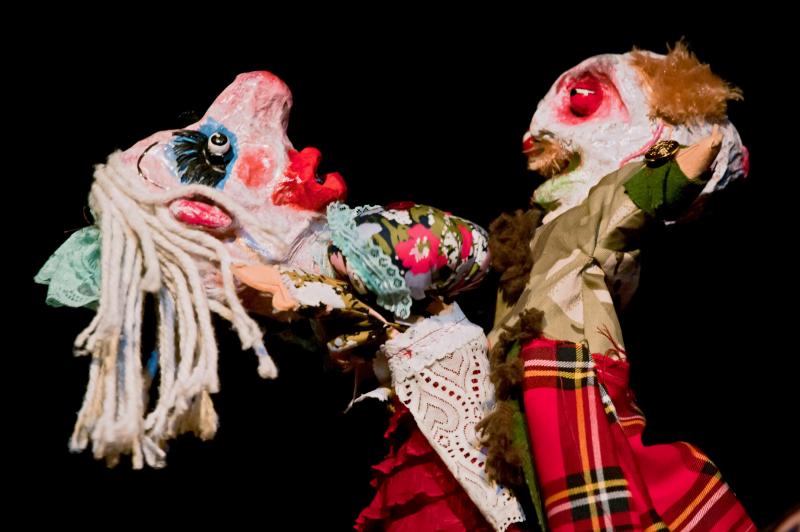
King Ubu and his wife
When Jarry first directed the play with actors, he had them in masks - useful for the student companies, who don't need a massive company, and relying on Jarry's language to reveal the interior emotions of his characters. Luckily, the script has the same disregard for realism as Shakespeare: the audience is let in on quite a few secrets, to the extent that the characters lack a subtext. What they are, what they are going to: it's all in the script.

Of course, that's not entirely true, and it's no fault: but Jarry is pretty clear about the meaning of the play. Ubu isn't a possible tragic hero, like Oedipus. He's a tyrant and a twat.

However... Jarry was a puppeteer, and after Ubu was a mask show, it was marionette theatre. Starting off as a student prank, Jarry managed to get it banned from the Parisian stage, and went off to do a puppet version.  And in the difference between the two iterations, an interesting aspect of the puppet is revealed.

Belusconi judges a beauty competition
There's a fascinating article that notes how Jarry - just ahead of the symbolists - used elements of puppetry within Ubu in a more folky and coarse manner. Their incompleteness, echoed in the use of the mask which prevents the nuance of emotion being expressed in facial expressions, was consciously evoked, allowing the audience to project onto them. It's like Woo's gorilla striptease all over again.

But I am more interested in the strings. At the moment, there is a version of Ubu that casts him as Mr Punch, an obvious avatar, and the point of Punch and the marionette is that they are manipulated by unseen hands. Actors, even in masks, perform the illusion of free will. Puppets are obviously not in control.

But wait: with actors, Ubu is all about how one man is driven by his self interest. It's a satire on the nature of power: not so much how it corrupts, but how the already corrupted chase and use it. Ubu is not so much a mere play, but a prediction of Berlusconi. In a sharp reverse of the usual reading of history as the story of great mean, Jarry's alternative universe has history as the story of assholes.

Put Ubu on a hand or strings, and he is not doing it. Something else is. Human agency is out the window, or hidden in the puppeteer's booth.

If Ubu isn't doing it himself, who is behind it all? The absurd universe gets more hostile.


Wednesday, 16 January 2013

Gayants get Banned.Twice.

These days, the parade of giant puppets at Douai in northern France is pretty much treated as an excuse to sell fancy food to tourists - it is said that any child who manages to plant a smacker on the cheek of the puppet will be less likely to suffer from eye problems, but there is not much of the uncanny about this annual tramp around the town. Yet the parade in rooted in a particular political celebration - a victory over the French, when Douai was part of Belgium in 1530 - when the basket makers guild designed a float (the gayant) to rove about the town.

By 1815, when Napoleon was finally removed from power, the adventures of the puppets, more or less came to end: the parade was reinstated after a period of suppression and it was able to settle into the tradition that has led to today's pageant. Yet in the previous three hundred years, when Douai played the political football in the various squabbles for land and revolutions, the gayant, and his wife, would be variously banned and reintroduced.

Histories of radical puppetry - usually written by activists who have a clear agenda to enlist the puppet as an ally of their revolution - point to the banning of puppet shows, whether by the Lord Mayor of London during Cromwell's era, or the government of Saxony in 1793, as evidence that puppetry is a subversive force. While this sometimes leads to the amusing sight of leftists justifying Mr Punch, wife-beater and murderer, for his representation of the everyman, it also simplifies the aesthetic complexity of the puppet into a bland tool for protest. 

A quick sketch of the gayant's status tells a different story. First of all, these giant puppets were not introduced as a sardonic comment on the socio-economic strictures of the sixteenth century: they were supported by the town's government, and fixed the recent victory against the French into the annual calendar. The guild, an early version of a closed shop, and very much an articulation of a professional class, made the puppets, doubtless to show off their skills in the weaving. It's a gung-ho symbol that doubles as a moving advertising hoarding.

The first ban of the gayants was not until 1667, when France conquered Douai. Obvious really: the town didn't need to be reminded of its heroic past fighting the nation it was now part of. The puppets would have been subversive, but only representing one military organisation against another. 

Over a hundred years later, the parade was revived, in 1780. Perhaps by this time, the original meaning of the parade had been forgotten, or the French weren't too upset about ancient history. Admittedly, only nine years later, the French monarchy was toppled, which makes conspiracy theory sense enough to link the return of the puppets to revolutionary action. 

That would work, in a completely irrational manner, if the revolutionary government hadn't banned the parade again. 

Now, the first ban, in 1667, was allegedly because it was "too profane." There were all these devils and dragons stomping about. Sure, that might have been a cover for the political agenda, but it's telling that a religious justification was used.

Then, the revolutionary ban was enforced because the parade was too religious, and had heroic aristocrats. Maybe religious sensibilities had shifted, so that something seen as heretical in 1667 could be seen as pious in 1789, or the actual form of the parade had changed (arguing against the continuity of the parade's content). Either way, a parade of heroic aristocrats isn't the greatest egalitarian protest march.