Last night, I found myself embroiled in a vigorous discussion with a puppeteer about "suspension of disbelief." I firmly believe that this is an unhelpful way to describe an audience's response to performance. We'd just been watching Neville Tranter's puppet Hitler, and suspending disbelief would have meant thinking that Hitler and his crazy pals were in front of us. Tranter might have lent his puppets some degree of humanity - certainly, against the ranting anti-christ in Downfall, this Hitler was almost human - but I hope that should I ever believe that the most notorious mass-murderer of the twentieth century is standing in front of me, I'll do a little more than applaud him after ninety minutes.
Suspension of disbelief seems very demanding: how do I switch off my natural inclination to believe or disbelieve? Is it the performer's responsibility to suspend my belief, or do I need to do a spot of yoga before the show to make me gullible? And even more worrying - I don't think suspending disbelief is a good thing. Sure. Mr Cameron, let me suspend my disbelief in your willingness to help the socially excluded. I'll believe every word you say, Mr Obama. I didn't actually see you in bed with my best friend, lover with a track record of infidelity.
After a week of manipulate, I am still scrambling around for something to replace this idea. I came up with the suggestion that the magic of theatre resides in the audience's ability to see two things at the same time: the literal presence (say, of a man with his hand up a Hitler puppet's back) and the suggested presence (the man is Hitler's servant, and this is the speech Adolf made in the bunker). I never lose either perspective.
I have experienced moments in which I have believed a performance to be literally real. There was that time during Audience when the actor abused an audience member. I thought it was not a plant, and I threw my shoe at the stage.
Then there was that time when I was frightened of The Tiger Lilies. They had sung a song about crucifying Jesus for a laugh, and I really did think they were that evil. Seeing the band in the bar after I show, I ran away in a miasma of fear.
Those were pretty intense moments. Having experienced it twice in ten years of theatre, however, suggests that if the success of a show depends on it, there's very little art that is going to work.
However, once this is replaced by the idea of bisociation, success becomes easier. Inevitably, the big concept I thought was going to be my contribution to critical theory had already been described. And, inevitably, it comes from a writer on the fringes of respectable academic philosophy. Arthur Koestler defined bisociation to explain how the human mind can hold two contrasting ideas about the same thing at the same time.
I discovered his definition in a book about conspiracy thinking. Oh, my impeccable sources.
Back to puppet Hitler - or the Live Art influenced work in progress by Sarah Hopfinger during Buzzcut@manipulate - the viewer's ability to read each moment in two ways ought to account for the power of their presence. Does a double perception of an image mean that twice as much information is being taken in?
And does a piece like Paper Cinema's Odyssey, which deliberately shows its workings and it surface, use bisociation to make tears come to my eyes?
Showing posts with label half-arsed theories. Show all posts
Showing posts with label half-arsed theories. Show all posts
Sunday, 10 February 2013

Thursday, 13 September 2012
Self Indulgent Meditation Part 47
I might have a habit of spamming Facebook everytime I write a new entry, but more personal entries like this tend to be set to one side. I don't think they are interesting enough to boast about - the point of the blog is to alert potential audiences to stuff I think is cool, and my egotistical musings are more of a side-bar. Unfortunately, I do feel the need to add the odd meditation on my beliefs and intentions.
Hopefully, these interludes make sense of my idiosyncratic attitude to criticism. For the record, I call it Radical Subjectivity, which refuses the hope of an objective opinion and highlights the writer's own experience to give context to the review. I throw out the odd straight review, even here, because I want to prove I can still write them. And yes, I am looking for work.
I have a fundamental belief that everytime anyone goes to the theatre, the world becomes a marginally better place. That is because I believe that being part of an audience, and having a shared experience, and being presented with a version of reality, is an intrinsic good. This also applies to art galleries, film showings, music gigs, anything where the artist dictates the location and time. Community performance is probably even better, but I am still grappling with that.
Combined with this blog's need to be fed (I can't keep the big readership without constant up-dating. That is the way of the web), I am willing to write about as much performance as press agents can provide. Within that, there are plays I can get very enthusiastic about, and others I am less inclined to push.
This is a matter of personal taste. I don't want to become a shrill side-show barker, supporting all of Scotland's theatre indiscriminately. Equally, I don't want to just bang on about experimental physical theatre and ignore anything more mainstream. Just because I am pretentious doesn't mean that there is a true hierarchy of art.
I am hoping that posts like this one put my choices in context, and make it clearer why I favour certain artistic endeavours. I am trying to find a way to allow the reader to react to my opinion, and be aware of how I make them.
One trick I am trying is to insult myself. If a flame war begins, I have said far worse about myself.
Sunday, 9 October 2011
The Big Lie, By Mr Criticulous
Okay, cards on the table time. I don’t believe in the Financial Crisis. Economic theory is like natural selection: I am sure it happens but I can’t explain it. I get my political information from the News In Briefs column in The Sun, and I am not going to trust Sam from Shoreditch, 25, when she tells that David Cameron’s understanding of the Big Society reminds her of Plato’s myth of Er.
I did do some Latin once upon a time and remember one phrase: cui bono? It’s the only question to ask and translates as – what bastard gains from this bullshit? The Financial Crisis seems to be plenty bueno for politicians who fancy making cuts to the arts and benefits, or privatising education. So forgive me my cynicism. The FC is BS.
The way that this Big Lie impacts on me is that theatre companies and visual artists are shitting their pants. Artistic types are prone to melodrama and holidays in other people’s misery: there’s plenty of otherwise creative, intelligent types who still think gritty is a synonym for realism.
Now, I love the arts, and I am prone to a spot of melodrama myself. I’ve dedicated the past five years to it, throwing away a promising career in boring school-children to make an eclectic radio show that celebrates music, dance and culture. But there have been moments – like that month of zero income and I hadn’t eaten for three days, and went to see a show that used hunger as a metaphor for social insecurity – when I want to eat the actor.
My gripe about artists aside, let’s get back to the pant-shitting. The catch-phrase of the artist is that the cuts we are seeing now in state funding are only the start. “Mark my words,” they say, and grimly rub their hands together. “This is only the start.” They are, at least, socially conscious enough to acknowledge that the parallel cuts in the Health Service are worse.
However, as a Platonist and a critic, I am fascinated by the power of illusion. If I wanted to convince the world that there was indeed a sudden shortage of money, I’d start off by cutting the funding of the arts, quickly followed by education. My cursory knowledge of Shelley dredges up something about artists as the unacknowledged legislators of mankind, an idea that I have clung to as my career ship in criticism has sunk below the waves of debt. I reason that art is so important that the writer, in their role of companion, advocator and supportive critic, is part of a cycle that contributes to human development. The artists help to shape the world. In my fantasy, where I am trying to make the world believe that there is no money left for them after I bought my second house in the Scottish Highlands, I’d take all the money away from the artists and make them struggle. I know enough about artists to know their art reflects their life.
And so it works a treat. Plays are written about the economic downtown. Conceptualists grapple with intellectual poverty. Of course, it doesn’t translate into mass panic – too few people really engage with the arts – but the people who do fancy a nice night out at the theatre or an opening at The Market Gallery are plunged into the creative expression of financial despair. If these are the people who make TV shows, participate in democracy, hold together management structures: well, it’s enough to have them worry. They then pass that worry on, through their work, at their dinner parties.
Pretty soon, we’ll all start to believe it. But a democratic government would never deliberately do something like that, would it? Never slash state funding of the arts simply to ensure an intellectual pessimism that would be eloquently expressed by those who dedicate their lives to creativity and communication? And there aren’t loads of plays about how bad the world is, are there?
Monday, 26 September 2011
Coming Soon: David Hughes and Last Orders
"I feel the company has an openness to the distortions and corruptions of dance to creative ends."
Alex Rigg, performer and poster boy for Last Orders
When David Hughes Dance hit the Traverse with The Red Room at Fringe 2009, the enthusiasm of the critics was contagious. Not only did he recruit the dark lord of clowning, Al Seed, he presented a version of The Masque of the Red Death that incorporated Indian dance, a disorientating light scheme and even a joke about ballet at the French court. Perhaps taking his cue from continental companies like Les Ballet C de la B, Hughes recruited a diverse cast, and placed their technical skill and traditions at the service of Seed's fiendish vision.
Come 2011, and expectations were running high for the "sequel": Al Seed taking on the legend of Sawney Bean, Scotland's most famous cannibal. Yet the result divided critics. Some delighted in the savagery of Seed's vision; others attacked it as predictable and distasteful. It was even accused of bulletin boards of "not being theatre" - an accolade usually afforded to the most challenging work that settles down in subsequent years to become an establishment favourite, like The Rite of Spring.
Hughes' career has included time in Ballet Rambert - when, under choreographer Christopher Bruce, they were are their creative peak - and DV8, who were crucial during the introduction of physical theatre to wider audiences. His subsequent work has included solo pieces from some of the UK's finest choreographers - especially the challenging Bruce's Hurricane, set to the music of Bob Dylan and retelling the story of the unjustly imprisoned boxer in a powerfully mimetic style.
Yet unlike many other companies - including Rambert, who have remained stuck in ballet-based technique - David Hughes Dance have followed up on the promise of freedom within "contemporary" choreography. While much so-called contemporary dance is ballet with a few ungainly additions, DHD reached out to other forms. The Red Room was an expression of confident mutation: Last Orders has taken that confidence further. Refusing to tame Bean's story for the stage, it has been accused of reveling in ugliness.
Of course, that is entirely appropriate for the story that Last Orders tells.That the show has met such harsh criticism does not reflect so much on the quality - no-one suggests that the company can't hack it - but the challenges made to the accepted ideas of what dance ought to cover. It's also a question of taste...
Alex Rigg, performer and poster boy for Last Orders
When David Hughes Dance hit the Traverse with The Red Room at Fringe 2009, the enthusiasm of the critics was contagious. Not only did he recruit the dark lord of clowning, Al Seed, he presented a version of The Masque of the Red Death that incorporated Indian dance, a disorientating light scheme and even a joke about ballet at the French court. Perhaps taking his cue from continental companies like Les Ballet C de la B, Hughes recruited a diverse cast, and placed their technical skill and traditions at the service of Seed's fiendish vision.
Come 2011, and expectations were running high for the "sequel": Al Seed taking on the legend of Sawney Bean, Scotland's most famous cannibal. Yet the result divided critics. Some delighted in the savagery of Seed's vision; others attacked it as predictable and distasteful. It was even accused of bulletin boards of "not being theatre" - an accolade usually afforded to the most challenging work that settles down in subsequent years to become an establishment favourite, like The Rite of Spring.
Hughes' career has included time in Ballet Rambert - when, under choreographer Christopher Bruce, they were are their creative peak - and DV8, who were crucial during the introduction of physical theatre to wider audiences. His subsequent work has included solo pieces from some of the UK's finest choreographers - especially the challenging Bruce's Hurricane, set to the music of Bob Dylan and retelling the story of the unjustly imprisoned boxer in a powerfully mimetic style.
Yet unlike many other companies - including Rambert, who have remained stuck in ballet-based technique - David Hughes Dance have followed up on the promise of freedom within "contemporary" choreography. While much so-called contemporary dance is ballet with a few ungainly additions, DHD reached out to other forms. The Red Room was an expression of confident mutation: Last Orders has taken that confidence further. Refusing to tame Bean's story for the stage, it has been accused of reveling in ugliness.
Of course, that is entirely appropriate for the story that Last Orders tells.That the show has met such harsh criticism does not reflect so much on the quality - no-one suggests that the company can't hack it - but the challenges made to the accepted ideas of what dance ought to cover. It's also a question of taste...
Friday, 1 July 2011
The Journey into Striptease: Part 1
 Back when they used to let me near children, and I was a happy Latin teacher, feminism was going through a strange time. Young women, who had high aspirations for their careers, and who would frequently demonstrate how little they needed a man, would frequently launch into anti-feminist rants. Meanwhile, the English Department were teaching “feminist criticism” as part of the advanced English curriculum – trite readings of texts according to some kind of objective, pro-female stance. It became obvious that feminism was being associated with this peculiar simplification and detached from its historical roots. Not only did this ignore the diversity of the feminist traditions, disconnect it from the campaigns towards political, financial and social equality and reduce it to a predictable narrative, it associated feminism with the pointless cod-academia of contemporary education. Effectively, its teeth were being pulled.
Fortunately, LadyFest was still a dynamic movement, and a quick trip to see Brat Mobile or Le Tigre could introduce another, vibrant feminism.
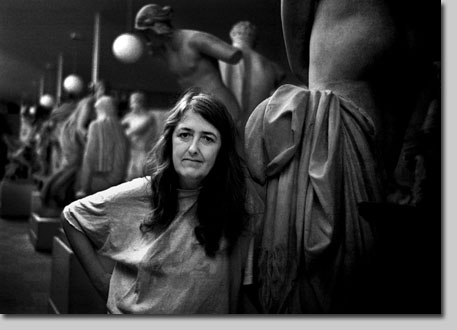
Further back, when I was toiling in the declensions and conjugations of Ancient Greek, feminism was having a splendid internal battle. Easily distracted from the hard work of learning my endings, I delighted in the fierce polemics of Mary Beard and Germaine Greer. I even did my dissertation on Medea as a heroine. In the real world – or at least in the broadsheets and culture shows – Camille Paglia and Andrea Dworkin squared up to claim the legacy of the Second Wave feminists. Paglia was all about sex, excitement and bravado, frequently hanging out with drag queens, strippers and Italian macho men. Dworkin was teaming with Catherine MacKinnon and drafting laws against pornography.
In an article from that period, Kathy Acker suggested that feminism had once been about the women’s right to say yes or no. Those two answers, she worried, had evolved into two separate and competing strands.

It was exciting.
The period between had been complex. Until a few years ago, many former leftists bemoaned the political shifts of the twenty-first century, feeling almost nostalgic for the dualisms of the 1980s, when Thatcher and Apartheid were Bad and the miners and Sandanistas were good. Happily ignoring the arms-dealers and New Labour’s superb corruption of the socialist ideal, they made their compromises with the state. Going into education, arts administration or finally getting that grant for their theatre company removed their teeth. You can spot them today: they are the ones who think that Labour are better than the Conservatives. Well, I admire their faith like I admire fundamentalist Christians. I am sure it is a consolation to them.
 The transition from feminism as the radical response to an obvious patriarchal society towards a media misrepresentation of lesbian man-haters (something it hasn’t been since 1974) was being completed. I woke up in 2005, roughly the time that I kicked the education habit and starting mainlining performance art, and found that burlesque and striptease were acceptable entertainment. While I remember reading in Goddesses, Whores, Wives and Slaves that the advance of women’s rights in Greece was accompanied by more explicit representations of tits and arse in art, I wasn’t sure whether this was okay. The last time I had looked, striptease was shoved into Soho alley-ways, and was likely to involve getting threatened for your credit card by a burly bouncer. Suddenly, I could go and see women disrobe before an audience of enthusiastic women. I didn’t even have to be ironic.
 Of course I decided to make cabaret part of my performance portfolio of interests.
Subscribe to:
Posts
(
Atom
)