Showing posts with label Vox Motus. Show all posts

Monday, 24 March 2014

Vox Motus talk silent Dragons...

Dragon was a massive hit for Vox Motus and the NTS in 2013. It's still touring too: the magic of physical theatre is that there is no need for a translation. I managed to chat with the director, Candice Edmunds, who not only interpreted Oliver Emanuel's script that saved the companies a bunch of cash, but was warmly received by the critics and young people. Here's the full transcript...

Every Vox Motus show seems to introduce a new set of techniques! What do you have lined up for the one?

Dragon is a story told without words so it has been a great excuse to really go to town on our visual techniques. I hope it's a show that keeps surprising you with new ideas. Puppetry is very central to the story. Likewise what I hope are our trademark inventive choreographic sequences. The original music for this show - by composer Tim Phillips - is also fundamental to the storytelling. He has written a beautiful epic score to help us tell our story.


How did you involve a fellow southsider, Oliver Emanuel on script duties - and given the nature of this performance, where does a script writer come into the process?

The very first step on the journey of this production was to engage the right writer. We knew we wanted a detailed, nuanced story but no dialogue. And that is exactly what Oliver Emanuel has delivered. He has also brought a great deal of his own personal experiences to Dragon.

The script does not look like a traditional script, but it feels like it has been written just for Jamie and I.
Oliver found a language and style that really helped fire our imaginations and managed to commit that to paper. It's been a very rewarding collaboration and a very unique process.

And finally - the show is aged at nine plus, putting it in that difficult all ages category. Is this a show that will work for adults as well as teenagers, or are you aiming for a younger audience?

'Nine plus' is simply an indication that there are dark themes within the work that an audience any younger might find distressing. It is by no means prescriptive. Our protagonist, Tommy, is a young teenager, and this is a story about his experience of the world. We have found that the slick, visual style of Vox Motus' work has always appealed to teenagers and adults alike. Dragon is really an opportunity to widen our audience, not limit it.

Friday, 1 February 2013

Puppetry is Dead...

Although I have had plenty of art-crushes in my life, I have had far fewer philosophy crushes. Generally, old  philosophers, like Plato or Nietzsche, have managed to express ideas that inspired me alongside the sort of gender politics that would make Jim Davidson blush. Fortunately, I haven't managed to delve into the biography of John Bell too far, and I think he is my current "philosophy of puppetry" crush.

Apart from having an obvious love of puppetry that comes through even in his most academic texts, Bell is unafraid of offering  big answers. Death and Performing Objects, which is where I first fell for his mind, looks at the history of puppetry and concludes that it is fundamentally a spiritual process. Once a member of Bread and Puppet Theatre, and currently holding a post named after a Jesuit, Bell chases after the essence of puppetry, concluding that it has been used within ritual thanks to the specific qualities of the materials used in its creation.

Death and Performing Objects has the bold energy of popular criticism rather than the precise detail of the academic essay: kicking off by establishing the dualism between the living and the inert (and noticing how life itself comes from non-living matter), he sees inspiration for the arts coming from performers' willingness to look towards death. 


Citing both Heinrich von Kleist's 1810 On the Marionette Theater and Edward Gordon Craig's 1906 The Actor and the Ubermarionnete, Bell separates object manipulation from both scripted and physical theatre by emphasising how the object can replace the human presence (he quotes Craig's sardonic "the body of man is by nature utterly useless as a material for an art"). He then promotes an alternative: the 'elevated prop' can work together with the actor to offer a more comprehensive representation of reality, one where the profound question of live against death is implicit in the very fabric of the performance.


Like McLuhan's declaration that the medium is the message, object manipulation draws attention to the function of art by its format. Vox Motus' Slick has human heads atop puppet bodies, mirroring the slapstick humour of the script in the actor's (suddenly diminished) presence. Paper Cut surrounds Yael Rasooly with fragments of the magazines that maintain her character's rich fantasy life. And Cloud Eye Control explore the contemporary interface between human and technology on a stage set by projections and software. 


Bell insists that there is a difference between actors' theatre which "can talk about death and show death with living bodies pretending to be dead" and object theatre: "When puppeteers, maskers, object performers, political demonstrators, machine operators, web site designers, film directors, multi-media producers, and advertising agencies work, they constantly create and modify relationships between living human beings and dead matter: wood, stone, metal, plastic, leather, bone. This makes for a profound reckoning with death on a constant subconscious or symbolic level."

The drama of Bell's essay is that he presents an essentialist vision of object theatre, before linking the idea back to its history. He's good on the global history too - Mongolian rituals bash heads with more contemporary experiments, and there is a generosity in his inclusive analysis. That uncanny moment of recognition, the magic of the puppet, is given a grounding in its very material. And even better, he offers a possible appreciation of the purpose of art that can be seen as consistent across time and place.


Monday, 16 January 2012

Vox Motus' Magical Theatre

In the past, I have struggled with Vox Motus' plays. There is no question that they have been one of Scotland's most innovative companies: they use the stage set as if it is an extra character, bridge a gap between the old proscenium arch and more intimate spaces, commission some great music (Zoey Van Goey's Michael John McCarthy turned up in their Not So Fatal Death of Grandpa Fredo) and are constantly learning new skills - especially puppetry. They are populist, immediate and hilarious and, inevitably, this pretentious critic was left demanding more.

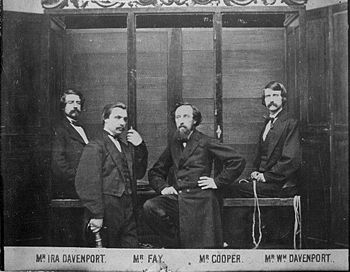
However, for their latest show, The Infamous Brothers Davenport goes some way towards shutting my stupid mouth. Enlisting Peter Arnott on script duties, they are teaming up with a playwright known for his engaged, intelligent and political writing (he was part of Wildcat's legendary line up, when satire still hoped to make theatre impact on society). And while past Vox Motus works have been been undermined by poor scripting -Bright Black was the victim of a faux-classical poetry - the Arnott alliance hints at a new potential.


While they were in rehearsal for Bros Davenport, I bothered the company - and they generously supplied answers to my questions.


Vox Motus has a reputation amazing use of theatre's architecture, diverse techniques and playing with theatrical tropes, but how did you get involved with Peter Arnott?
We had begun a partner project with Playwrights Studio Scotland to bring new playwriting voices into our process. Peter was the perfect collaborator for this project as he's a theatrical wordsmith with a real ability to conjour the period through his text and dialogue." He's also a real team player and that is key for any level of involvement in a Vox Motus production. We're a very collaborative bunch. I think Peter's really helped us to tell a dark, compelling tale of two brothers in conflict woven around acts of illusion and Vox Motus theatricality.


Where did your interest in the "magic" of the 19th century come from? 
Jamie has worked as a magician since he was a teenager. It's a job that taken him all over the world. Nowadays his focus is on illusion for theatre (e.g. creating the flying flame Tinkerbell for NTS's Peter Pan). So we're often reading about magic and illusionists. The 19th century really was the golden era for magic - and indeed the manifestation of spirits and spiritualism.

Is this a period piece, or does it have an immediate contemporary resonance?
Surely every period piece should have an immediate contemporary resonance - otherwise why are we telling this modern audience this story? We are interested in a gripping, human story rather than a history lesson. The 1860's is framing for this piece - a time and space in which we understand spiritualism was finding its voice and magic was celebrated across the western world. Regardless, communication with spirits is still very much a part of many people's lives today. It's a means of offering hope and that is a universal need and quest.

Vox is known for adding to its repertoire of theatrical techniques with each production - as well using some great music. 
We are definitely using some great music! We have commissioned musician and composer Phamie Gow, who is performing her original soundtrack live alongside the production. It's not every day you work with a musician who has performed at Carnegie Hall, NYC, at the request of Philip Glass. She has just spent a period in the States (where the Davenport Brothers came from) and there is a beautiful American sensibility to her composition.


Is there anything new that you have added for this production? Or anything familiar from past shows?
I think another exciting prospect is that a small number of audience members will be able to opt in to taking part in the Brothers' seance. It's going to be a very immediate experience for the audience - and the actors who are taking them on this journey.