Showing posts with label Film. Show all posts

Tuesday, 11 July 2017

Night of the Living Dramaturgy: Ben Singer @ Edfringe 2017


Modern Robot presents 


Alive: Music for Night of the Living Dead – 

a live screening that will get under the skin

 of the audience. 

Featuring the silent film 

Night of the Living Dead, 

accompanied by a brand-new score performed 

live, each night of the festival, in ZOO’s 

atmospheric church sanctuary.


What was the inspiration for this performance?


In Modern Robot, I take existing film material and compose music to it. When I saw Night of the
Living Dead
, its potential was immediately clear. It is a widely known film, but re-watching it tends to surprise both fans and newcomers. Especially with editing, the film is more character driven than gory, and more human than zombie. It brings up questions about the time, about the filmmakers, about our own time, about racism, and puts it all in a good story.

Is performance still a good space for the public discussion of ideas?

I believe that performance can inspire self-reflection and private discussion. I have misgivings about the public discussion of ideas, both past and present.


How did you become interested in making performance?

I cannot remember a time I have not been interested in performance. My parents were musicians and performers, and my older sisters in music and dance, so it was always a part of our lives. It's an interesting question, but I have no answer!


Is there any particular approach to the making of the show?

I break it down into approachable steps. To fit the production, I needed to edit "Night of the Living Dead" from 96 minutes to 60 minutes. In my first pass, I may have cut 15-20 minutes. The second, another 10 minutes; the third, another couple minutes. In this editing, I begin to understand the movie and its details.

The music begins with an inspired evening or two, creating a handful of themes, and from there, I sit with the edit and the themes to piece the two together. In this case, it was almost a year between the first themes and the first performance.

I have a roadmap at the time of the show, but being a duo allows me to be flexible in performance. Some of the best themes have come from veering off into improvisation, and I consider this part of making the show too. I record every performance and continue to the revise both the music and editing.


Does the show fit with your usual productions?

It does, but it's also a nice extension of my previous shows. My last production at Edinburgh Fringe was a score to the 1926 film "Faust". It was my original music, performed on electric guitar and drums. I wrote music that spoke to me, not in a 1920's style, and  made careful but significant edits to the film. 

All this is the same for "Alive: Music for Night of the Living Dead", but in this case, it's not a silent film. The dialog is still part of the movie, and the experience is one of a "talkie". I had to carefully work with the dialog to keep it clear.


What do you hope that the audience will experience?

I would like the audience to be pulled into the story, and to feel it. There's something about using unfamiliar or anachronistic ingredients that compels me, and my hope is the experience is thoughtful.


What strategies did you consider towards shaping this audience experience?

Bringing it back to the first question, my main strategy is the choice of film. Finding that piece of material, whether it is a silent film, an old home movie, an industrial or marketing film, it's like a road trip. I don't know what I'll find, but I'll know it when I see it.

Saturday, 26 March 2016

Thoughts on Bats and Supes

Craig Neilson-Adams asked why the Batman versus Superman film has fared so badly in review - using the Rotten Tomatoes site as evidence. In contrast to comments by no-critics, he notes, the film has been consistently panned by 'professional' critics.


He suggests that this may be the result of a small sample group of critics - although a small group provides a reason to dismiss findings rather than accounting for its figures - or the 'burden of preconception' -  many of those who have been involved in film writing receive so much preview material that an unattainable expectation of quality emerges. He also considered, in a Facebook status, the problems of comparison between The Avengers franchise, which created a standard and style for films about superheroes.

I reject two of these ideas: the small sample is inevitable, since the parameters are 'professional critic' deliberately limit the number of eligible comments in order to privilege certain characteristics of form; the burden of preconception weighs on everybody. The comparison question, which I addressed in a response to his earlier thoughts does strike me as the post-persuasive, because the criticism-as-comparison has a long history of causing bias.

However, the statistics remain. Leaving aside the possibility that critics have better analytic skills for the moment, this disparity between popular and critical reception feels important.

For that matter, Neilson-Adams' article feels important, questioning the authority, and even the value, of 'professional criticism.

Fortunately, professional critics do not have to be 'right' to be 'useful'. As long as criticism is a guide to discussion, and not some kind of absolute judgement on art, it does not have to represent a 'right' answer (in this case, let's call 'right' a shared assessment with the populist opinion). It becomes a challenge, a specific position in a lattice of opinions: a provocation to dialectic.  

It's worth considering what shapes a critic's perspective though.


Monday, 15 June 2015

THE CLOSER WE GET

“A beautifully rendered and ultimately heart-breaking reminder that there is no such thing as an ordinary life.” Alison Rowat THE HERALD

Winner of International Documentary Award - HOTDOCS 2015
Directed by Karen Guthrie

In UK Cinemas September 2015


This is a powerful and bittersweet portrait of loyalty, broken dreams and redemption told by its director, reluctantly-dutiful daughter Karen, who takes you under the skin of the household she returns to for this long goodbye.

Karen’s mother Ann suffers a devastating stroke that brings her daughter back home. But Karen isn’t the only one who comes back to help care for Ann in the crisis: Her prodigal father - the endearing yet unfathomable Ian, who’s been separated from Ann for years - also reappears. 

Reunited so unexpectedly, and armed with her camera, Karen seizes this last chance to go under the skin of the family story before it’s too late, to come to terms with the aftermath of the secret her father had tried - and failed - to keep from them all, and to find that Ann’s stroke has in fact thrown them all a life raft.

With candour, warmth and much unexpected humour, Karen’s role as family confidante, busybody, therapist and spy brings to life both an extraordinary story and a profound portrait of family survival.


Karen was raised on the West coast of Scotland and now lives on a smallholding in the rural Lake District (North West England). She met co-producer and Director of Photography Nina Pope whilst students at Edinburgh College of Art and they have since worked together on many creative projects and commissions, winning the first Northern Art Prize in 2007 for their films and installations. 

Together they founded Somewhere in 2002 and have undertaken art commissions from the likes of Tate Modern and Cambridge University alongside their three feature documentaries:Jaywick Escapes (2012)
Living with the Tudors (2007)
Bata-ville: We Are Not Afraid of the Future (2005)

These have screened at many festivals including Edinburgh International Film Festival, SXSW & Sheffield Doc Fest. 

Alongside her films, Karen continues to work as an artist on diverse projects including a recent commission for Hauser & Wirth. Somerset. The Closer We Get is Karen’s solo directorial debut.

Sunday, 1 March 2015

Glasgow Film Festival announces winner of first-ever Audience Award, closing dates and 2015 admissions


As the 2015 Glasgow Film Festival comes to a close with the UK premiere of  Force Majeure, the organisers are delighted to announce the winner of their inaugural Audience Award, as well as 2015 admissions numbers, and the dates for 2016’s event. The directors of the festival paid tribute to the 2015 audience and described this year as their ‘best ever’.


AUDIENCE AWARD

The winner of GFF’s first-ever Audience Award was Radiator, a beautiful and moving low-budget British film created by writer/ first-time feature director Tom Browne, and shot in the Cumbrian house of his deceased parents. 

Radiator features a pair of astonishing, career-best performances from veteran British actors Richard Johnson and Gemma Jones as elderly hoarders Leonard and Maria. Johnson and Jones, with Browne, were among the visitors to the festival this year. 

The Audience Award was voted on by the GFF audience from a selection of ten films made by first or second-time directors. Over 1100 votes were cast. The Audience Award runner up was the documentary Tender, directed by Lynette Wallworth. Both Radiator and Tender are currently seeking distribution.

Radiator writer/director Tom Browne said:
‘Receiving the Audience Award has made us all terrifically happy - thank you! Radiator has an unfashionable theme and was made on a tiny budget. Unsurprisingly it is taking a while for the film to find a place within the film industry so to receive this award is very significant for Radiator's future. Richard, Gemma and I had a great time in Glasgow - we were treated so kindly and were touched by the engagement of the audiences evident in the Q and A sessions.’


Glasgow Film Festival Co-Director Allan Hunter said:

‘We've always known that our audience has the best taste and now they have proved that all over again. The GFF audience has
enthusiastically embraced the responsibility of picking their favourite film from a list of ten contenders and deciding the winner of the festival's first Audience Award. They couldn't have picked a more worthwhile winner than Radiator.

Tom Browne's deeply autobiographical film resonates across the generations as it deals with the dynamics of family relationships and the challenges we will all face in our final years. It is funny, touching and told with a fearless truth and beautifully judged performances from Gemma Jones, Daniel Cerquiera and the magnificent Richard Johnson. I only hope distributors will take encouragement from the public passion for Radiator and the Audience Award and bring the film to the wider audience it clearly deserves.’


AUDIENCE NUMBERS
Despite fielding 23 fewer events this year due to unavailability at long-term venue partner Cineworld, the festival has still managed to reach over 40,000 admissions for the second year in a row at time of going to press.  45% of the events in the programme sold out completely; 61% of screenings sold 75% of their tickets.


Glasgow Film Festival Co-Director Allison Gardner said:
‘This year might just have been the best Glasgow Film Festival ever. It’s certainly been the most fun I've ever had. From ballroom dancing to roller-skating, from coming together in rapt appreciation at classic festival films like Wild Tales or
Mommy, giving a standing ovation to legendary Scottish writer William McIlvanney, or queuing for tickets for the Internet Cat Video Festival, our audiences have been generous, committed, passionate and open-minded. 

And they’ve all got fabulous taste in fancy dress costumes, which we have asked them to wear in some form almost every night. We’re also absolutely delighted that we've broken 40,000 admissions for a second year running, despite working with a smaller programme. Thanks so much to our wonderful audience: you make all the hard work worth it.’


2016 DATES
Glasgow Film Festival 2016 will run from 17-28 February.


Thursday, 26 February 2015

FESTIVAL THEATRE ANNOUNCES LIVE SCREENINGS


OPERA SCREENING: CARMEN
Wed 15 July 2015, 8.30pm. Tickets £18.50

Live from the Ancient Theatre of Taormina in Sicily comes this stunning production of Carmen as part of the Festival Euro Mediterraneo. 

Each summer, the Teatro Antico in Taormina is home to the Taormina Arts festival. Since its construction in 7th century BC, audiences have feasted their eyes on the views of the Ionian Sea and Mount Etna that provide a dramatic backdrop for this stunning arena stage. 

Best known for his operas in a career cut short by his early death, Bizet achieved few successes before his final work, Carmen, which has become one of the most popular and frequently performed works in the entire opera repertoire. This event presents the opportunity to enjoy the classic opera on Scotland’s biggest cinema.

Monday, 6 October 2014

Document Festival

Tonight, on the Vile Arts Radio Hour, I run out of time. That explains why I start late and end early, and in between there are two interviews with the stars of Arches Live!

I had another entire interview to do...


However, I'll be putting that on mixcloud, and... lo and behold:


Thursday, 13 March 2014

BBC in GFT & CCA

The BBC has today announced details of a brand new arts documentary festival. Taking place as part of the Glasgow International Festival, Art Screen will showcase some of the world’s best arts documentary films and include highlights from the BBC archive.
 
Art Screen will showcase a wealth of arts documentaries in two of Glasgow’s renowned art spaces, the Glasgow Film Theatre and Centre for Contemporary Arts from the 10th-13th April 2014. The diverse four-day programme will include screenings of documentaries on art forms including visual arts, architecture, music and photography alongside accompanying events and discussions. Kirsty Wark and Tim Marlow will chair interviews and participate in panel discussions offering conversational sessions across the four day festival.
 
Art Screen will include Arts in the Archive, a strand dedicated to the many hours of extraordinary arts footage in the BBC’s own archive. Arts in the Archive, screening at the CCA, will provide access to many hours of rarely seen footage, from throughout the BBC’s history.
 
Art Screen is a national partnership created by the BBC and delivered in collaboration with Glasgow International, British Council, frieze, LUX, Glasgow Film, CCA and BFI. It is supported by Creative Scotland.
 
Jonty Claypole, Head of Arts for BBC Productions said: "The BBC is delighted to launch Art Screen, a place for audiences, artists and film makers alike to be inspired by a selection of some of the best arts documentaries from around the world. This is a unique collaboration that brings together a range of creative organisations from across the UK to curate and produce the first Art Screen programme."
 
With the full programme due to be revealed on 19th March 2014, organisers have today revealed a taster of what Art Screen will bring to the city. Highlights of the festival programme include two world premieres that will screen in Glasgow’s GFT.
 
Our Glasgow

One of the programme highlights, Our Glasgow, produced by frieze magazine co-editor Jennifer Higgie and part of their frieze Video strand, leads the celebrations of Glasgow as a unique hub of creativity. This screening will be followed by a discussion exploring the reasons for Glasgow’s extraordinary creative success.
 
Featuring a cross-section of local artists, writers and curators and exploring the evolution of Glasgow from industrial heartland to artistic centre; in Our Glasgow we visit studios, contemporary galleries and the famous Rennie Mackintosh designed Glasgow School of Art, a masterpiece of the Arts and Crafts Movement.  
 
Facing Up to Mackintosh

And in the week the new Reid Building at The Glasgow School of Art is officially opened Art Screen will show the world premiere of the BBC documentary Facing Up to Mackintosh, which charts the ultimate architectural challenge – how to design a building to sit opposite a Mackintosh masterpiece. 

The screening will be introduced by the film’s director, GSA graduate and BBC Scotland Director, Louise Lockwood,  and will be followed by a discussion which will explore the themes of the documentary.
 
Merging interviews with architects Steven Holl and Chris McVoy and footage of the design and build filmed over three years, Facing Up to Mackintosh also features the creative responses of four recent GSA Design graduates, and weaves their reactions into the body of the film. The Reid Building, designed in partnership with JM Architects of Glasgow, is Steven Holl Architects first ever building in the UK. 
 
Janet Archer, CEO of Creative Scotland commented: “We are delighted to support these events in collaboration with the BBC, British Council, frieze, Glasgow International, LUX, BFI, Glasgow Film and CCA.  It’s hugely exciting to be a part of this celebration.We are working to identify two key learning, collaboration and networking opportunities for the creative sector in Scotland to engage with the filmmaking and artistic talent present at Art Screen.”  
 
Christine Bardsley, Programme Manager - Film, from British Council said: “Our business is cultural relations and we are excited to be a partner in Art Screen. Film is the seventh art and a wonderful medium through which to celebrate the richness of the artistic landscape at home and abroad.”
 
Allison Gardner, Head of Cinemas at Glasgow Film Theatre, said: "We're delighted to be partnering with
the BBC on this unique arts documentary celebration. GFT has been leading the way in specialised cinema since 1974. This year we are celebrating three anniversaries; 10 years of Glasgow Film Festival, 40 years of GFT and 75 years of a cinema on our Rose Street site. We continue to expand and diversify for audiences and Art Screen is a fantastic way of bringing new arts documentaries to our audience."
 
Ainslie Roddick from CCA Glasgow, said: “The curators of Art Screen have put together a brilliant programme of events, allowing us the chance to watch and discuss some of the most remarkable artist documentaries and revisit pivotal moments in visual culture. As well as talks and screenings, CCA and Saramago Cafe Bar will be hosting special guest DJs each night in the cafe, and visuals from Glasgow artist Torsten Lauschmann. It's a great opportunity to uncover some provocative footage and a great addition to the city's arts programme."
 
Sarah McCrory, Director of Glasgow International said: “Art Screen is a unique and exciting partnership project and is a fantastic addition to 2014’s Glasgow International programme.  Art Screen will allow artists and their work to be seen from an alternative perspective, through the medium of the arts documentary, and will contribute to Glasgow’s renown as a place of great creative endeavour.”
 
Jennifer Higgie, Co-Editor, frieze said: “frieze magazine has been exploring the medium of video for over a year with a variety of formats and approaches. For Art Screen we have developed on an earlier strand of city reports from around the world and produced a documentary exploring the past and present of the lively Glasgow art scene. We are honoured to be included in Art Screen, and applaud this great and much-needed initiative to highlight contemporary documentaries focusing on the wealth of art and design produced in the UK.”
 
Benjamin Cook, Director of LUX said: “LUX is very excited to be partnering on Art Screen and showcasing our Artists in the Archive collaboration with BBC Arts as part of the weekend.”
 
Marcus Prince, BFI television programmer said: “The BFI is pleased to be involved in helping to make some of its great collection of BBC Arts programmes accessible to audiences through the Art Screen festival. The BFI National Archive collection is one of the world’s largest and most important, and we are pleased to be working with Art Screen to bring some of these great treasures to the screen.”


Sunday, 20 January 2013

Wonder Women @ GFF

Despite its title, Wonder Women! The Untold Story of American Superheroines is not an analysis of women in comic books but a broad study of how action women have been marginalised in American media for the past half century. Beginning with a look at Wonder Woman's origins - skating over her creator's serious bondage fixation - it expands its focus to include the resurgence of heroines in popular media in the past twenty years, taking in television, film and, movingly, a youth workshop for young female film-makers.

Intelligent commentary from Kathleen Hanna, Gloria Steinem, Trina Robbins and other cultural critics is interspersed with a history of the heroines. Sadly, the sections on comics are the weakest: rather than address the rise of superheroines in the 1970s (a glance at Valkyrie from Marvel would have seen how clumsy but endearing their attempt to develop a feminist hero was, while Ms Marvel was partially based on Gloria Steinem, if her profession is any guide), it dwells on Wonder Woman in detail and mistakes an interlude of bad reinvention for an anti-feminist coup. Yet the message is loud and clear: strong women are under-represented in fantasy, and there remains a severe shortage of female creators.

Using the superheroine as a trope, Wonder Women is a satisfying primer for the ways in which feminism has engaged with the media. Kathleen Hanna is especially trenchant, reflecting on how the paucity of images has led to any signs of support be grasped hopefully and how her own revolution was quickly co-opted by the mainstream. Xena and Buffy are placed in a social context, and the hopes of second wave feminists are located alongside a media that has preferred objectification of women.

There is a lack of aesthetic analysis  - showing the panels that led to the Women in the Refrigerator controversy without mentioning it, or not picking up on the phallic symbolism of Xena's death Saint Sebastian style seem wasted opportunities - but this is par for a documentary that considers art in a social context. A primer on American feminism that holds up Wonder Woman as an icon rather than the definitive word on any of the topics it touches, Wonder Women provides plenty of material for serious discussion and is brave enough not to flinch at the ideals of feminism.

Monday 18 February 2013
CCA (part of Glasgow Film Festival)

Thursday, 17 January 2013

Film Theatre at the Edinburgh Festival Theatre

There's a natural defensiveness in my response to the news that the Edinburgh Festival Theatre is screening a series of live operas and ballets in February: although the live transmission of a performance has become commonplace, there is still a sense that it is neither film nor theatre, but an over-priced and clumsy combination. The thrill of the intimacy and immediacy of theatre is dulled by the screen, and the polish of the film is threatened by the vagaries of the live show.

Having said that, certain pieces are enhanced by the big screen: dance has been successful in the 3D format (Bausch, Wim Wender's tribute to the goddess of German Dance Theatre brought the audience right into the thick of her Rite of Spring and Matthew Bourne's Swan Lake gains an intimacy, ironically, by being blown up to a bigger size). And, frankly, there's little chance of my visiting La Scala to see Roland Petit's Notre Dame de Paris in the near future. A satellite link and a HD screen are my best bet.

Unlike comic book author Alan Moore, who doesn't regard cinema as being all that (comic book authors might be a little sensitive about who gets called "high art" but the state of the current blockbuster industry does support his complaint), I am enthusiastic about cinema - I am currently trawling through the Glasgow Film Festival Brochure in hope of deciding whether I want to follow the James Cagney season of fight for Joss Weedon's Much Ado About Nothing. Part of a generation that learnt about international cinema due to staying up late to watch Channel 4 in hope of some naughty bits, I don't just see it as a parasitic art that devours talented actors from the stage and diminishes the complexity of human existence by replacing recognisable body shapes with a minimal range of glamorous cyphers.

That said, the context of theatre and cinema are very different. Going to the cinema involves eating large amounts of junk food - which compensate for the scripts which would be laughed out of the theatre - sitting behind a two year old child who decides to bellow throughout and not hanging about afterwards. It also connects me to a far larger audience, a more common experience and is cheaper and more comfortable than a night at the ballet.

Theatre, on the other hand, is all about the unrepeatable moment, the proximity of the performer, the ways around naturalism, the immediate chat over post-show drinks and the sense of being part of a local audience.

The Festival Theatre, however, isn't necessarily the place where I go for that. It's got a sense of scale, and importance, and I travel there because they put on the big names. If part of my reason to go to theatre is to learn more about theatre - and it is - then getting to see Verdi's Nabucco is important, regardless of whether it is live or screened.

I shall conclude with a few unanswered questions in the best tradition of post-modern scholarship - if I keep this up, someone will have to offer me a PhD.

How do theatre companies view these showings - are they an event in themselves or an attempt to enchant new audiences, who might then go and see a live performance? Is the direction adapted to the screen, or do the acts turn out their usual repertoire of expressions and moves? And is the emotional impact - and atmosphere of the screening - more akin to the popcorn popping multiplex or the seriousness of a night at The Arches with David Hughes Dance?


Listings

Wednesday, 16 May 2012

Brown versus 85A

When a cheerful commentary on The Simpsons and Philosophy contains asides about the rise of nihilism, and post-modernisms are being reinvented through a Marxist lens, the function of art appears to be up for grabs. Having been brought up in an era when post-modernism was still at the edge of academic discourse - that is, it didn't get mentioned in my lectures on Virgil but turned up in style magazines - I am still hopeful that it might be rehabilitated: but in a world where it has been used to explain the rise of celebrity culture, I imagine I'll remain a lone voice. Again.


Trisha Brown is clearly associated with "post-modern dance." She was hanging about the Judson Memorial Church alongside Yvonne Rainer and Steve Paxton: this loose affiliation of choreographers would ask a series of critical questions about movement that became known as post-modern dance. Rainer became a film-maker - although she made a triumphant return to choreography - and Paxton pioneered contact improvisation. Brown is arguably, however, the most consistent in her career as a choreographer, as she has her own company and her work now sits in the repertoire of ballet companies across the world.

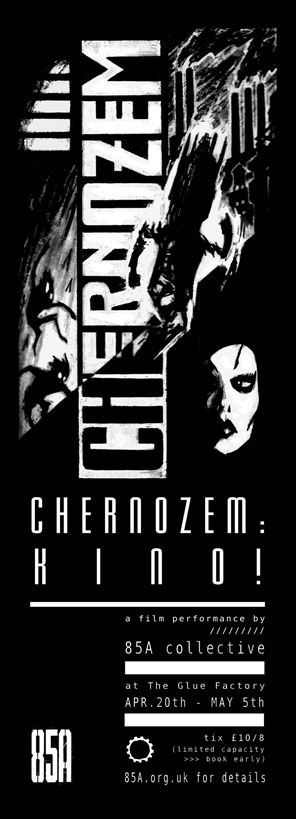
85A - through the use of overworked metaphor - could be identified as the natural descendants of the Judson Memorial gang. They don't use dance - Chernozem, their entry into the GI Fringe, was an expanded film experience - but they are associated with a specific venue (The Glue Factory) and enjoy busting boundaries. And where Rainer, Brown et al were affiliated, the 85A Collective has a similar feel, with individual members holding their own yet becoming part of something more impressive.

Brown's company arrived at Tramway with an eclectic mix: three "classics" and a new piece. Leah Morrison opened the account with If You Could See Me from 1994. Notable as a solo where the dancer faces away from the audience, it has the particular style that identifies Brown: rejecting flashy displays of technique, the movement is precise, closer to martial art than ballet. While it is a strong statement of Brown's interest in challenging the predictable relationship between audience and performer - Morrison never peeks at the crowd - Tramway's unique space adds a tension - the solo almost becomes a trio, with the two pillars at the side of the stage lit up like immobile partners in dance.

The contrast with the opening of Chernozem could not be more powerful: 85A are all about "hot" media, dragging the audience into character and forcing them to watch the opening scenes of the film on tiny screens. Throughout Brown's performance, the audience is invited to observe - Chernozem insists. Pushed around on carts, chased by dominatrix prison guards, pushed between the hulking scenery, they immerse and cajole. Brown's choreography is "cool", so self-contained, it barely acknowledges the audience. For MG: The Movie happens as if behind a screen, and the pas de deux of Les Yeux et L'Ame are all about the connection between performers.

Nipping back - realising that I started off going on about post-modernism, and probably need to justify my pretentious introduction - it strikes me that the post-modern instinct is vital to both choreographer and collective. They reject easy definitions of their genre - Brown might use technically skilled dancers, 85A might make a film - but they go far beyond the expected. Yet in their different attitudes to the audience, they make a strikingly similar point about how art is created by the observer. For 85A, the observer is togged out in prison gear: for Brown, the audience has to work hard to enter into the dance's  world. My easy and lazy definition of post-modernism - that it takes away the possibility of a central, defining characteristic to just about anything - is satisfied by both works.


Saturday, 12 November 2011

Bill T Jones is a Good Man

Seeing Rambert Dance Company and a documentary about Bill T Jones in one night is a tough call. The slight dissatisfaction I felt after Rambert became a raging resentment once I’d watched A Good Man. There’s nothing wrong with Rambert, apart from the strange dishonesty that has a company made up mostly of ballet dancers still avoid the word in their name. The triple bill is a little weak – the final piece seems to have an oddly outdated notion of childhood, despite the company having an in-house scientist to help with child psychology – but they get their legs and the acrobatics tight. But in the light of Bill T Jones, caught in the process of choreographing a commission about Abraham Lincoln, they come across as the polite and slightly boring kid at the big wild party.

Jones is an anachronism: he is in that very American mode of the artist who wants to make a big statement. At one point he stands in the middle of his dancers, stripped to the waist, apologising for his earlier anger in the same way that a Glaswegian hard-man argues over the latest increase in the bus fare. He’s a determined modernist, a romantic, striving like Jackson Pollock, Jack Kerouac, all those tough guys who dare audiences to call them sissies for being sensitive.

So, he is even a stereotype. Luckily, he addresses this: admitting that he has faith in art, faith in the great man, he surprises himself. He knows that he is arrogant – he moans at one point that he doesn’t want to be a saint – but his physical excellence lends him a charisma that his temper doesn’t deserve. And he is certainly all man, all power. The end of the film sees him going mad for the biggest sound he can get out of the musician, before being told that he would need to warn an audience about the volume in case someone has a heart-attack.
But by God, he’s exciting. Apart from one scene, when the company perform some ritual before going on stage, there’s no sentimentality, no special pleading. Listening to Jones find the hidden racism in the Great Emancipator’s speeches is thrillingly taboo: his arguments with the musicians and dancers reveal the passion that binds them in this difficult relationship. Best of all, the look of fear on his audience’s faces. I may be unkind, but that will teach them to think a night at the dance is the emotional equivalent of a champagne picnic.
The more I think about that documentary, the deeper it gets. It reminds that dance is the most appropriate art for philosophical discussion: what other performance could explore Lincoln without turning it all history detail or windy rhetoric? Where else can the personal and the political mesh so elegantly, as when Jones uses the lives of his dancers to reflect on the USA’s horrible domestic history? And there, at the centre, Jones himself. Battling age, inspiration, expectation. He mocks those who commissioned him for tokenism, then moans that audiences are lazy. He is picture book perfect.