Showing posts with label Chernozem. Show all posts

Monday, 25 March 2013

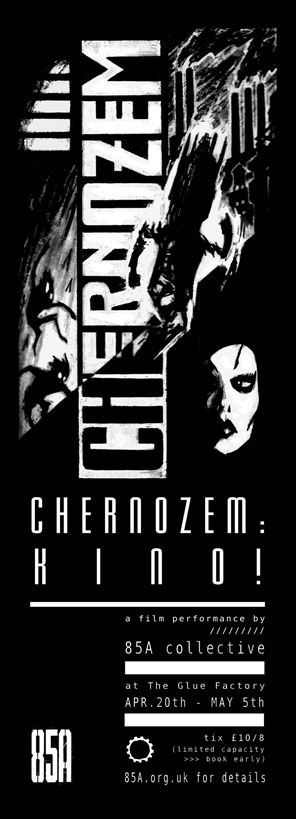
Chernozem @85a @GFT @THE FLYING DUCK


The first incarnation of 85A's Chernozem was a site-reponsive jamboree. Taking over The Glue Factory, a natural home for the collective's broad mash-up of post-industrial chaos and Teutonic expressionist paranoia, they presented the film as a series of scenes, connected by DIY funfair rides and strict injunctions to tour the building. If this edition sacrifices the theatricality for a more traditional cinematic experience - it is being shown in the Glasgow Film Theatre - the surrounding events at The Flying Duck are a reminder that this crew are all about more than just the celluloid.
The evening begins with the Renegade Maskerrade: a masked ball starring redneck hill-billy stomp from Sister Deadfoot and, as 85a put it, the audience's own dreams of barefoot zombie sex teetering on the edge of civilisation. Then a short parade down the road, and the film begins. Judd Brucke's Chernozem is unashamedly bleak - it has the nightmarish surrealism of early horror, a fascination with totalitarian imagery and the harsh, snappy editing of an industrial rock video. Taking in themes of control, dark sensuality and domination, Chernozem is a post-apocalyptic thriller that has the flavour of a fragmented, and thought lost, documentary from cinema's early years.
Finally, it's back to The Flying Duck for the 85A DJs - known to make a rare noise that evokes the energy of techno and the brutality of 1990s industrial. And if the Collective aren't devising a hyper-cinema this time, this triptych of events echoes their enthusiasm for the immersive.
Although it is easy to spot the influence of post-industrial decay in their output, with various members intrigued by refitting old spaces or materials, 85A's most obvious precedent is the rave culture of the 1980s, before it was absorbed into superclubs and name DJs. The willingness to involve different art forms, as attested by their long  association with grim storytellers Luona, and build new worlds to encase their art harks back to rave's warehouse parties, that would construct pleasure domes within old factories. The rough, DIY ethos and aesthetic is an implicitly political statement of affintity with movements of the 1980s and 1990s that shunned the capitalist mainstream. Even their occasional fondness for Soviet iconography is more combative towards global capitalism's influence on art, than leftist sentimentality.
Unlike many groups that use the noun, 85A are a genuine collective, a disparate  gang who come together for specific events. Their politics are not easily discerned, thanks to their refusal to shout the slogans that usually pass for engagement within the arts and their route to the GFT, which has been self-funded, is a more eloquent statement of integrity and self-determination than a thousand letters or Facebook entries bemoaning the current state of Creative Scotland. Chernozem's fantasy of a blackened planet may be a reflection of contemporary Britain's cultural anguish, but 85a's very identity is an act of resistance to the mundane.

Wednesday, 16 May 2012

Brown versus 85A

When a cheerful commentary on The Simpsons and Philosophy contains asides about the rise of nihilism, and post-modernisms are being reinvented through a Marxist lens, the function of art appears to be up for grabs. Having been brought up in an era when post-modernism was still at the edge of academic discourse - that is, it didn't get mentioned in my lectures on Virgil but turned up in style magazines - I am still hopeful that it might be rehabilitated: but in a world where it has been used to explain the rise of celebrity culture, I imagine I'll remain a lone voice. Again.


Trisha Brown is clearly associated with "post-modern dance." She was hanging about the Judson Memorial Church alongside Yvonne Rainer and Steve Paxton: this loose affiliation of choreographers would ask a series of critical questions about movement that became known as post-modern dance. Rainer became a film-maker - although she made a triumphant return to choreography - and Paxton pioneered contact improvisation. Brown is arguably, however, the most consistent in her career as a choreographer, as she has her own company and her work now sits in the repertoire of ballet companies across the world.

85A - through the use of overworked metaphor - could be identified as the natural descendants of the Judson Memorial gang. They don't use dance - Chernozem, their entry into the GI Fringe, was an expanded film experience - but they are associated with a specific venue (The Glue Factory) and enjoy busting boundaries. And where Rainer, Brown et al were affiliated, the 85A Collective has a similar feel, with individual members holding their own yet becoming part of something more impressive.

Brown's company arrived at Tramway with an eclectic mix: three "classics" and a new piece. Leah Morrison opened the account with If You Could See Me from 1994. Notable as a solo where the dancer faces away from the audience, it has the particular style that identifies Brown: rejecting flashy displays of technique, the movement is precise, closer to martial art than ballet. While it is a strong statement of Brown's interest in challenging the predictable relationship between audience and performer - Morrison never peeks at the crowd - Tramway's unique space adds a tension - the solo almost becomes a trio, with the two pillars at the side of the stage lit up like immobile partners in dance.

The contrast with the opening of Chernozem could not be more powerful: 85A are all about "hot" media, dragging the audience into character and forcing them to watch the opening scenes of the film on tiny screens. Throughout Brown's performance, the audience is invited to observe - Chernozem insists. Pushed around on carts, chased by dominatrix prison guards, pushed between the hulking scenery, they immerse and cajole. Brown's choreography is "cool", so self-contained, it barely acknowledges the audience. For MG: The Movie happens as if behind a screen, and the pas de deux of Les Yeux et L'Ame are all about the connection between performers.

Nipping back - realising that I started off going on about post-modernism, and probably need to justify my pretentious introduction - it strikes me that the post-modern instinct is vital to both choreographer and collective. They reject easy definitions of their genre - Brown might use technically skilled dancers, 85A might make a film - but they go far beyond the expected. Yet in their different attitudes to the audience, they make a strikingly similar point about how art is created by the observer. For 85A, the observer is togged out in prison gear: for Brown, the audience has to work hard to enter into the dance's  world. My easy and lazy definition of post-modernism - that it takes away the possibility of a central, defining characteristic to just about anything - is satisfied by both works.