Showing posts with label expanded film. Show all posts

Thursday, 17 January 2013

Film Theatre at the Edinburgh Festival Theatre

There's a natural defensiveness in my response to the news that the Edinburgh Festival Theatre is screening a series of live operas and ballets in February: although the live transmission of a performance has become commonplace, there is still a sense that it is neither film nor theatre, but an over-priced and clumsy combination. The thrill of the intimacy and immediacy of theatre is dulled by the screen, and the polish of the film is threatened by the vagaries of the live show.

Having said that, certain pieces are enhanced by the big screen: dance has been successful in the 3D format (Bausch, Wim Wender's tribute to the goddess of German Dance Theatre brought the audience right into the thick of her Rite of Spring and Matthew Bourne's Swan Lake gains an intimacy, ironically, by being blown up to a bigger size). And, frankly, there's little chance of my visiting La Scala to see Roland Petit's Notre Dame de Paris in the near future. A satellite link and a HD screen are my best bet.

Unlike comic book author Alan Moore, who doesn't regard cinema as being all that (comic book authors might be a little sensitive about who gets called "high art" but the state of the current blockbuster industry does support his complaint), I am enthusiastic about cinema - I am currently trawling through the Glasgow Film Festival Brochure in hope of deciding whether I want to follow the James Cagney season of fight for Joss Weedon's Much Ado About Nothing. Part of a generation that learnt about international cinema due to staying up late to watch Channel 4 in hope of some naughty bits, I don't just see it as a parasitic art that devours talented actors from the stage and diminishes the complexity of human existence by replacing recognisable body shapes with a minimal range of glamorous cyphers.

That said, the context of theatre and cinema are very different. Going to the cinema involves eating large amounts of junk food - which compensate for the scripts which would be laughed out of the theatre - sitting behind a two year old child who decides to bellow throughout and not hanging about afterwards. It also connects me to a far larger audience, a more common experience and is cheaper and more comfortable than a night at the ballet.

Theatre, on the other hand, is all about the unrepeatable moment, the proximity of the performer, the ways around naturalism, the immediate chat over post-show drinks and the sense of being part of a local audience.

The Festival Theatre, however, isn't necessarily the place where I go for that. It's got a sense of scale, and importance, and I travel there because they put on the big names. If part of my reason to go to theatre is to learn more about theatre - and it is - then getting to see Verdi's Nabucco is important, regardless of whether it is live or screened.

I shall conclude with a few unanswered questions in the best tradition of post-modern scholarship - if I keep this up, someone will have to offer me a PhD.

How do theatre companies view these showings - are they an event in themselves or an attempt to enchant new audiences, who might then go and see a live performance? Is the direction adapted to the screen, or do the acts turn out their usual repertoire of expressions and moves? And is the emotional impact - and atmosphere of the screening - more akin to the popcorn popping multiplex or the seriousness of a night at The Arches with David Hughes Dance?


Listings

Wednesday, 16 May 2012

Brown versus 85A

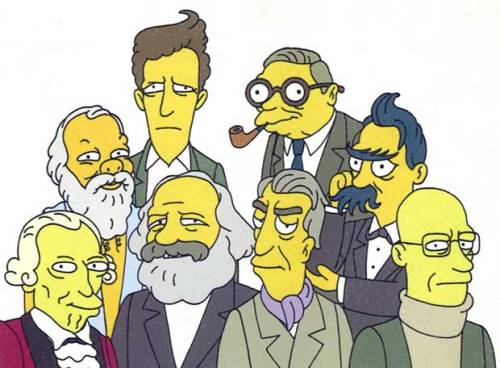
When a cheerful commentary on The Simpsons and Philosophy contains asides about the rise of nihilism, and post-modernisms are being reinvented through a Marxist lens, the function of art appears to be up for grabs. Having been brought up in an era when post-modernism was still at the edge of academic discourse - that is, it didn't get mentioned in my lectures on Virgil but turned up in style magazines - I am still hopeful that it might be rehabilitated: but in a world where it has been used to explain the rise of celebrity culture, I imagine I'll remain a lone voice. Again.


Trisha Brown is clearly associated with "post-modern dance." She was hanging about the Judson Memorial Church alongside Yvonne Rainer and Steve Paxton: this loose affiliation of choreographers would ask a series of critical questions about movement that became known as post-modern dance. Rainer became a film-maker - although she made a triumphant return to choreography - and Paxton pioneered contact improvisation. Brown is arguably, however, the most consistent in her career as a choreographer, as she has her own company and her work now sits in the repertoire of ballet companies across the world.

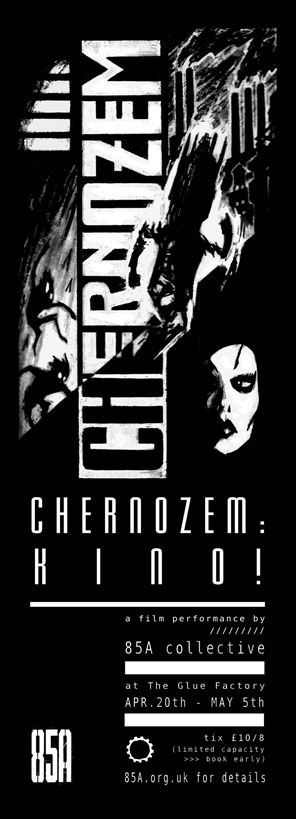
85A - through the use of overworked metaphor - could be identified as the natural descendants of the Judson Memorial gang. They don't use dance - Chernozem, their entry into the GI Fringe, was an expanded film experience - but they are associated with a specific venue (The Glue Factory) and enjoy busting boundaries. And where Rainer, Brown et al were affiliated, the 85A Collective has a similar feel, with individual members holding their own yet becoming part of something more impressive.

Brown's company arrived at Tramway with an eclectic mix: three "classics" and a new piece. Leah Morrison opened the account with If You Could See Me from 1994. Notable as a solo where the dancer faces away from the audience, it has the particular style that identifies Brown: rejecting flashy displays of technique, the movement is precise, closer to martial art than ballet. While it is a strong statement of Brown's interest in challenging the predictable relationship between audience and performer - Morrison never peeks at the crowd - Tramway's unique space adds a tension - the solo almost becomes a trio, with the two pillars at the side of the stage lit up like immobile partners in dance.

The contrast with the opening of Chernozem could not be more powerful: 85A are all about "hot" media, dragging the audience into character and forcing them to watch the opening scenes of the film on tiny screens. Throughout Brown's performance, the audience is invited to observe - Chernozem insists. Pushed around on carts, chased by dominatrix prison guards, pushed between the hulking scenery, they immerse and cajole. Brown's choreography is "cool", so self-contained, it barely acknowledges the audience. For MG: The Movie happens as if behind a screen, and the pas de deux of Les Yeux et L'Ame are all about the connection between performers.

Nipping back - realising that I started off going on about post-modernism, and probably need to justify my pretentious introduction - it strikes me that the post-modern instinct is vital to both choreographer and collective. They reject easy definitions of their genre - Brown might use technically skilled dancers, 85A might make a film - but they go far beyond the expected. Yet in their different attitudes to the audience, they make a strikingly similar point about how art is created by the observer. For 85A, the observer is togged out in prison gear: for Brown, the audience has to work hard to enter into the dance's  world. My easy and lazy definition of post-modernism - that it takes away the possibility of a central, defining characteristic to just about anything - is satisfied by both works.