I saw a weird piece on daytime television once about a really big child. He was a couple hundred pounds and barely 4 years old. He was referred to as a Gentle Giant.
He was intimidating and ‘grotesque’ and absolutely adorably sensitive and sweet.
It made me cry. It was overwhelmingly satisfying to see the reactions of people turn from horrified into touched. It was a reminder to me to look deeper, to dig beneath the surface for true meaning.
Sasquatch is like this child. His emotional arc is the core of what I was trying to achieve.
In what I try to do, performance is the ultimate space for public discussion of ideas. I aim to provoke and
to question people’s motives. I hope ideally to create conversations about the course of humanity and the tools we need to develop to make things work. Being able to think and discuss in the forum of theatre makes the process easier for some. For me.
I like to be looked at and I love attention. I feel confident enough with my perspective to shout it from
the rooftop, so to speak. From an early age I felt a need to be heard. Throw theatrics into that mix and
it makes a message all the more palatable.
I tried to keep the piece as stripped down and as bare as I could make it. I wanted ultimately to leave
as much room for the performances as possible. The instrumentation is very sparse; timpani’s, drum machine,
synthesizers, and trumpets. It’s as simple and as dark as I could make it. I kept that in mind with the costumes
and the set design as well. I also tended to err on the side of somber. ‘Sasquatch, The Opera’ usually brings
about a chuckle and I wanted to set the tone from the get-go that it’s a dark and serious piece.
|
Showing posts with label Opera. Show all posts
Showing posts with label Opera. Show all posts
Monday, 10 July 2017
Sasquatch the Dramaturgy: Roddy Bottum @ Edfringe 2017


Sunday, 1 November 2015


Friday, 19 June 2015
Who's Best at Singing: Rent or Opera Mouse?
Next up, a couple of tasty numbers for the Fringe: this time, you can sing along.
Uncompromising Artistry Productions presents everyone's favourite musical about Alphabet City: Rent. Let's see what they've got for us...

Jonathan Larson's gripping rock musical is brought to life by NYC based Uncompromising Artistry Productions. The Pulitzer Prize and Tony Award-winning RENT took the world by storm when it premiered on Broadway in 1996. Seeking to recapture the immediacy of this modern day classic, UAProductions pays tribute to the legacy of Larson's beloved masterpiece, with creative consultation from original Broadway cast member, Anthony Rapp.
Set in New York's bohemian Alphabet City under the shadow of the HIV/AIDS epidemic, RENT illuminates the power of community and the necessity of love in our darkest times. This production is under the direction of Nicola Murphy.
Featuring a cast comprised of young New York actors, Rapp agrees - the cast is “dynamic, authentic, and extraordinarily talented”. Featuring, fresh from Broadway, Janet Krupin (“If/Then”) as Maureen, and announcing Johnny Newcomb ("The Last Ship", "American Idiot") as Roger.
“We have such an amazing group of talented artists and also really genuine, down to earth, authentic people which was really important to us as a creative team to find because this piece is so much about community and they’re so confident in themselves as people and as performers in what they can bring, and I think we did a really good job with that”, Murphy says of the cast.
Featuring a cast comprised of young New York actors, Rapp agrees - the cast is “dynamic, authentic, and extraordinarily talented”. Featuring, fresh from Broadway, Janet Krupin (“If/Then”) as Maureen, and announcing Johnny Newcomb ("The Last Ship", "American Idiot") as Roger.
“We have such an amazing group of talented artists and also really genuine, down to earth, authentic people which was really important to us as a creative team to find because this piece is so much about community and they’re so confident in themselves as people and as performers in what they can bring, and I think we did a really good job with that”, Murphy says of the cast.
Difficult one to follow there - but if anyone can do it, I'll put my money on OPERA MOUSE.

|
About the Artists
Uncompromising Artistry Productions was founded by Samantha Cunha, Michael Quadrino, and Erin Mizer. UAProductions aims to support new work, new artists, or new viewpoints; it may be an entirely original script or a new take on a classic. “This production is as relevant today as it was in 1996,” says Artistic Director, Samantha Cunha. “With this reputation comes many challenges, but we are up to the task - presenting this piece in a way that is as urgent and pulsing as ever with a stamp on it that says, ‘this is ours’.”
Uncompromising Artistry Productions was founded by Samantha Cunha, Michael Quadrino, and Erin Mizer. UAProductions aims to support new work, new artists, or new viewpoints; it may be an entirely original script or a new take on a classic. “This production is as relevant today as it was in 1996,” says Artistic Director, Samantha Cunha. “With this reputation comes many challenges, but we are up to the task - presenting this piece in a way that is as urgent and pulsing as ever with a stamp on it that says, ‘this is ours’.”
Tuesday, 28 April 2015
HighTimes: Hansel and Gretel
Opera is not always regarded as an easily accessible art - perhaps
 because of its theatrical complexity, or because the old audience tend to be aging enthusiasts, who freight the medium with ideas about its 'importance' as high art. However, a new professional opera company HighTime has been founded which 'actively seeks out those who might not currently have access to opera'.
Co-founder and stage director Felicity Green is passionate that audience development is a core aspect of the company's agenda.

 Working with a new translation of the libretto, this production adds a new character: in place of the witch, a Ringmaster becomes the villain, bringing a new angle to the story.
Co-founder and stage director Felicity Green is passionate that audience development is a core aspect of the company's agenda.
'I feel that a lot of companies are driven by the aims and ideas of the artists rather than considering the audience's wants and needs,' she says. 'Whilst this approach works for some, we felt that because so many people feel that opera is not 'for them' we needed to spin this on its head, and put the audience at the centre of the company, in terms of tackling audience development head on and the development of the artistic product itself.'
The tension between artists and audiences, at least in terms of who gets to decide what defines 'quality art' is a problem that emerged most clearly in the nineteenth century, when Romanticism encouraged the artists to act like they were gods. This got worse during the twentieth century, when the avant-garde (supported by occasional guest on this blog, Adorno) decided to climb up its own arse.
Green is more charming than I am in explaining why Hansel and Gretel is a good choice for HighTime's first production. Using a tale more usually associated with fairy-stories, it can be suitable for all ages.
'It's an opera for and about children, but for and about adults too. It functions like all excellent storytelling - like a Disney Pixar movie - it works on two levels - children and adults will both get something out of it, but they might not be the same things.'
Working with a new translation of the libretto, this production adds a new character: in place of the witch, a Ringmaster becomes the villain, bringing a new angle to the story.
'The development of the Ringmaster was really a move away from the traditional stereotype of the witch being an old ugly woman,' Green adds. 'A villain who is glamorous, who is appealing to an audience, is far scarier in some ways, as it plays on your fears and your sense of judgement. To be seduced by a villain is much more unsettling than to dislike them outright!'
Hansel and Gretel Opera for All
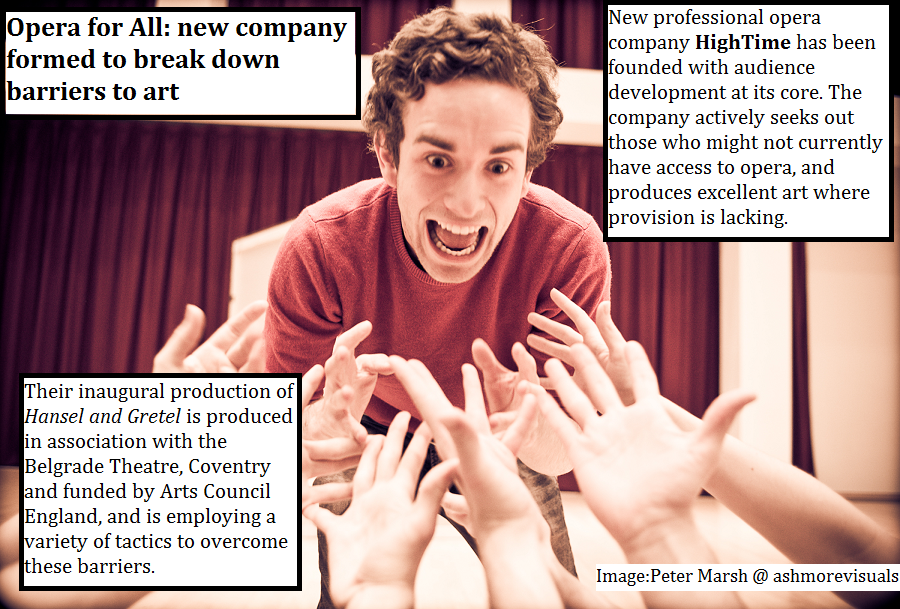
Co-founder and stage director Felicity Green explains why this is at the heart of the group. "It¹s fair to say that the majority people feel that opera is not for them. That reputation is still present. The barriers to accessing this art form are multiple and complex. They are social, cultural, and economic. To break these down, we need to use a range of different methods."
Working in new English translations with affordable ticket prices, the group initiates projects which actively targets those who may be missing out.
They are working in partnership with Mind to break down barriers people facing mental health difficulties may face in attending cultural events. The company's Indiegogo campaign, which will give support for 45 local clients to attend the production, is close to its target just four days after launching.
The company are invested in young people gaining access to opera. 60 children from across the city are being given a specially designed Introduction to Opera and the opportunity to perform in the professional production as members of the chorus.
One ever-present issue pervading the arts is the London vs the regions dichotomy. Benjamin Hamilton, co-founder and musical director, says: 'having lived in Coventry for most of my life, I was frustrated by the lack of access to good quality opera here. Our aim for the future is to actively target other regions who may be experiencing the same problem.'
Artistic quality is key to the group¹s work. Felicity continues: 'to fully democratise the art form, we have exceptional production standards. We are working with singers who have performed in some of the world¹s most famous opera houses. Our core values place imaginative theatre and choreography as integral to create exciting work fit for the modern theatre.'
Their production presents a new spin on the traditional fairy tale. In a new English translation produced with Kit Hesketh Harvey, translator for English National Opera and Opera North, Hansel and Gretel live on the outskirts of society, hungry and poor, when their mother sends them to forage for food on the mean city streets. News soon arrives that the circus has come to town, led by a very sinister Ringmaster, renowned for luring children away from their homes with the intoxicating smell of frying hot dogs.
On this reimagining, Felicity says: 'I think the production will resonate with a diverse modern audience. It¹s exciting and challenging to reimagine a story we are all familiar with. Repositioning the traditional figure of the witch as our childcatcher-esque Ringmaster, for example, is a particularly interesting shift.'
'There is lots of debate about the issue of traditional dress in opera. It sometimes seems the art form is several decades behind theatre; any vaguely innovative or risky production faces serious resistance in the opera community. But then, this production isn¹t being staged for that group. It's being built to inspire a new generation of opera lovers.'
Hansel and Gretel runs 7-9 May 2015 at the Belgrade Theatre B2.
One ever-present issue pervading the arts is the London vs the regions dichotomy. Benjamin Hamilton, co-founder and musical director, says: 'having lived in Coventry for most of my life, I was frustrated by the lack of access to good quality opera here. Our aim for the future is to actively target other regions who may be experiencing the same problem.'
Artistic quality is key to the group¹s work. Felicity continues: 'to fully democratise the art form, we have exceptional production standards. We are working with singers who have performed in some of the world¹s most famous opera houses. Our core values place imaginative theatre and choreography as integral to create exciting work fit for the modern theatre.'
Their production presents a new spin on the traditional fairy tale. In a new English translation produced with Kit Hesketh Harvey, translator for English National Opera and Opera North, Hansel and Gretel live on the outskirts of society, hungry and poor, when their mother sends them to forage for food on the mean city streets. News soon arrives that the circus has come to town, led by a very sinister Ringmaster, renowned for luring children away from their homes with the intoxicating smell of frying hot dogs.
On this reimagining, Felicity says: 'I think the production will resonate with a diverse modern audience. It¹s exciting and challenging to reimagine a story we are all familiar with. Repositioning the traditional figure of the witch as our childcatcher-esque Ringmaster, for example, is a particularly interesting shift.'
'There is lots of debate about the issue of traditional dress in opera. It sometimes seems the art form is several decades behind theatre; any vaguely innovative or risky production faces serious resistance in the opera community. But then, this production isn¹t being staged for that group. It's being built to inspire a new generation of opera lovers.'
Hansel and Gretel runs 7-9 May 2015 at the Belgrade Theatre B2.
Tuesday, 7 April 2015

Tuesday, 9 December 2014
OPERA HIGHLIGHTS TOUR SET TO VISIT 17 VENUES ACROSS SCOTLAND
Scottish Opera will celebrate the 21st anniversary of Opera Highlights with a 17-date tour of Scotland in the New Year.
A great evening for those brand new to opera, seasoned fans and everyone in-between, Opera Highlights features music from some of the world’s most popular operas, as well as some lesser-known treats selected by Scottish Opera’s Head of Music,Derek Clark.
This January, Scottish Opera’s trusty van will be loaded up with a piano, a handful of props and 4 singers to perform at some of the smaller or more remote venues the length and breadth of Scotland. The annual tour has been taking to the road since 1994, when it started life as Essential Scottish Opera. This year’s tour visits Rutherglen, Brechin, Campbeltown, Islay, Benderloch, Durness, Torridon, Arisaig, Peebles, Castle Douglas, Cumnock, Findhorn, Golspie, Banchory, Duns, Killin and Bathgate.
Arias from Mozart’s The Magic Flute and Verdi’s La Traviata will be showcased alongside the famous Habanera from Bizet’s Carmen. Audiences will also be treated to Gilbert & Sullivan classics from HMS Pinafore and The Gondoliers as part of the 2-hour production.
This year’s Opera Highlights programme also includes a world premiere from Scottish Opera’s new Composer in Residence,Liam Paterson, entitled “Touching Eden”.
Scottish Opera’s Head of Music, Derek Clark, said:
“In the midst of a Scottish winter sometimes we all need a bit of warming up, so the theme for the show this year is an operatic garden party.
“These are really evenings for everyone. Even if you don’t know a single tune when you come to see us, I guarantee you’ll be humming at least one of them on the journey home.”
This year’s singers are former Scottish Opera Emerging Artist Sioned Gwen Davies and tenor Sam Furness, who performed as Kate and Frederic in 2013’s The Pirates of Penzance. They are joined by Welsh tenor Joshua Owen Mills, Ben McAteer, winner of NI Opera’s inaugural Festival of Voice competition in 2011, and soprano Reisha Adams, winner of the 2012 Ian Stoutzker prize for outstanding musicianship. They will be accompanied by pianist Ina Selvelieva and the production is directed by Max Webster.
www.scottishopera.org.uk
Rutherglen Town Hall Thu 29 Jan 7.30pm
Brechin City Hall Sat 31 Jan 7.30pm
Victoria Hall, Campbeltown Tue 3 Feb 7.30pm
Bowmore Village Hall Thu 5 Feb 7.30pm
Benderloch Victory Hall Sat 7 Feb 7.30pm
Durness Village Hall Tue 10 Feb 7.30pm
Loch Torridon Community Centre Thu 12 Feb 7.30pm
Astley Hall, Arisaig Sat 14 Feb 7.30pm
Eastgate Theatre, Peebles Tue 17 Feb 7.30pm
The Fullarton, Castle Douglas Thu 19 Feb 7.30pm
Cumnock Town Hall Sat 21 Feb 7.30pm
Universal Hall, Findhorn Tue 24 Feb 7.30pm
Golspie High School Thu 26 Feb 7.30pm
Woodend Barn, Banchory Sat 28 Feb 7.30pm
Volunteer Hall, Duns Tue 3 Mar 7.30pm
McLaren Hall, Killin Thu 5 Mar 7.30pm
Regal Theatre, Bathgate Sat 7 Mar 7.30pm
A great evening for those brand new to opera, seasoned fans and everyone in-between, Opera Highlights features music from some of the world’s most popular operas, as well as some lesser-known treats selected by Scottish Opera’s Head of Music,Derek Clark.
This January, Scottish Opera’s trusty van will be loaded up with a piano, a handful of props and 4 singers to perform at some of the smaller or more remote venues the length and breadth of Scotland. The annual tour has been taking to the road since 1994, when it started life as Essential Scottish Opera. This year’s tour visits Rutherglen, Brechin, Campbeltown, Islay, Benderloch, Durness, Torridon, Arisaig, Peebles, Castle Douglas, Cumnock, Findhorn, Golspie, Banchory, Duns, Killin and Bathgate.
Arias from Mozart’s The Magic Flute and Verdi’s La Traviata will be showcased alongside the famous Habanera from Bizet’s Carmen. Audiences will also be treated to Gilbert & Sullivan classics from HMS Pinafore and The Gondoliers as part of the 2-hour production.
This year’s Opera Highlights programme also includes a world premiere from Scottish Opera’s new Composer in Residence,Liam Paterson, entitled “Touching Eden”.
Scottish Opera’s Head of Music, Derek Clark, said:
“In the midst of a Scottish winter sometimes we all need a bit of warming up, so the theme for the show this year is an operatic garden party.
“These are really evenings for everyone. Even if you don’t know a single tune when you come to see us, I guarantee you’ll be humming at least one of them on the journey home.”
This year’s singers are former Scottish Opera Emerging Artist Sioned Gwen Davies and tenor Sam Furness, who performed as Kate and Frederic in 2013’s The Pirates of Penzance. They are joined by Welsh tenor Joshua Owen Mills, Ben McAteer, winner of NI Opera’s inaugural Festival of Voice competition in 2011, and soprano Reisha Adams, winner of the 2012 Ian Stoutzker prize for outstanding musicianship. They will be accompanied by pianist Ina Selvelieva and the production is directed by Max Webster.
www.scottishopera.org.uk
Rutherglen Town Hall Thu 29 Jan 7.30pm
Brechin City Hall Sat 31 Jan 7.30pm
Victoria Hall, Campbeltown Tue 3 Feb 7.30pm
Bowmore Village Hall Thu 5 Feb 7.30pm
Benderloch Victory Hall Sat 7 Feb 7.30pm
Durness Village Hall Tue 10 Feb 7.30pm
Loch Torridon Community Centre Thu 12 Feb 7.30pm
Astley Hall, Arisaig Sat 14 Feb 7.30pm
Eastgate Theatre, Peebles Tue 17 Feb 7.30pm
The Fullarton, Castle Douglas Thu 19 Feb 7.30pm
Cumnock Town Hall Sat 21 Feb 7.30pm
Universal Hall, Findhorn Tue 24 Feb 7.30pm
Golspie High School Thu 26 Feb 7.30pm
Woodend Barn, Banchory Sat 28 Feb 7.30pm
Volunteer Hall, Duns Tue 3 Mar 7.30pm
McLaren Hall, Killin Thu 5 Mar 7.30pm
Regal Theatre, Bathgate Sat 7 Mar 7.30pm
Saturday, 14 June 2014


Wednesday, 20 February 2013
Killing Art By Churning
Having just read Steve Albini's argument with Stool Pigeon (well worth checking out, even if the stylised use of paragraphing is irritatingly hip), I am pondering ways of avoiding "churnalism" on this blog. Having been unimpressed by the willingness of newspapers to allow their comment pages to be clogged up by pretend articles generated by cunning PR firms (sugardaddies dot com, anyone), I hypocritically keep slapping out the press releases, disguised by my own interjections to give them some semblance of original thought.
On the other hand, I do want the blog to be a locus for information, seducing the reader with the promise of information then delivering my own poorly considered opinions and perspective.
Let's try a case study. Here's a release...
 "French metal rockers Karelia are set to release new album Golden Decadence. The album features a guest performance from the legendary Scorpions guitarist Rudolph Schenkeron the tracks Keep Watch On Me and The Way Across The Hills. The first single from the new album is entitled Vanity Label."
Now, to be honest, I don't like metal - unless it has some quality beyond being genre rock - I am thinking Rammstein's ability to make sly political points through the pyrotechnic displays of their live gigs,or their punning on homosexual subtexts.
And the presence of Scorpion's guitarist does not fill me with joy. Sure, they promise "groove-laden industrial and electronic riffs, melodic catchy anthems and extremely loud crunching" guitars. But my blog is full of articles about performance art and electronic music.
That reads like churnalism to me.
Albini's point is that laziness is endemic in the writing business - he was annoyed that his comments on Amanda Palmer overshadowed the point he was making about her financial arrangements. He has a very valid point. He ended up being the headline when he was championing the right of musicians to be paid for gigs. But it is easier to mention stuff without checking, without seeing its relevance.
The Daily Mail Online is hugely successful mainly because it does this, when a quick look at the underlying morality of the newspaper would suggest that a website full of celebrity nonsense would be inimical to their stated agenda, which is old fashioned values or something.
Let's press the point. Next press release on the list: opera.
"Scottish Opera’s new production of The Flying Dutchman revisits Richard Wagner’s original libretto. In researching the piece, director Harry Fehr uncovered a copy of the original score which set the story in a remote Scottish coastal community."
Okay. Opera is closer to my usual beat. And I have a family story: my grandfather's hair would literally stand on end when he heard the overture to The Flying Dutchman. Wagner's preoccupation with Total Theatre, and the inspiration he provided to a young Nietzsche gets him in. I'll be ignoring his rather dubious political fans.
In some ways, Wagner is for classical music what metal is for pop: a rougher, more aggressive version that deals with the point where angst and violence collide. The Flying Dutchman is a dark romance - young girl meets fascinating fantasy man. I bet the score contains "groove-laden riffs, melodic catchy anthems and extremely loud crunching" cellos.
I need a final hook. Yes. That's it: metal is like opera. in the magical world of churnalism all art is reduced to a sound-bite. I am destroying depth. I am part of the cultural phenomena that Rachel MacLean deconstructs in her video work.
I'll be back later with a top five or something...
On the other hand, I do want the blog to be a locus for information, seducing the reader with the promise of information then delivering my own poorly considered opinions and perspective.
Let's try a case study. Here's a release...

Now, to be honest, I don't like metal - unless it has some quality beyond being genre rock - I am thinking Rammstein's ability to make sly political points through the pyrotechnic displays of their live gigs,or their punning on homosexual subtexts.
And the presence of Scorpion's guitarist does not fill me with joy. Sure, they promise "groove-laden industrial and electronic riffs, melodic catchy anthems and extremely loud crunching" guitars. But my blog is full of articles about performance art and electronic music.
That reads like churnalism to me.
Albini's point is that laziness is endemic in the writing business - he was annoyed that his comments on Amanda Palmer overshadowed the point he was making about her financial arrangements. He has a very valid point. He ended up being the headline when he was championing the right of musicians to be paid for gigs. But it is easier to mention stuff without checking, without seeing its relevance.
The Daily Mail Online is hugely successful mainly because it does this, when a quick look at the underlying morality of the newspaper would suggest that a website full of celebrity nonsense would be inimical to their stated agenda, which is old fashioned values or something.
Let's press the point. Next press release on the list: opera.
"Scottish Opera’s new production of The Flying Dutchman revisits Richard Wagner’s original libretto. In researching the piece, director Harry Fehr uncovered a copy of the original score which set the story in a remote Scottish coastal community."
Okay. Opera is closer to my usual beat. And I have a family story: my grandfather's hair would literally stand on end when he heard the overture to The Flying Dutchman. Wagner's preoccupation with Total Theatre, and the inspiration he provided to a young Nietzsche gets him in. I'll be ignoring his rather dubious political fans.
In some ways, Wagner is for classical music what metal is for pop: a rougher, more aggressive version that deals with the point where angst and violence collide. The Flying Dutchman is a dark romance - young girl meets fascinating fantasy man. I bet the score contains "groove-laden riffs, melodic catchy anthems and extremely loud crunching" cellos.
In fact, Francesco Corti, Scottish Opera’s Director of Music and conductor, makes the point in more considered language: "Wagner was in his thirties when he wrote the piece and it shows. The music is ridden with the power and energy of a young man: the score is bursting with romantic notes which are much more incisive than his previous music, and with a rich naturalistic texture; in it you can hear the wind blowing, waves crashing on the shore and the throwing of anchors overboard."
I am churning it out and the reader can decide: Wagner or Karelia?
Theatre Royal, Glasgow
Thu 4 Apr 7.15pm
Sat 6 Apr 7.15pm
Tue 9 Apr 7.15pm
Flying Dutchman Unwrapped Fri 5 Apr 6pm
Festival Theatre, Edinburgh
Sat 13 Apr 7.15pm
Tue 16 Apr 7.15pm
Fri 19 Apr 7.15pm
I'll be back later with a top five or something...
Thursday, 17 January 2013
Film Theatre at the Edinburgh Festival Theatre
There's a natural defensiveness in my response to the news that the Edinburgh Festival Theatre is screening a series of live operas and ballets in February: although the live transmission of a performance has become commonplace, there is still a sense that it is neither film nor theatre, but an over-priced and clumsy combination. The thrill of the intimacy and immediacy of theatre is dulled by the screen, and the polish of the film is threatened by the vagaries of the live show.
Having said that, certain pieces are enhanced by the big screen: dance has been successful in the 3D format (Bausch, Wim Wender's tribute to the goddess of German Dance Theatre brought the audience right into the thick of her Rite of Spring and Matthew Bourne's Swan Lake gains an intimacy, ironically, by being blown up to a bigger size). And, frankly, there's little chance of my visiting La Scala to see Roland Petit's Notre Dame de Paris in the near future. A satellite link and a HD screen are my best bet.
Unlike comic book author Alan Moore, who doesn't regard cinema as being all that (comic book authors might be a little sensitive about who gets called "high art" but the state of the current blockbuster industry does support his complaint), I am enthusiastic about cinema - I am currently trawling through the Glasgow Film Festival Brochure in hope of deciding whether I want to follow the James Cagney season of fight for Joss Weedon's Much Ado About Nothing. Part of a generation that learnt about international cinema due to staying up late to watch Channel 4 in hope of some naughty bits, I don't just see it as a parasitic art that devours talented actors from the stage and diminishes the complexity of human existence by replacing recognisable body shapes with a minimal range of glamorous cyphers.
That said, the context of theatre and cinema are very different. Going to the cinema involves eating large amounts of junk food - which compensate for the scripts which would be laughed out of the theatre - sitting behind a two year old child who decides to bellow throughout and not hanging about afterwards. It also connects me to a far larger audience, a more common experience and is cheaper and more comfortable than a night at the ballet.
Theatre, on the other hand, is all about the unrepeatable moment, the proximity of the performer, the ways around naturalism, the immediate chat over post-show drinks and the sense of being part of a local audience.
The Festival Theatre, however, isn't necessarily the place where I go for that. It's got a sense of scale, and importance, and I travel there because they put on the big names. If part of my reason to go to theatre is to learn more about theatre - and it is - then getting to see Verdi's Nabucco is important, regardless of whether it is live or screened.
I shall conclude with a few unanswered questions in the best tradition of post-modern scholarship - if I keep this up, someone will have to offer me a PhD.
How do theatre companies view these showings - are they an event in themselves or an attempt to enchant new audiences, who might then go and see a live performance? Is the direction adapted to the screen, or do the acts turn out their usual repertoire of expressions and moves? And is the emotional impact - and atmosphere of the screening - more akin to the popcorn popping multiplex or the seriousness of a night at The Arches with David Hughes Dance?
Listings
Having said that, certain pieces are enhanced by the big screen: dance has been successful in the 3D format (Bausch, Wim Wender's tribute to the goddess of German Dance Theatre brought the audience right into the thick of her Rite of Spring and Matthew Bourne's Swan Lake gains an intimacy, ironically, by being blown up to a bigger size). And, frankly, there's little chance of my visiting La Scala to see Roland Petit's Notre Dame de Paris in the near future. A satellite link and a HD screen are my best bet.
Unlike comic book author Alan Moore, who doesn't regard cinema as being all that (comic book authors might be a little sensitive about who gets called "high art" but the state of the current blockbuster industry does support his complaint), I am enthusiastic about cinema - I am currently trawling through the Glasgow Film Festival Brochure in hope of deciding whether I want to follow the James Cagney season of fight for Joss Weedon's Much Ado About Nothing. Part of a generation that learnt about international cinema due to staying up late to watch Channel 4 in hope of some naughty bits, I don't just see it as a parasitic art that devours talented actors from the stage and diminishes the complexity of human existence by replacing recognisable body shapes with a minimal range of glamorous cyphers.
That said, the context of theatre and cinema are very different. Going to the cinema involves eating large amounts of junk food - which compensate for the scripts which would be laughed out of the theatre - sitting behind a two year old child who decides to bellow throughout and not hanging about afterwards. It also connects me to a far larger audience, a more common experience and is cheaper and more comfortable than a night at the ballet.
Theatre, on the other hand, is all about the unrepeatable moment, the proximity of the performer, the ways around naturalism, the immediate chat over post-show drinks and the sense of being part of a local audience.
The Festival Theatre, however, isn't necessarily the place where I go for that. It's got a sense of scale, and importance, and I travel there because they put on the big names. If part of my reason to go to theatre is to learn more about theatre - and it is - then getting to see Verdi's Nabucco is important, regardless of whether it is live or screened.
I shall conclude with a few unanswered questions in the best tradition of post-modern scholarship - if I keep this up, someone will have to offer me a PhD.
How do theatre companies view these showings - are they an event in themselves or an attempt to enchant new audiences, who might then go and see a live performance? Is the direction adapted to the screen, or do the acts turn out their usual repertoire of expressions and moves? And is the emotional impact - and atmosphere of the screening - more akin to the popcorn popping multiplex or the seriousness of a night at The Arches with David Hughes Dance?
Listings
Tuesday, 6 November 2012
Claudia Molitor: A Good Memory

"This piece tries to draw the listener-spectator into a sonic space where small sounds become big events, where the senses are heightened to hear what we might usually miss," Molitor continues. "I am fascinated with the way that we can occupy ourselves in a world with trials and tribulations and great big events and ideas (like in an opera) with only a pencil and paper, a made up song or a few toys when we are children." Taking her cue from this, Molitor condensed the grand themes into a tiny space. " So miniaturist on the surface yes, but still with all the big ideas and ideals!"
Remember Me also stands out in the festival programme as one of two pieces - the other is Bluebeard - that explicitly connects to opera, the original "total art" that, at the turn of the nineteenth century, was seen as an integrative performance to include all of the other arts. There's a a clear line from that vision of opera to Cathie Boyd's vision for Sonica, although whereas last time, it ended up with Wagner, the scope of Cryptic's festival offers more intimate works with equally lofty ambitions.
Molitor expands. "Themes in opera are of course grand and big and tragic, they seem hyper-real, but then those themes touch all our lives, because essentially opera is always a reflection of the way society understands itself at any given time, in any given socio-political or cultural situation. It reflects on the way people relate to and interact with each other. Of course on the opera stage this is highly stylised, but then it is in my work too, but in a very different way."
Yet the scale of Remember Me, and even the original inspiration - the gift of an antique from Molitor's grandmother - insist that this is a far more personal performance than a grand-standing comment on these socio-political situations. Her heroines may have been victims in their stories, but art has given them a grandeur and sympathy. "They are very different, but what they both have in common is that they are defined by very specific roles in their respective stories," she comments,
"In terms of music and opera I see a connection when looking at two arias: Dido's Lament in Purcell's opera is one of the most well known operatic arias where Dido laments her absent lover Aeneas, who is travelling the seas; Orpheus' lament for Eurydice, lost to him to the Underworld after she has been bitten by a snake, in Gluck's opera is a similarly celebrated aria," she adds. "These two laments to me highlight how the female voice in opera and, in turn, in society exists in relation to the male, rarely on its own terms. This is an important aspect of opera, where the most fantastical arias are often sung by the female voice, but that female element is more often than not the aspect that has unsettled the status quo, which by the end of the opera is re-established often by the death of the heroine."

Remember Me more than embodies Sonica's tagline of "sonic art for the visually minded": it speaks to wider concerns about both how performance is consumed, deliberately avoiding the fashion for the monumental - perhaps often visible in the work of Scottish theatre companies - while seriously considering the way that art can both reveal historical perspectives, in this case about women, and then address them and look towards change.
Scotland Street School, 8, 14, 15 November. Various times
Sunday, 9 September 2012
Scottish Opera takes revenge...
One of the best things about the prophets and patriarchs of the Torah is the way that they are constantly arguing with G-d. If they aren't running away from their sacred mission, they are complaining about justice, or questioning the divine will. Both contemporary fundamentalists and their atheist opponents frequently forget that The Bible refuses to present a monolithic notion of the holy. From the book of Genesis, where two competing creation myths are laid out for consideration, scripture is all about the dialogue.

James MacMillan has never been shy about his Catholicism: Clemency unsurprisingly uses a story from The Bible to question the nature of vengeance. Better known as an icon by Andrei Rublev, the meeting between Abraham, his wife and three angels is a prime example of how Judaism's relationship with G-d is anything but simplistic.
In collaboration with regular librettist Michael Symmons Roberts, MacMillan updates the story, giving the angels the feel of three terrorists. The hints of middle eastern music in the score, and the extended justification of the angel's behaviour, draws explicit parallels to the activities of certain Islamic groups. The great moral rage of the trio might be deliberately timeless, but it acts as a handy condemnation of modern excesses, whether metaphorically or literally - the details could come from any journalist's description of war zones or invaded nations.
The triptych stage set consciously pulls the opera back into the grand tradition of religious art: the costumes update the story, much in the way that Renaissance artists would do to Biblical stories. The message is clear that far from being irrelevant, Biblical stories retain a mythological meaning and are not to be mistaken for historical truth.
And so, Scottish Opera's New Opera season does something rare: religion has not formed the foundation of opera in the same way as it has for visual art, or symphonic compositions. It's a lovely irony that a company so keen to woo a younger audience (great deals for the youth here) has presented an opera that moves from the form's mainstream into an area that, on the surface, is deeply unfashionable.
There is a slight awkwardness in the libretto, since huge philosophical ideas are flung down in a mixture of prosaic and hyperbolic language. The angels' justification for their murderous intentions (they are off to destroy a couple of towns which have strayed from the path of righteousness) and Sarah's contemplation of her promised child have a stand alone beauty and power that could get them some nice Classic FM airplay. Yet it is the intensity of MacMillan's score and Symmons Robert's brooding questioning that give Clemency a bite.
By the end, when Abraham panics, realising that the angels are unlikely to find the necessary five good souls that would save the towns, or when Sarah ponders the world her child might inherit, the problems of holy rage and deserved retribution have been sketched out for further discussion. Atheists might notice that the angels provide an example of how the divine will can be used to justify some pretty vicious behaviour, just like the G-d that Dawkins doesn't believe in. Believers might be unsettled by the implications of a patriach like Abraham doubting the will of G-d. But Clemency updates the myth, and remains true to its difficult, argumentative nature.
Monday, 11 June 2012
The Francis Bacon Opera

In 1986, Melvyn Bragg interviewed artist Francis Bacon for the now cancelled and much-lamented Southbank Show. Throughout the conversation, Bragg and Bacon have a few drinks, leading to an unexpectedly candid insight into Bacon's process and life. It wasn't entirely inevitable, however, that this meeting would lead to a comic opera.
"Opera is certainly not popular, but nor should it be," says composer Stephen Crowe. "If you equate 'popularity' with 'relevance' (which I think a lot of people would) then the most relevant form of culture is TV talent shows." Yet even in an over-crowded Fringe, Crowe is confident that The Francis Bacon Opera will stand out.
"The fact that it's a brand new opera is one thing, and the fact that it's fucking brilliant is another." he laughs. Using the text of the Bragg-Bacon encounter- "it's either a direct transcript, retaining all the fluffs and mispronunciations and interrupted thoughts, or it's nothing" - Crowe gets inside the mind of one of the twentieth century's most visceral painters.
"The most inspiring thing about Bacon is his childlike openness," he continues. "He says controversial things, and always has fascinating opinions- but they are genuine. They don't come from any need to be shocking or outrageous, they come from the need to be totally honest."
Bacon might have found a visual language that deconstructed the expected politeness of paint - before the explosion of conceptual art, he was already pushing taste and acceptability - but his incisive vision could be turned inward. "He can be as dismissive about his own work as he can be scathing about Rothko, and he loves a lot of things, too." And back in the 1980s, art and celebrity were not so entwined: this interview was not about the hype.
Bacon reveals, Crowe states, "the sort of vehemence and adoration you hear behind closed doors, but never in a broadcast interview, unless there is a drive for publicity at the root of it. And the fact that Melvyn Bragg was willing to join him in his quest for honesty, and that alcohol lubricated the way is just perfect!"
19–27 Aug,
18:00 (1hr00)Wednesday, 1 June 2011
In the Penal Colony
 I watch performance in a desperate attempt to feel something. A constant stream of internet information, romantic failures, continued disappointment at the idiocy of elected politicians, a nagging sense of self-doubt and mounting financial concerns have conspired to convince me that an emotional numbness is the only way to exist. A night out at the theatre isn’t a gentle entertainment anymore. It is my last, best hope for feeling.
Opera works well for this. At the very least, it is a reminder of emotions I want to inhabit: huge passions, absurd expression, hopeless desire and tremendous waves of sound. And Philip Glass delivers wave of repetitive energy, working and reworking a small study of notes, building over time towards a final, deliberate moment of revelation and disgust.
When Kafka wrote about a brutal execution machine, he adorned his short story with typically obscure motifs and symbolism. When Philip Glass wrote an opera based on the story, he stripped it back to his usual minimalist intensity, turning Kafka’s meditation on the nature of punishment into an argument between a stern traditionalist and an uncertain liberal observer.
 Music Theatre Wales are known for their stripped down approach to opera, and Glass’ clipped intent suits their style: the line from Kafka’s original through the score to Michael McCarthy’s direction is clear and sharp. The two singers move between torture table, ladder and around the voiceless prisoner: the certainty of the warden is slowly undermined by the discomfort of the observer. The subtexts, the passions, the violence itself, are all subsumed beneath Glass’ urgent and mesmeric strings.
For the first hour, the libretto sets up a moral conundrum. Is it still acceptable for punishment to be merely punitive, or must it be redemptive? In the last moments, the warden inevitably finds himself at the mercy of his own ideas, his own machine. As the blood drips down onto his back, the horrible revelation, that is no revelation, is unfolded. For all his talk of the morality of his justice, the warden is wedded to horror, not reform.
I write about performance in a desperate attempt to express something of what I have experienced. Yet, through Glass’ score, McCarthy’s direction and the musicians’ intensity, I am brought back to my own state of numbness. It is as if In the Penal Colony is reflecting my own shock and dislocation, resolving nothing and proving only that horror itself is merely anaesthetising.

Subscribe to:
Posts
(
Atom
)