Showing posts with label Hansel and Gretel. Show all posts

Tuesday, 28 April 2015

HighTimes: Hansel and Gretel

Opera is not always regarded as an easily accessible art - perhaps
because of its theatrical complexity, or because the old audience tend to be aging enthusiasts, who freight the medium with ideas about its 'importance' as high art. However, a new professional opera company HighTime has been founded which 'actively seeks out those who might not currently have access to opera'.

Co-founder and stage director Felicity Green is passionate that audience development is a core aspect of the company's agenda.

'I feel that a lot of companies are driven by the aims and ideas of the artists rather than considering the audience's wants and needs,' she says. 'Whilst this approach works for some, we felt that because so many people feel that opera is not 'for them' we needed to spin this on its head, and put the audience at the centre of the company, in terms of tackling audience development head on and the development of the artistic product itself.'

The tension between artists and audiences, at least in terms of who gets to decide what defines 'quality art' is a problem that emerged most clearly in the nineteenth century, when Romanticism encouraged the artists to act like they were gods. This got worse during the twentieth century, when the avant-garde (supported by occasional guest on this blog, Adorno) decided to climb up its own arse. 

Green is more charming than I am in explaining why Hansel and Gretel is a good choice for  HighTime's first production. Using a tale more usually associated with fairy-stories, it can be suitable for all ages.

'It's an opera for and about children, but for and about adults too. It functions like all excellent storytelling - like a Disney Pixar movie - it works on two levels - children and adults will both get something out of it, but they might not be the same things.'

Working with a new translation of the libretto, this production adds a new character: in place of the witch, a Ringmaster becomes the villain, bringing a new angle to the story.

'The development of the Ringmaster was really a move away from the traditional stereotype of the witch being an old ugly woman,' Green adds. 'A villain who is glamorous, who is appealing to an audience, is far scarier in some ways, as it plays on your fears and your sense of judgement. To be seduced by a villain is much more unsettling than to dislike them outright!'

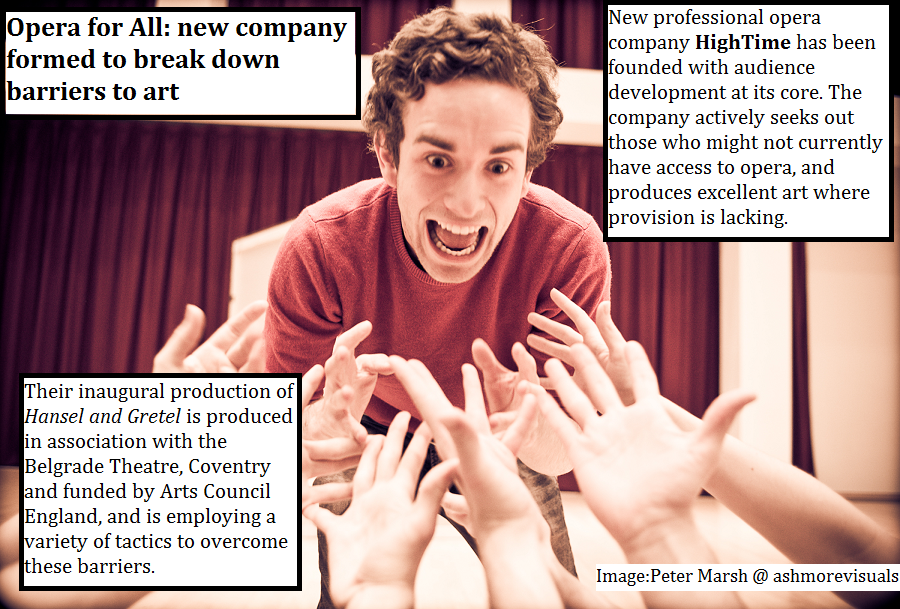


Hansel and Gretel Opera for All


Co-founder and stage director Felicity Green explains why this is at the heart of the group. "It¹s fair to say that the majority people feel that opera is not for them. That reputation is still present. The barriers to accessing this art form are multiple and complex. They are social, cultural, and economic. To break these down, we need to use a range of different methods."


Working in new English translations with affordable ticket prices, the group initiates projects which actively targets those who may be missing out. 

They are working in partnership with Mind to break down barriers people facing mental health difficulties may face in attending cultural events. The company's Indiegogo campaign, which will give support for 45 local clients to attend the production, is close to its target just four days after launching. 

The company are invested in young people gaining access to opera. 60 children from across the city are being given a specially designed Introduction to Opera and the opportunity to perform in the professional production as members of the chorus.


One ever-present issue pervading the arts is the London vs the regions dichotomy. Benjamin Hamilton, co-founder and musical director, says: 'having lived in Coventry for most of my life, I was frustrated by the lack of access to good quality opera here. Our aim for the future is to actively target other regions who may be experiencing the same problem.'


Artistic quality is key to the group¹s work. Felicity continues: 'to fully democratise the art form, we have exceptional production standards. We are working with singers who have performed in some of the world¹s most famous opera houses. Our core values place imaginative theatre and choreography as integral to create exciting work fit for the modern theatre.'

Their production presents a new spin on the traditional fairy tale. In a new English translation produced with Kit Hesketh Harvey, translator for English National Opera and Opera North, Hansel and Gretel live on the outskirts of society, hungry and poor, when their mother sends them to forage for food on the mean city streets. News soon arrives that the circus has come to town, led by a very sinister Ringmaster, renowned for luring children away from their homes with the intoxicating smell of frying hot dogs.


On this reimagining, Felicity says: 'I think the production will resonate with a diverse modern audience. It¹s exciting and challenging to reimagine a story we are all familiar with. Repositioning the traditional figure of the witch as our childcatcher-esque Ringmaster, for example, is a particularly interesting shift.'
'There is lots of debate about the issue of traditional dress in opera. It sometimes seems the art form is several decades behind theatre; any vaguely innovative or risky production faces serious resistance in the opera community. But then, this production isn¹t being staged for that group. It's being built to inspire a new generation of opera lovers.'


Hansel and Gretel runs 7-9 May 2015 at the Belgrade Theatre B2.