Showing posts with label chaos and contingency. Show all posts

Thursday, 21 March 2013

Chaos and Contingency


Usually, dance that attempts to explain science is a disaster. The complexity of scientific knowledge is difficult enough to express through language. A single formula can represent a chapter's worth of assumptions. Movement is abstract. It can evoke multiple interpretations. While science is not uncomfortable with plurality, it is most powerful when clear.
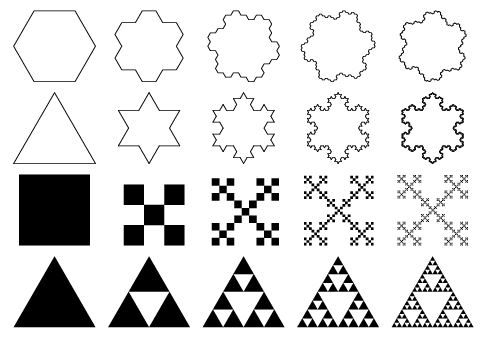
Chaos and Contingency, however, uses the beauty of dance to illustrate a series of simple mathematical concepts. Although a palindrome is embedded into the choreography, and the elegance of the formations depend on precise numerical grouping, it is the elaboration on the basic idea of fractal patterning that is most obvious throughout. Fractals are most popular when reduced to psychedelic postcards. In Chaos, Janis Claxton reveals how these are generated.
The basic movement vocabulary is exact and not spectacular. In the Kelvingrove, viewed from above, the floor is divided into sections. The dancers move through these sections, marking out the stage's geography and blossoming into complex patterns. Yet the simple rules of the dance are always evident. Claxton simply allows the gentle stye to iterate its possibilities.
The style is sparse and caters little to gender difference. In place of flashy male leaps or subtle female nuances, the movement is almost restful and consistent. In measured display, the dancers plot the various patterns inspired by eight bodies in space. And while there is no traditional partner work, the integration of the company is complete.
Both male and female dancers have the gentle authority of tango experts. The occasional burst of solo activity is supported by a precision of group movement. More than an exercise in mathematical form, it does reveal how repetition can build complex narratives and evokes the subtle rise and fall of complex organisations. Without boasting of its intelligence or hooking abstract ideas onto a more personal story, Chaos and Contingency is a technical triumph.

Thursday, 28 February 2013

Janis Claxton (part two)

Some fractals getting it on
When CP Snow deplored the gap between scientific and liberal arts education in The Two Cultures (1959), he suggested that the emphasis on Latin and Greek had left the British intelligentsia under-educated on the most basic scientific matters. The British state has spent the past fifty years trying to work out how to integrate science and humanities, managing to marginalise Classics but without making an appreciable difference to the division. Tim Minchin's Storm monologue hints that posh dinner parties are still cursed by a lack of even the most simple understanding of science.

The intrinsic problem might be that the timetable of school divides subjects up into categories: the strict division between geography and history is arbitrary, and it is the same physics that operates in the classroom and on the cricket pitch. And the opposition of art and science, rather like the one between religion and science, is based on dogmatic assumptions about the fundamental nature of the objects.

Fortunately, artists aren't so bothered by the division of knowledge. Although Janis Claxton has explained that an understanding of mathematics isn't essential to understand Chaos and Contingency, she acknowledges that numbers are one of the inspirations.

"We are using mathematical structures, games and number patterns as inspiration for creating both material and especially the structure," she says. "I have been inspired by Jon Conway's  Game of Life which is a cellular automaton." Conway's Life began as a board game, which needs no players, and explores the mechanism of evolution: through a series of simple rules, it follows the increasing complexity of selection processes. Chaos, designed to be viewed from all sides and above, reflects the patterning that computer versions of Life can reveal.

It isn't so much that it is necessary to understand cellular automaton to appreciate the choreography as that the choreography clarifies some of the ways the automaton operates. The dryness of the computer simulations of Life are replaced with something more visceral, more flowing, more vital.

Claxton adds that fractals were another influence: although these turned up in one of the films at Entre Chien et Loup during the Glasgow Film Festival, they are frequently portrayed as pretty visuals with a psychedelic flavour. Again, the choreography of Chaos illustrates their process, demonstrating how a simple form can be elaborated, by repetition, into something complex and profound.

It's unsurprising that Claxton also mentions Brian Eno: perhaps the most scientific of musicians in terms of process, he not only inspired a generation of electronic musicians but offers strategies for composition. The titular chaos of Claxton's choreography is not so much anarchic disorder but the working out of an idea to a point where it confuses human perception.

what happens if they keep doing it
"We have worked with 'chaos' and the idea that making a small change in a structure or material can yield wildly different results," says Claxton. "We have also been strict about staying true to the original set of conditions as a premise for what constitutes chaos rather than just total messy change. Its been fun. But we could change the name of the work to Chaos and Counting!"

Attempts to shoehorn scientific ideas into dance are not always executed with such precision - even the attempts by Wayne McGregor to get Darwin dancing lost the message within the movement. But by using Life and fractals as a foundation, Claxton moves closer to the application of a scientific method, so that the process becomes a form of experiment while the performance might be analogous to the results. 

Although these foundations appear very different to Claxton's best known works, which feed on her academic study of primates, there is a shared enthusiasm for using rigorous research to formulate the movement. Her own eclectic knowledge ensures that every production takes her in a different direction, although she can see the relationship between each piece.

"The week we began this research The New Scientist had a front page and article about Fractals and evolution.We were also working on all the Human Animal stuff so... connections alert!" she remembers.

Wednesday, 27 February 2013

Janis Claxton: Part One

Over the past decade, Janis Claxton has revealed an inquisitive approach to choreography that has propelled dance beyond its comfort zones and taken on serious subject matter, from her studies on primate behaviour - most famously placing her company within a pen at the zoo - to Chaos and Contingency's foundations in mathematical theory. However, she says that behind the different subjects, "the movement vocabulary is not actually that different to the basic style I have been playing with for a very long time." And although the superficial aspects may have changed - for the theatre, she has substituted the open spaces of Scotland's grand art galleries and museums - there is a continuity in her approach that goes back to her first choreography.

"The difference with this piece is that it is forty-five minutes of movement with eight glorious dancers: the material is a drawn from both my body and all of the dancers so there is more range of material than before," she continues. "And as this work is so much about movement itself, we had time to experiment and push the range some. But I wouldn't say the style is so divergent - just more developed and better and starting to get noticed for the virtuosity it contains!"

Although she is not impressed by my suggestion that the flowing movement of Chaos and Contingency is influenced by tai chi ("I think you (and others) are trying to gear me towards this Tai Chi/Chinese thing and some apparent major influence - but I'm not having it!"), Claxton's attitude towards international exchange is serious and integral to her practice. Rather than a gesture towards multiculturalism, Claxton has pursued eastern connections because of her own enthusiasms.

"I went to China because I resonated with the movement much more than I do in the UK. I went there so that I could work with dancers who could do my 'style.' So this is historical for me, not new," she says. "I have been studying/practicing/influenced by Eastern movement arts and culture for 30 years now - in both direct and indirect ways."

The molten techniques of Chaos and Contingency are difficult to resolve into a single influence: Claxton has developed a personal style that admits aspects from most traditions of modern dance. Yet this integration does reflect her eclectic evolution as a choreographer, and the east does figure in her past and present.

"When I was 18 I started working with Kai Tai Chan in his company The One Extra Dance Theatre in Sydney," she remembers. "The man was brilliant- a Chinese/Australian Architect and Choreographer and pioneer of dance theatre Down Under." Kai Tai Chan added a martial element to the usual practice. "We did Kung Fu as part of our training and that was it - I was hooked. I studied Kung Fu five days a week for four years in Sydney's China Town. I really wanted to be in Kung Fu films but I was NOT that good!" she laughs.

"It was difficult to go to China back then (early 1980s) so circumstances brought Japan into my life . I received a grant to study Butoh Dance there. I had realized that it was an (East) Asian sensibility about the body, movement and performance that fascinated me so Japan became home and I lived in Tokyo for four years."

It might be difficult to associate the raw physicality of Butoh with Claxton's current elegant production, but it offers a freedom of approach that is not usually found in the western traditions that have roots in ballet. Equally, Butoh insists on a precision and discipline that remains a strong feature in Chaos and Contingency.

In the last five years, China has been more open, especially to visiting artists - but while many of the exchanges could be characterised as opportunistic, Claxton's long term interest has made her exchanges a far more dynamic engagement.

"Nearly 30 years latter I finally got to China. My passion for the Far East is deep and I am really committed to China. It is the most amazing and infuriating place and I am a bit obsessed about the change that is happening as China 'takes over the world'. It is so important, sometimes underestimated, and we need cultural understanding between East and West - and we need it fast!"

"For me this starts in small ways - like my dancers being in China for three months in the studio everyday working with Chinese dancers and visa versa.  I am learning Chinese (slowly) and I read and engage in what is happening with China's expansion in the West. I am happy to dispel some Western myths about China at any chance. It is an amazing country with vast and rich cultural heritages. There are fifty six different ethnic groups and more than 100 languages! I will go on and on if anyone wants to have a beer and talk China! I love the place!"


Saturday 2 & Sunday 3 March 
Kelvingrove Art Gallery and Museum, Glasgow
in association with Tramway
Midday and 2pm 
FREE

Saturday 16 March 
Aberdeen Art Gallery
Presented by Citymoves Dance Agency as part of March Moves in association with Aberdeen Art Gallery
Midday and 2pm
FREE

Saturday 23 & Sunday 24 March
National Museum of Scotland, Edinburgh 
in association with Edinburgh International Science Festival and National Museums Scotland
1:00pm and 3:00pm 
FREE

Tuesday, 26 February 2013

RIP IT UP SEASON’S FINAL MONTH


 Since I am sitting in Tramway, using their internet connection and enjoying their coffee, I feel obliged to give a mention to the final month of their Rip It Up season. I have had my Young Critics at every event so far, and the fruits of their hard work will be revealed in the next publication of their magazine, Clingfilm

The first piece in March isn't even happening in Tramway. Although the main space here is my favourite venue in the world (with the possible exception of the amphitheatre at Ephesus, where I once performed an extract of Hippolytus  to a bemused audience of tourists), it makes perfect sense for Janis Claxton's Chaos and Contingency to be taking place at Kelvingrove Art Gallery. Claxton has previously used Edinburgh Zoo as a stage for her work, and while Chaos and Contingency does represent a different movement vocabulary to her recent studies based on primate behaviour, it is a fine example of how Claxton's choreography uses space as well as the body.

Using simple mathematical patterns to begin, Claxton builds up towards increasingly complex designs, which can be viewed from all sides (hence the use of the Kelvingrove, which allows the audience to stand on all sides). 

Since this is free, there is no excuse to miss this. Claxton regularly tours the world, and it would be a shame to miss this number, which is uncompromisingly experimental in form yet very easy on the eye. 

Equally free is the exhibition Space-Craft from Rachel Adams. This one is in T5 - the white space with the big window at the front - and Adams has promised she'll be mixing up science fiction (hence the name), classical sculptural motifs and decorative craft techniques (hence the name).

This looks like fun, right up until the press release mentions that these elements "brought together to create a temporal collapse." Which either means that T5 is going to be playing host to a black hole, which will devour most of Glasgow over the next six months, or that there will an interesting mixture of styles which come from diverse historical periods.  


Thursday, 21 February 2013

Dance: Within This Dust and Chaos and Contingency

Within This Dust is an example of the kind of choreography that I warmly approve. Inspired by the events of 9/11 - in particular the photographs by Richard Drew of a man falling from the building and appearing to take flight - it is determined to engage with the wider world, and has moments of dance-theatre (half acting, half dancing) that are intense, immediate and moving.

Across three pieces, Within This Dust tries to make sense of the horror of 9/11

It's no accident that Dance Base booked Smallpetitklein into their Fringe programme in both 2011 and 2012: first of all for an extract, then a return gig for the complete trilogy. Like the press release says, it "touches the intellect as well as emotion." 

Dance can be a hard sell: as a critic who unashamedly loves the form, I wonder whether my enthusiasm is being flung into an abyss of disinterest and antagonism. I could try to throw around a few cliches - how everyone dances, that the unique quality of dance is to echo the metaphorical meanings of an event, and through choreography put individual experience into a broader context. Unfortunately, I am a critic, not an academic, and while I'll badger away at the more definitive meanings - mostly through slapping up 500 words on here, or slipping a throwaway line into a review - it is the practical experience of watching dance that has captivated me. 

It's unlikely that my writing about dance will persuade anyone. But the recent triple bill by Mark Brew at Tramway, or the erotic savagery of Por Sal Y Samba at manipulate, make explicit what I am struggling to explain. Dance can engage the intellect and the emotions in a similar way to theatre, but the emphasis on movement makes it all the more visceral.

Another Scottish company, Janis Claxton Dance, invited me into the studio last week to see a rehearsal of Chaos and Contingency. Standing on the rooftop, looking into the studio (the piece has been designed to be watched from multiple angles),  I quickly realised that Claxton's choreography here was a study in how the repetition of simple gestures can evolve into an unspeakably complex weaving of dancers around the space and each other. 

This simplicity is deceptive - all of the dancers are technically accomplished, including three whom Claxton brought across from China - and the basic vocabulary owes as much to the soft sway of Tai Chi as to the rigours of either classical or Cunningham traditions. Even in this early form, the use of numbers made Chaos and Contingency something between a meditation on mathematics and the kabbalistic meanings of numerology. 

Yet unlike reading a scientific text book, it was not baffling - it encouraged me to have another crack at those formulae that give me a headache - and unlike the usual esoteric mysticism, it wasn't soft headed junk. 

Within This Dust takes on a very different theme (death, despair et al), but it shares Chaos and Contingency's ability to translate ideas into the physical realm. In different ways, both pieces affirm my faith in dance as a medium: that they have such radically different subjects, and avoid sentimentality, and that their basic approaches to movement are so different. 

Somewhere between the two comes my enthusiasm for dance. It isn't difficult to define, although definitions are always contested and can be deconstructed (dance has been described as "bodies moving in space" in an attempt to include every possible genre of dance, leaving the definition so basic as to mean nothing): but it is difficult to express. Then again, that's the whole point. If Chaos and Contingency could be fully explained in verbal language, there would be no need for the choreography. 

Thank God language is a failure.


Within This Dust Tour Dates
Wed 13 February – Woodend Barn, Banchory
Fri 1 & Sat 2 March – Center for Performance Research, New York, USA
Sat 16 March – Eastgate Centre, Peebles
Tue 19 March – Gardyne Centre, Dundee
Fri 22 March – The Brunton, Musselburgh
Sat 23 March – Birnam Centre, Dunkeld
Wed 10 April – The Riverfront, Newport
Fri 12 April – Square Chapel, Halifax
Thu 18 April – The Palace Theatre, Kilmarnock
Wed 1 & Thu 2 May – Aberystwyth Arts Centre
Chaos and Contingency Tour Dates
Saturday 2 & Sunday 3 March
Kelvingrove Art Gallery and Museum, Glasgow
in association with Tramway
Midday and 2pm
FREE

Saturday 16 March
Aberdeen Art Gallery
Presented by Citymoves Dance Agency as part of March Moves in association with Aberdeen Art Gallery
Midday and 2pm
FREE

Saturday 23 & Sunday 24 March
National Museum of Scotland, Edinburgh
in association with Edinburgh International Science Festival and National Museums Scotland
1:00pm and 3:00pm
FREE