Showing posts with label Nottdance. Show all posts

Monday, 25 March 2013

Robert and Maria @ Nottdance


Ever since Brecht banged on about the fourth wall - or perhaps when Aeschylus' chorus first entered and sung to the amphitheatre - the relationship between the audience and performer has been debated. The enthusiasm for You Me Bum Bum Train comes from a fascination with the sheer immersiveness of the production, and even a less controversial show, like Hotel Medea, can pose complex questions about who is the actor and who is the observer.
The nineteenth century ideal of the artist is still common. The great individual makes their art and reveals their wisdom. The audience gets to admire it, or hate it, and their role is merely to be a witness to the art. Add in the spice of modern consumerism, and the audience is merely a passive receptacle for the genius's seed.
What the contemporary trend for immersive theatre suggests is that the audience has more responsibility for the creative process. Ontroerend Goed make a point of including their response in their performances. The belief that art takes place at a point of connection between audience and artist is more than a fanciful version of the Sistine Chapel's vision of Man and God touching. It is a vibrant tool for devising theatre.
Both Robert and Maria and Assembly (part of Dance4's Nottdance 2013) rely on this moment. While Robert and Maria provides tiny details, the most dramatic moments happen in the imagination of the audience as they try to make narratives to explain their meaning. Assembly is more literal, adjusting the number of dancers to audience members, and moving from one scene to the next on cues from the entry of new audience members.
Since Nottdance is based on a cheeky pun, it is unsurprising that Assembly and Robert and Maria take place at the very edges of what can be considered dance. Their interest in abstract movements that imply narratives but are applicable to multiple interpretations line them up with most contemporary dance - for all Martha Graham's efforts, choreography is not as precise a medium as verbal language. Yet the more expected distinctive features of dance - the technical skill, the choreographic vocabulary, the precision of movement - are absent.
Any festival concerned with experimental art is likely to have works like these, however, because it is the relationship between audience and performer that the most difficult questions of format are being asked. Debates about "what is dance?" have been largely fruitless since choreographers like Pina Bausch insisted on having doses of chat between the physical work-outs and slapping lapels onto performances is fun, but speaks nothing of the emotional impact of theatre. Questioning the assumed positions of audience and actor,  on the other hand, cuts to a fundamental characteristic of theatre.
If all that  Robert and Maria or Assembly had to say was in the  exposure of this relationship, they would be empty pieces: rather, they use the challenge of breaking the expected relationship to open up the ideas within their pieces. Robert and Maria offer a contemplation on  devotion: Assembly plays out the impact of new members joining a social group. If it can be difficult for the audience to accept their new role as co-creators, this strategy has the virtue of helping theatre become a more inclusive, and flexible, art.

Thursday, 21 March 2013

Sideways Rain @NottDance


Minimalism in music and visual art has always been clearly defined, becoming a signature sound or look for certain artists and composers: in dance, it has retained the common meaning, suggesting a lack of  movement. Yet in Sideways Rain, Guilherme Botelho has found a choreographic analogue to the heady vitality of Reich or Glass. Although the thirteen dancers do little more than cross from stage left to right, occasionally pausing or addressing each other, the relentless energy of the performance, and the gradual shifts towards more complex crossings lends Alias' production a modernist purpose that is sometimes grim, sometime celebratory.
At first, they crawl. Each dancer has the same set of movements, but different speeds. A new sequence is introduced, and gradually becomes the dominant pattern - from  crawling to walking to  rolling to tumbling. Murcof's minimal electro music is used like a film soundtrack, adding emotion to the movements: at first it broods, then injects a jittering energy, before emerging triumphant. If a dancer drops out of the constant flow,  they are ignored, perhaps taking a moment to change the paths of the others or attempt to engage them. Then, suddenly, they are sucked back into the relentless running from side to side.
For once, the description of the performance in the programme is accurate: "they tirelessly walk, run, fall, rise, stop then start again, driven by an inexplicable desire... towards a fate that seems to slip through their fingers... they depict  the human condition, the evolution of Man... a  visual and physical metaphor of brute force that animates all life."
The constant running is mechanical - each dancer is reduced to a cog in a machine that cannot stop. Murcof's alienating electronica stresses that only an impersonal will governs this universe, and that the running is an end, without purpose.
When a dancer pauses, it is as if they have briefly noticed the meaningless and, surprised, try to find something more. They might essay a brief pas de deux. They might block the runners' paths. These moments of grace are rapidly integrated back into the running, at best suggesting a new pattern of crossing.
A subtle change of lighting can lift the mood -  the running takes on a more thoughtful, even spiritual mood. While the individuals may still pace and race, their is more agency in each step. A finale, where clothes are left behind and the stage is criss-crossed by lines of thread, seems a delicious exhibition of freedom. Meaninglessness is replaced by sudden joy.
It is in these subtle changes of mood that Bothelho most closely follows the path of Reich or Glass, demonstrating how the single repetition is capable of dramatic velocity and exposing different emotions despite the limited vocabulary.  This minimalism might follow the harsh clatter of contemporary mechanical life, the dull routine of the commuter or the unimaginative shudder of pop beats: but in all of that, the indefatigable human spirit continues to feel.

Tuesday, 26 February 2013

Jack Webb


Jack Webb has been knocking around the Scottish dance scene for a while - he was part of Dance Base's Fringe season in 2011, and has been seen strutting his stuff at The Arches as a soloist and all around the nation in Do You Nomi? and David Hughes Dance's The Chinaski Sessions. However, like the rock'n'roll stars that have inspired his choreography for GlitterGrid, Webb is hitting the road hard for spring. 


"I'm doing it because I think it's important to make and show," he says.  "I've been a huge amount of research in the past two years and then it comes to a point when you actually have to do it and stop thinking and talking about it, so I am. This isn't the first time I'm travelling about doing lots of shows like this but it is the first time I'm calling it a 'tour'. It's very exciting."

"I love touring and I love showing my work, I think it's very important to be present in on the scene because without touring and performance then work ceases to exist," he continues. Recently, touring has included time in some of the more intriguing new choreographies of the past year: Do You Nomi? was something of a performance supergroup, bringing together rising stars from live art, performance poetry and The Arches Christmas show. But this tour sees him take the stage alone.

"Being in a company is a great comfort to most people because you're surrounded by people that support you and who you support, you share all the good and the bad and it's a wonderful thing," Webb admits. "So going on this tour is slightly daunting, because it's mostly just me, my ideas and me supporting me, except for one of the new pieces which is a duet, so I won't always be alone. Working independently on your own work can be punishing and very lonely, it's something that is very rewarding and isolating all at the same time."

The dates feature various combinations of Webb's work, and include workshop antics and community projects, but the core triple bill is made up of a solo, a film and a duet. GlitterGrid studies the transformation of identity, but has a very faniliar influence. "With GlitterGrid I'm more influenced by some of his movement language and particularly David Bowie's ability to transform physically, performatively and his sense of style," Webb says. "Many of his ideas about collecting and taking on the guises of others influence this work greatly. I share desire for transformation, just like he did."

The film, Katy-Ann is a new venture for Webb. "In Dundee last year, I was commissioned to make a piece on the final year students and Katy-Ann was one of them. She's a compelling performer. The film started as a side project, just by myself: I wasn't taking it seriously," he remembers. This vague interest, however, developed into something more and - given Webb's vigorous performance style, a film makes for a good break for him to recover between the two live dances.  "I was looking through a book that said something about making side projects in to something, so I did. It was initially supposed to feature other people but I filmed Katy-Ann and realised she was more than enough. It's a simple film and a bit of an experiment."

The third piece, FLESHnote is a duet performed by Webb and a female dancers (either Jessica Todd or Madira Gregurek). For someone who has made plenty of solo pieces, it is an intriguing new direction, although Webb doesn't see it as such. "I need someone to relate to on the stage:  I love doing solo work but it's isolating and tough. 

"Jessica and Madira, who are sharing the part, are friends of mine and people who I can trust to be left with the ideas I give to them and make something with it that will fit with my work and practice. It's taken a while because I haven't met anyone who I would want to or indeed trust. But they are both incredibly compelling and just as horrifying as myself."

As Webb showed in Do You Nomi? he can be a little saucy as well as horrifying, but his choreography does play with the boundaries of elegance and ugliness. The polish of his training is increasingly connected to his expansive ideas and willingness to challenge conventional movement. Or, as he explains it, more succintly: "Mental. But life affirming."


MARCH 22ND/DUNDEE
Performance and workshops at the Scottish School of Contemporary Dance. SSCD students only.

MARCH 24th/ABERDEEN
MARCH 28TH/NEWCASTLE


APRIL 5TH/EDINBURGH


Tuesday, 19 February 2013

ARE YOU Still DANCING?


Dance4

Presents
Nottdance
7-17 March 2013


I have already mentioned Nottdance, but the press release is still lurking in my inbox, tempting me to travel south. Of course, the start clashes with Steve Reich's visit to Glasgow, so I might be late, but I wouldn't be the only person heading to the Midlands from Scotland. Colette Sadler is taking a new work with a title that, frankly, I cannot resist - On Order and Anarchy - and Jack Webb is take his tour down there...

My main enthusiasm is for the tone of the festival. Here's the artistic director of Dance4, Paul Russ, explaining the ethos.

"For the past 23 years, Nottdance has earned its international reputation amongst artists as a vital platform to present new ideas and for audiences this remains a festival that challenges perceptions whilst being playful and entertaining."

I have often been worried that the end of The National Review of Live Art would spell a disaster for work that doesn't easily fit into the boxes I make up in my head to describe art. But it looks as if events like this, or the NTS/Arches season of Auteurs, are taking up the slack, but with a more specific focus.

It's always a bit of a hit and miss experience with experimental art, which is why it is best to taste it at a festival: that way, if one thing fails to hit the art bone, the next show might. I suppose I could say the same thing about stand-up comedy, although dance events are less likely to contain show names based around puns on common phrases.


Thursday, 14 February 2013

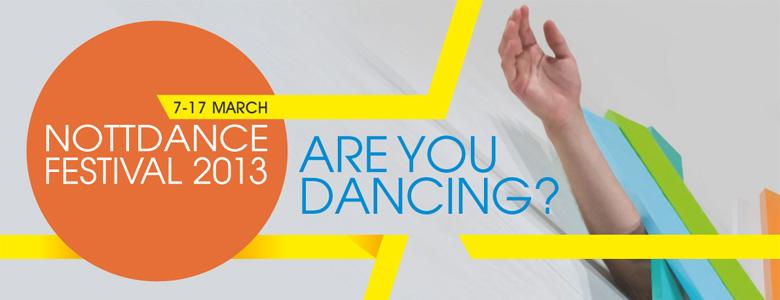
ARE YOU DANCING?


Dance4
Presents
Nottdance
7-17 March 2013

Dance4 has been responsible for bringing some of the more intriguing works in that whole physical theatre/choreography margin to the Edinburgh Fringe. That they have a biannual festival in Nottingham, Nottdance, which is a cheeky pun on the location and a nice statement of the ambiguity surrounding contemporary dance. Even the slogan could be a rejoinder to some of the more experimental performers in the genre.

Nottdance has been going for 23 years - suggesting that the question of "what is dance?' has been a bother for longer than is usually realised. It is international in scope - guests include Alias from Switzerland, Niv Sheinfeld and Oren Loar from Israel, Maria Hassabi from the USA, Miguel Pereira from Portugal, Rodrigo Sobarzo from the Netherlands and Colette Sadler from the UK. And Paul Russ, the artistic director, is clearly committed to the fun of messing with definitions.

"All of the work in this programme tells us something different about the artform by pushing the boundaries of dance and performance," he says. "For the past 23 years, Nottdance has earned its international reputation amongst artists as a vital platform to present new ideas and for audiences this remains a festival that challenges perceptions whilst being playful and entertaining."

And while the dance will continue in traditional venues like the Nottingham Playhouse and the Lakeside Arts Centre, Nottdance is promising to take a trip around the city into shopping centres, night clubs and offices.

Sometimes, experimental work is best experienced as part of a festival. My own love of Live Art comes from having attended the old National Review of Live Art in Glasgow, and my appreciation of conceptual visual art is the result of seeing loads during Glasgow International. This is partially due to context - dropping in for a bit of light entertainment and getting a deconstruction of gender relationships is always a bit of a surprise, so a festival that announces that the work will be a challenge stops too many surprises of tone.