Showing posts with label Vanishing Point. Show all posts

Monday, 29 February 2016

What is Theatre for, eh?

An idea that comes up again and again - especially when I interview Andy Arnold - is that theatre has a special place for the discussion of public concerns. Whether this existed in the earliest days of staged performance, I can't say (if it did, the Athenians of the fifth century had a few issues with patricide and mother-fucking). Of course, I think Diderot started it off. 

His writing on theatre - especially when he tries to explain why his plays are quite good, actually - emphasises the important of reflecting the worries of society. He invented a new genre, known as the drame, to make this point.

Even Kenneth 'Whiplash' Tynan, patron saint of critics and swearing on TV, argued with Ionesco that theatre is always political (the example he gave of how far political decisions impinge on life was, inevitably, in the purchase of cigarettes). He was not keen on what Arnold calls 'existential theatre', which privileged existential angst over more specific anguishes. 


While I am uncomfortable with my responses to The Citizens' recent Endgame, I believe that my complaint against its familiarity reflects my assumption that theatre ought to challenge the audience. Beckett is obviously a master playwright, and Endgame's vision of a post-apocalyptic world straddles the divide between abstraction and more specific paranoia (a hostile universe and a nuclear winter respectively). Although Dominic Hill did a solid job, getting great performances and playing out the script with clarity, I thought that Beckett's nightmare is too familiar, and draws heavily on 1950s' fears. 

The Beckett estates' conservatism on matters of interpretation - manifested in Hill's production - leaves Endgame as a period piece, lacking the immediacy of Hill's direction of, say, Crime and Punishment. It allows the audience off the hook, to read the event as performance rather than a critique. That is, it's easy to eulogise the actors, enjoy the words and revel in the dystopian rather than embrace the challenge of a play that reflects contemporary alienation.

Back with Andy Arnold, who recently directed Beckett's Happy Days: his choice of Mike Barlett's Cock was a far more bracing confrontation with the audience. Given its frank discussion of sexual identity, it did respond to modern dilemmas. Its basic premise - a man torn between male and female lovers - reveals a society more comfortable with observing same-sex relationships, but also going beyond a simple message of positivity. 

Despite sharing a certain bleakness with Beckett, it conforms to Diderot's ideal of the bourgeois comic tragedy. There were laughs, but the protagonist ended up alone on stage, the darkness slowly encroaching.

Cock was more uncomfortable than Endgame. It is set in a familiar domesticity which becomes more sinister than Beckett's blasted planet both because it fails to recognise wider catastrophes (the characters do reflect on their self-absorption) and it is more difficult to 'other' the characters' experience. Most people haven't existed in a post-apocalypse twilight. They have had dinner parties and worried about their ambitions and desires.

However, my reading of both plays is predicated on the assumption that 'theatre ought to challenge'. It's a variation on Diderot's claim: contemporary social relevance does not need to be provocative. One function of the critic might be to recommend productions - hence the star rating. My reviews are aimed at audiences who are, at least, in sympathy with my assumption. Endgame and Cock were well worth the time and money, although Gareth Nichol's Blackbird at The Citizens ticked the box harder.

Whether the purpose of theatre is to annoy the hell out of the audience is not necessary proven... the production of Cleansed, which is apparently ever so shocking, has bought back some public debate about the acceptability of on-stage violence. And sometimes, as Vanishing Point are currently showing in The Destroyed Room, breaking the format can be a powerful way of shoving the shit right in the audience's mush.

Monday, 6 October 2014

Interiors @ Tramway

MYRA MCFADYEN, AURORA PERES AND BARNABY POWER
There’s little point in belabouring the excellence of Vanishing Point
EVENT REVIEW BY GARETH K VILE.
PUBLISHED IN THE SKINNY01 OCTOBER 2010


Interiors scooped the CATS awards in 2009, even against the competition from David Leddy’s first run of the powerful Sub Rosa, and has more stars than a major constellation. The cast, silent behind a glass screen, bring the intense emotions and trivial interactions with appropriately naturalistic mime and the drama, allowing for typical theatrical compression, is naturalistic and nuanced. The voice-over does get rather over-wrought at times, but the willingness not to spell out the exact details, and the contrast between the exterior of the party and the emotional turmoil within is seamlessly handled.

It’s more interesting to consider Interiors’ message: essentially that to be human is to desire, but that death eventually takes us all. Interiors doesn’t turn this into a soft appeal for compassion. The detachment is almost Buddhist, while the final message, from the ghostly observer, is, paradoxically, inconclusive and slightly melodramatic.

Interiors doesn't quite celebrate life. It is a play of “almost” and “nearly”, constantly homing in on moments where one set of possibilities are opened, only to be abruptly closed. Young love almost flowers, a seduction is foiled, a marriage proposal is rejected, then mocked. The comedy is never cruel, but softens the intensity lurking in the interplay of the characters. Nothing really happens, although the characters seem to threaten sudden outbursts.

Interiors seems to be profound, yet offers little but a vague truism. Through its deceptively casual performances and measured direction, this absence of moral or meaning is, in itself, fascinating. It is as if Vanishing Point are refusing the convention that theatre has to have a message, and come close to actually expressing the anguish of a community disconnected and purposeless. The relationships between the characters are vague, their reason for assembling never clear, the empty seat at the table is never explained. This incompleteness is discomforting, lending the production a luminal, suspended languor.

The responses of the audience are equally fascinating. One Scottish performer claimed that he wanted his hour back, comparing it unfavourably with the sense of event that surrounded the revival of Blackwatch: another said she didn't understand the mention of polar bears, or why the ghost outside bothered dressing for winter after repeating that she didn't feel anything, anymore. These are more than quibbles, especially given the critical and popular reception of the play. They express the unease and discomfort Interiors generates. Their negative responses, however, do not detract from the importance of a play that so imaginatively uses the stage and actors to comment, albeit slightly, on the subtle conversations and disappointments of mundane life.

Tomorrow @ Tramway

Vanishing Point have made a virtue of eclecticism: while their productions share a commitment to high production values and an integration of text, scenography and precise direction from Matthew Lenton, they tackle subjects as varied as violent pornography, moral corruption, existential doubt and, in Tomorrow, the onset of dementia and death. Reducing Tramway's expansive space to an intimate stage, through Jamie Harrison's austere design, Lenton's study of a man's final days is a moving elegy that refuses sentimentality.

At just over an hour, Tomorrow abandons a typical dramatic story for a series of allusive episodes. The transformation of the young man into his senile self is quickly effected, through encasing him in a latex mask, and the following scenes - the lounge of a hospice, a sneaky cigarette with the nursing staff, a sudden burst of loud music and desperate action - examine the dwindling hours as he is gradually submerged in his dementia. From the vague interactions with the other patients to the difficult reunion with his daughter, whom he inevitable mistakes for his wife, the hero only briefly longs for escape before the lights, then the sounds, disappear.

Lenton's dispassionate direction makes Tomorrow all the more melancholic: rather than build towards a dramatic resolution, he allows events to take their course. An attempted escape from the hospital becomes poignant, and the final scenes descend into a comforting darkness. Tomorrow evokes a state of confusion, tracing the sad journey of one man as his life, and memory, slowly fades to black.


Wednesday, 3 September 2014

Why UK theatre should look beyond its borders

As much as I am trying not to distracted by the outside world, Lyn Gardner posted an opinion piece on the important potential of British work looking towards Europe for future collaboration. Aside from a pessimistic belief that it is being encouraged 'as the money dries up in the UK,' she makes some positive sounds about the artistic possibilities.

Quick as a flash, someone - I assume it is Matthew Lenton - from Vanishing Point added a comment. They noted that Gardner's article used the UK when she meant England (and I know that's getting called these days), and that his own company had been collaborating with Europeans for years. On twitter, Tam Dean Burn mentioned that he's first seen European work in Scotland during the 1980s.

Before I started doing my survey on Glasgow performance - and before I even became a critic - I always thought that talk of British theatre denied the distinctive identity of Scottish theatre (and probably the local identity of the regions, too). Being a critic then got me into more shows than anyone with a social life would want. And my assumption was that Scottish theatre was an amalgam of English and European traditions. I was getting to see all sorts of Belgian antics at Tramway, plus David Greig at the Tron.

There was a period, early on in my critical career, when everyone seemed to be doing a Forced Entertainment. I didn't mind, because I had had my mind blown by Bloody Mess, but as I saw more (say, Les Ballets C de la B), I recognised that international traditions were crucial to Scottish performance.

The initial soundings of my survey are confirming this - no results yet, please wait and see - but Lenton's reply (if it is him) cuts to the bone. I'm ploughing through Rewriting the Nation by Aleks Sierz and am constantly surprised by how few Scottish-based works are mentioned. Of course, the book is about new writing and legitimately excludes much of the devised work I praise (although the line between the two processes is pretty thin these days).

However, preoccupied as I am with the idea of a Glaswegian performance identity (which may or may not exist), I am frustrated by the grand-standing of critics who make large statements without closing in on the facts. I am suspicious of 'should' and I am even more suspicious of 'UK theatre' as a meaningful category. 

I do have a category of 'international theatre': stuff which is big enough to tour the world. I always put Vanishing Point in that category, even though their office is just upstairs from me.

Monday, 19 May 2014

CATS 2014: Shortlist for Male actor and Thoughts

BEST MALE PERFORMANCE:

Adam Best (Raskolnikov), Crime and Punishment, Citizens Theatre, Liverpool Everyman and Playhouse and Royal Lyceum Theatre, Edinburgh
Looking pretty hardcore in this photo (credit: Tim-Morozzo), Best got to play a dream part: the existential hero of Dostoevsky's novel that saved me from wondering whether it was okay to break the law if I was cool enough (it isn't). A big role, that addressed the audience on matters philosophical and went increasingly wild as the guilt heated up, Best's performance was an intriguing mix of bad-ass and sensitive poet. Just like Raskolnikov himself...


Jimmy Chisholm (Bob Lawson), The Collection, Rapture Theatre in association with the Beacon Greenock
While Tam Dean Burn played the guy you really wouldn't want turning up to the door, Chisholm pulled on his natural stage presence to present Bob Lawson, Scotland's answer to that one in Death of A Salesman. In a play that is earnest and horrific (shades of the fast-talking bastards who hide behind lovely adverts for extortionate loans), Lawson's tragedy is the problem of giving a shit in an industry of shits. 


Sandy Grierson (Ivor Cutler), The Beautiful Cosmos of Ivor Cutler, Vanishing Point and the National Theatre of Scotland presented in association with Eden Court
Being Ivor Cutler was always going to be a tough gig: add in (Grierson's own co-written) version of the man, who dances in his imagination, and a storytelling structure that has Grierson jump between himself and Cutler, then Grierson had a showcase for versatility. Sometimes he was Ivor the confused older man, sometimes the laconic singer, other times the cheeky outsider. 


Scott Reid (Thomas), A Perfect Stroke, A Play, a Pie and a Pint presented by the Traverse Theatre Company
A month after seeing this, I can't decide whether Reid's Thomas was a victim or predator. It's a tough ask to play a schoolboy having at go at seducing the teacher, and Reid's big red face when he got angry suggests he'll be playing Lear at some point in the future. With McKnight's script awkward and subtle, Reid's role was pivotal for the sense of sexual unease. He is doing some acting exercises in the photo (credit:  Lesley Black), I think. Perfectly innocent


Friday, 11 April 2014

The Beautiful Cosmos of Ivor Cutler

Five parts of The Beautiful Cosmos, divided for assessment.


The Text: Vanishing Point use the life and music of 'surrealist folk' poet Ivor Cutler as the basis of the production. His songs provide a structure to episodes from his life, starting with his childhood in Ibrox through his relationship with Phyllis King, his success in London (he was a regular on all the BBC radio stations) to his senility in a home. Although some of Cutler's songs are performed in the style of the original (generally, a solo dour voice accompanied by the harmonium), others are orchestrated. Actor and co-creator Sandy Grierson's meetings with King are dramatised, both connecting the performance to Cutler's surviving associates and exposing the process of making.

The Direction: Matthew Lenton's position as artistic director suggests that he is responsible for the adaptation of the source texts - but the programme notes that it was 'created by James Fortune (the music director), Sandy Grierson and Matthew Lenton with the Company.' There is a broad chronological arrangement of the source texts, making Beautiful Cosmos a straight-forward journey of the man as artist. Yet by interrupting this simple narrative with song and dance routines, intimate and charming conversations between Grierson and Phyllis King (played with a warm, independent sensuality by Elicia Daly), the company juxtapose the art against the life, hinting at complex emotional depths behind the apparently humorous words.

The biggest interpretation comes from the decision to orchestrate Cutler's songs with a full band. Cutler himself was not a rock'n'roller, despite being in a film with The Beatles and championed by John Peel. Indeed, Grierson quotes one of Cutler's most famous complaints 'amplification is the curse of civilisation' when his microphone cut out. But in giving some of Cutler's numbers more rhythm and more melody, Vanishing Point explore some of the subtexts in his lyrics (his Jewishness in a klezmer-inflected jamboree, his dreamy playfulness in a groovy little number about a fly), while abandoning his art's frailty and minimal dourness.

When they reach Cutler's dotage, this is supported by a melancholic, disjointed sequence - echoing Cutler's decline and shattering the chronological span. It's a beautiful moment, capturing the alienation and confusing of a man on the threshold of death.

The Technology: A big live band, an interlude with foley action, Kai Fischer's predictably impressive set, a detailed lighting score (which Grierson's Cutler draws attention to by asking for the speakers to be turned down and the lighting made 'more miserable'): Vanishing Point slap the scenography out in front of the audience in that good old Brechtian style. The scenography is used to emphasise the theatricality of the show, to break any suggestion that this is a realist production.

This goes against the grain of Cutler's own aesthetic, but works to highlight his personal vulnerability -and the fragility of his art. There is richness to the ideas beneath Cutler's tranquil poems and songs, and the exposed technology conjures up a lively emotional life not always revealed in the sardonic recitations he committed to vinyl.

The Performances: The band do a fine job, Grierson convinces both as himself and Cutler, Elicia Daley is charming and Ed Gaughan works very hard in multiple roles. Good ensemble work et c... but Vanishing Point are never a worry on this score.

Ethics: Interesting category for review, this one. Isn't it?


Saturday, 15 March 2014

Vanishing Point appear in Brighton

Vanishing Point are one of a group of companies that I associate with the growth of Glaswegian performance during the late 1990s (the others are Cryptic, Suspect Culture and Untitled). Whether it is just a fantasy, or they all were inspired by the flow of international work that used to come through Tramway, I see them as making work that was as engaged with the visual as the literary, creating theatre that was worth watching and not just hearing.

They all share a serious work-rate, too. Vanishing Point obviously felt making the Big Show of the Year for the NTS wasn't enough, and are nipping down to  premiere a new piece at 2014 Brighton International Festival/ It is called Tomorrow, and marks Vanishing Point’s first co-production with Brighton International Festival and Cena Contemporânea, Brasilia.

Press release begins...

Following the Brighton premiere at Brighton Dome Corn Exchange on 21 – 24 May 2014, the production will play at Cena Contemporânea, Brasilia(August 2014) and Glasgow’s Tramway (October 2014).

Conceived and directed by Matthew Lenton, Tomorrow is a devised piece with an international cast exploring issues of old age and dementia, needing care and needing to care.

“Old age, dementia and care are among the most pressing issues facing 21st century society,” says Lenton. “Through this production we aim to explore some of the many challenges and dilemmas from the perspectives both of those who care and those who need care.”

“We are delighted to be premiering the piece at the 2014 Brighton International Festival and to be continuing our long and fruitful relationship with Tramway,” he adds.

"Brighton Festival is very happy to be collaborating with Vanishing Point, one of Scotland’s most consistently stimulating and intriguing theatre companies,” says Sally Cowling - Associate Producer, Brighton Festival. “Their mesmerising and elegant show, Interiors, played in Brighton in 2012 and we greatly look forward to the company’s return this May. Their new piece, Tomorrow, will premier at the Festival alongside the work of extraordinary artists from all over the world including Declan Donnellan, Wim Vandekeybus, Dmitry Krymov and the Belgian theatre and filmmakers, Berlin".

Tomorrow also marks another first for the company which has been flying the flag for Scotland internationally for over 10 years. Following a series of master-classes led by Matthew Lenton at the 2013 Cena Contemporânea, the company is now set to co-produce a work with the leading South Americanarts festival.

“It is particularly exciting for the company to be co-producing a work with Cena Contemporânea,” says Severine Wyper, Producer and Manager of Vanishing Point. “Over the years we have worked with a number of international venues and festivals, but this is our first co-production with a leading South American festival and we are delighted to be partnering with Cena Contemporânea.”

“How to build a bridge linking the cities of Brasilia and Glasgow?” adds Guilherme Reis, Director of Cena Contemporânea, Brasilia “The Cena Contemporânea Festival and Vanishing Point joined together to build this bridge. The festival reaches its 15th Edition this year reaffirming its vocation to break frontiers, broaden horizons and build a better world. Overcoming distances and difficulties, we are proud to participate in the new piece by this important Scottish company and we are ready to receive Tomorrow in our festival in August 2014. ‘Tomorrow’ is soon.”

Lenton began work on Tomorrow last summer in a series of master-classes for the Stanislavsky Foundation in Moscow with a group of international actors. The ideas explored in these sessions were then taken forward in a development period with the cast and creative team in Glasgow earlier this year.

The cast brings together actors from Scotland (Jenny Hulse, Samuel Keefe and Peter Kelly), England (Elicia Daly), Russia (Aleksandra Kuzenkina), Serbia (Damir Todorovic) and Brazil (William Ferreira). Meanwhile regular Vanishing Point collaborators including Pamela Carter (dramturg), Kai Fischer (lighting design) and Mark Melville (sound and lighting design) form part of the creative team for Tomorrow which also includes Jamie Harrison (stage design) Jessica Brettle (costume design) and Pauline Goldsmith (artistic associate).

This is an interesting bunch of colaborators: Jenny Hulse was in Wonderland, the controversial Vanishing Point show about on-line pornography (the violent stuff); Todorovic has made his own, very political theatre; Fischer is a great of theatre design, who can turn out a set that really can double as an installation in its own right; Pamela Carter is always value for money, with a sharp insight, and Jamie Harrison is out of Vox Motus, who totally knocked it out the park with Dragon. 

Tomorrow is Vanishing Point’s second major collaborative project in 2014 along with The Beautiful Cosmos of Ivor Cutler, a co-production with the National Theatre of Scotland which premieres at Glasgow’s Citizen’s Theatre on 10 April 2014.

Tomorrow is a Vanishing Point, Brighton International Festival, Cena Contemporanea, Brasilia and Tramway (Glasgow) co-production in association with Platform (Easterhouse) and National Theatre Studio (London)


Saturday, 13 April 2013

Beggars Opera

BLOG POST BY GARETH VILE.
PUBLISHED 16 SEPTEMBER 2009


At this year’s Critics’ Award for Theatre Scotland, Vanishing Point swept the board with the intimate Interiors. For latest production, The Beggar’s Opera, they negotiate a co-production between Tramway – home of radical European performance – and the more sedate Lyceum. Bridging the gap between hip and sedate, Vanishing Point’s Matthew Lenton is one of the most important directors in Scotland.

From the moment the curtain rises on the two-levels of the set, with A Band Called Quinn ready to rock and a huge video screen in the rafters, The Beggar’s Opera boasts its cross-platform, multi-media, contemporary theatre practice credentials. But when the band kicks into the first tune, the contradictions are painfully evident. Muffled music, garbled lyrics and the sort of physical theatre that needs proper choreography: conservatism triumphs, reducing any radicalism to a suggestive, symbolic trace.

The tension between Vanishing Point’s desire to create an edgy, modern version of John Gay’s satire, and the politeness of the adaptation is never fully resolved. The humour – hardly helped by performances that veer from school-play melodrama to pantomime mugging – is lost and the moments of explicit social comment are blunt.

The visual impact of the criminals, hidden behind gas-masks and outré costumes, is lost whenever they slip into Gay’s text and the video footage is static. Predictable swipes at celebrity, brief soliloquies, sexy costumes - even the famous finale that breaks the suspension of disbelief - attempt to transcend the fourth wall but are all half-hearted: even a brothel scene is unerotic and trite, where the presence of a dominatrix is merely a signifier of taboo, lacking emotional impact. The presence of a healthy burlesque culture in the central belt exposes the three whores as tokens of subversion, rather than frightenly sexual and alluring.

The references to popular culture – including a weak version of The Doors’ The End and – oh God – The Streets - are limp and the antihero MacHeath misses either charisma or genuine edginess. The overall impression is of either a mainstream company appropriating alternative theatre, or an gang of outsiders selling out.

Yet it was, at the curtain call, fairly well-received: despite the jokes and the dramatic tension falling flat, it seemed to serve, for the Lyceum audience, as an interesting and titillating experiment. It is encouraging that the Lyceum is willing to engage with more challenging work, and that Vanishing Point are willing to move out of their comfortable small scale: Quinn don’t disgrace themselves, even if they are competing with Weill and Brecht’s re-imagining of the play, and Damir Todorovic evinces a sinister policeman.

The ideas driving this production are beautiful, but it needs better performances, tighter pacing and less compromises with accessibility: it fails to shock or threaten, and its challenges are predictable. Vanishing Point are still a vibrant force, and they will go on to create good work again, but this is a disappointing jumble of good expectations and poor taste.

Tuesday, 26 March 2013

As It Is (Mayfesto), Pastoral (Soho Theatre), Un Petit Moliere


Vanishing Point don't mind tackling tough subjects - their Edinburgh International Festival entry Wonderland confronted their audiences with the online, violent pornography - and their contribution to the Tron's Mayfesto season is a chilling journey back to one of the 1990s' most horrifying conflicts. As It Is has been created by Associate Artist, Damir Todorovic and revisits the war in Bosnia.

Following the theme of Mayfesto, As It Is grapples with issues of identity: yet in a Europe where national identity is in crisis, belonging to one nation or another can be a matter of life and death. Todorovic's characters is looking for the truth in his past, but finds that memory can play tricks and even a lie detector might not be enough to get to reality.

Apart from undermining Jeremy Kyle's moment of high drama, As It Is is a reminder that identity isn't just a parlour game for armchair politicians. The war in Bosnia has become a flashpoint for questions about civilisation and nationhood: a brutal conflict sprung up in what was supposed to be a continent that had grown out of warfare. In a state twisted by totalitarianism, the truth is neither simple nor necessarily possible: lies may be the only way to stay alive, or live with any integrity.
AS IT IS

Tue 14 – Thu 16 May, 7.45pm

Another new work - this time in London, the winner of the Soho Theatre's Verity Bargate Award for new writers - deals with humanity on the brink, albeit in slightly easier circumstances. Menacing cats and strutting voles are stalking the countryside, and nature seems to have become dangerously fecund. Although Thomas Eccleshare's script has a dark humour, its representation of nature preparing to take back the planet from humans is sinister and serious
PASTORAL
Previews: Thu 25 – Sat 27 Apr, 7.30pm
Wed 15 May – Sat 8 Jun, 7.30pm
Matinees on Thu & Sat at 3pm
Press Night: Fri 17 May, 7.30pm

After two dark, modern plays: a little light relief. I'll let Lung Ha's Theatre Company speak for themselves...


Thursday, 18 October 2012

Biding My Time

Although Biding Time (Remix) follows the story of Louise Quinn's personal story of music industry horror, she has spent most of the past decade reinventing herself as a post-modern singer-songwriter. Leader of A Band Called Quinn, she wrote and performed the music for Vanishing Point's Beggar's Opera, curated a series of cabaret nights that replaced the usual neo-vaudeville with serious and funny acts inspired as much by Live Art, has worked with Mischief La Bas and collaborated with Kid Loco.

For her version of Pippa Bailey's original play - which addressed Bailey's frustrations at the entertainment industry from an actor's perspective, Quinn hooked up with Grid Iron's Ben Harrison and a cast that includes legendary drag king Diane Torr, Gaelic film-maker Uisdean Murray, alongside her band and young actor Martin McCormick, and remixed the script into a fresh study of record label dishonesty.

Quinn cleverly uses the traditional format of the gig to structure Biding Time: the filmed and performed interludes - involving McCormick as a sinister and sometimes sweet white rabbit - push along the narrative which is illustrated by a song cycle. Moving from the band's enthusiasm and good fortune, towards their inevitable rejection by a music industry that is lecherous, dishonest and manipulative, Biding Time touches on juicy political issues - the objectification of women in music, the obsession with style over substance, the vogue for alternative thinkers to be swept away by an environmental evangelism - without ever distracting from the powerful craft of the band.

Playing heavily on Quinn's ambiguous persona - she recalls the alienated glamour of David Byrne's early Talking Heads' stage persona - the set is heard not through the usual PA system but through the fashionable silent disco equipment. Personal headphones replace amps, perfect for relaying the intimacy of Quinn's signature style, gentle New Wave rock. Inevitably, the single mimed moment represents the song encouraged by the label, the mainstream appeal, distorting Quinn's melancholic vocal into a stereotypical disco queen, substituting her idiosyncratic song-writing for a generic female sex object.

Quinn's story - the programme comments that "any resemblance to real persons, living or dead, is purely intentional" - is most engaging when dealing with gender politics. Aside from her transformation into a Madonna clone, the decision to cast Diane Torr as Mr Big emphasises the masculine culture of the record label: the insinuating lechery of various other music industry characters - again performed by McCormick - places Quinn at the mercy of a voracious assembly. The presence of the White Rabbit alludes to an Alice in Wonderland adventure, with Quinn cast as the innocent abroad. But like vanishing Point's Wonderland, this Wonderland is less fantastic than exploitative.

The music, the method of amplification and the episodic story-telling mesh effectively with Harrison's subtle direction and Bailey's original tale: this is experimental theatre that avoids aggression for a compassionate disappointment. The narrative is advanced as much by mimed, symbolic set pieces as the words - which include the voices of disappointed fans, business figures, an idealistic hippy and Quinn's mother ,a constant dour worry. At heart, it's another showcase for A Band Called Quinn's talent, filtered through a structure that offers at least one possible escape route from the predictability of the rock gig, and an opening for other theatre-makers to explore the medium's potential.

November 1 Cumbernauld


Thursday, 27 September 2012

Okay, that's enough on Wonderland


An image that does not appear in this version of the show.
Wonderland didn't go far enough. That isn't to say that a story about violent pornography, the destruction of the heteronormative relationship through the accessibility of on-line dark fantasies and the degradation of sexuality into a mere commodity is in some way mundane. But the focus on a particular sort of pornography and eroticism, ironically, softened the blow.

Although Wonderland - it shares a title with a film about the association of the pornographic and the criminal - sets out to unravel the sickening complicity of polite society and its darker underbelly, it descends too quickly into the world of violent, misogynist pornography. The allusions to Alice in Wonderland suggest a sort of "seduction of the innocent" but this Alice is already corrupted by the start of the play. She may act the innocent at the start, but she is merely posing, all the better to fulfil the pornographic fantasy.

The simple narrative of a woman losing her autonomy through  performing in pornography is complicated by Alice's own ability to switch between the compliant and the determined.  Although there is a moment when she resists the pornographers - sincerely, not in character - the switches between her porn persona, Heidi, and her true self, Alice, prevent the moral as being simply a condemnation of exploitation.

Then there is the sort of pornography being represented in Wonderland. It is not, as many reviews have stated, "hardcore pornography". It  is violent, hardcore pornography. Wonderland isn't making a point about the general availability of sexually explicit content. It is looking at a very specific strand of pornography.

Vanishing Point reduce the problem of on-line pornography into a matter of content, not its very existence. The tension between the complexity of Alice's story and the specificity of the pornography undermines Wonderland's immediacy. It is more philosophically satisfying - Wonderland is far from an angry polemic on exploitation - but lacks a visceral attack.

The danger presented in Wonderland is that certain men are getting their sadistic kicks through the proliferation of hardcore, violent film. Instead of an everyman character being seduced into nastier eroticism, the male starts off with some fairly vicious kinks: he tries to persuade a cam woman to abuse herself, has a thing for young girls. That the woman on cam draws a line under his antics is a forceful reminder that, actually, such behaviour is extreme. By the time he is watching a video of a woman being murdered (which the play makes clear is a performance and not a snuff film), he has already embraced his desires as liberating.

He's effectively insane by the time he is running about and cleaning his house in paroxyms of guilt.

By making the villain so specific, Vanishing Point allow the audience an escape. Lenton is clearly not interested in bland generalisations - the fuss made about the production at the Edinburgh International Festival implied that this was a scathing analysis of hardcore pornography's impact on society. It also suggested that the play had gone too far, and become as exploitative as the material it aimed to condemn. Neither of these are true. The appearance of the actors for the traditional bow reveals how far this show is from torture pornography. The blood can be wiped away.

Instead, Wonderland is about a specific perversion, one still generally regarded as beyond the pale. When The Skinny is full of articles about how pornography is okay, really, Lenton does well to find a subject that remains controversial: yet ultimately, few people will be challenged by the idea that being sexually aroused by violence against women is a bad thing.

However, Lenton does hint at a broader application. The dream-like sequences, familiar from Vanishing Point's last production, Saturday Night, encourage a more metaphorical interpretation. If the torture porn is a symbol for violence or pornography in general, the play is making a powerful point, examining how pornography can alienate. Yet, ironically, the class of the characters becomes important: it's a nice middle-class couple getting screwed by the internet. Again like Saturday Night, Vanishing Point are preoccupied with the horror beneath the facade of respectability.

It also becomes a man's story. Ultimately, Alice walks away, and the lingering image is of the consumer, covered in blood - very deliberately, Alice wipes the blood from her face in her "exit interview," designed to prove that the film she has been making is fictional. Vanishing Point have done such a good job of mixing fantasy and reality by this point, it is not clear whether the blood she wipes away is meant to be real. But the story of Alice is submerged beneath John's.

Vanishing Point are a brilliant company: Kai Fisher's design is superb, allowing the video footage to dominate the domestic bliss the straight couple have built in the form of a comfortable sitting room; Jenny Hulse is incredible as Alice, flickering between her pornographic role as a victim and an assertive young woman with ease. The cast is strong throughout and Lenton's ability to introduce a surreal visual sequence is deployed to disorientating effect.

But this brilliance can obscure the seriousness of the subject. An accomplished drama can hide the viciousness of its content beneath the veneer of theatrical intelligence. Wonderland tells one story - and rejects telling a great many others - with theatrical verve and philosophical integrity. But as a meditation on the power imbalance within pornography, it is trumped by Pamela Carter's short, Meat, which manages, in twenty minutes and a final wry smile, to deconstruct the acceptability of pornography in a similar heteronormative couple's life.

Tuesday, 25 September 2012

Wonderland: Alice's Story


Strip away the parallel story of John, husband and consumer of violent pornography. Strip away the mundane villainy of the Eastern European pornographer. Strip  away the uneasy allusions to Lewis Carroll.

Strip away Kai Fisher's set. Strip away Matthew Lenton's skillful manipulation of reality and fantasy. Strip away the condemnation of bourgeois dishonesty. And strip away the introduction that describes reality as a series of rooms, each one darker.

Be left with Alice's story. Alice comes from a safe family. By the start of Wonderland, she is ready to act in hardcore, violent pornography. It's never clear what has led her to this point: her clothes do not suggest poverty, her manner is not redolent of abuse. Of course, in real life, these things are hidden. But theatre has the option of making them present. Wonderland chooses not to.

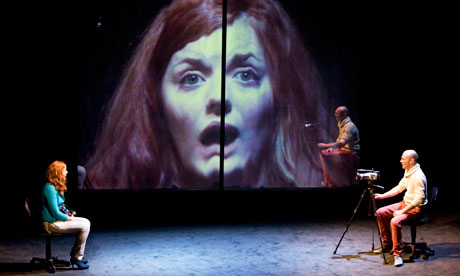
First scene: Alice is interviewed twice. Once as herself, once as Heidi, her porn persona. At various points in Wonderland, her projected face looms above the set. She whispers that she is frightened, that she fears that she is going to be killed. A knife is pulled on her throat.

She runs screaming from the filming, followed by her co-star. She is Alice again, not Heidi. She asserts herself, then returns to the film.

Following a spot of surrealism, the climax: Heidi is murdered. Symbolically, the murder is not enacted by her co-star but John, the viewer and her father. Then, she performs her exit interview, wiping the blood from her face, affirming that she gave consent to the filming. She is paid, she leaves. Her intention is to come back, for something more spectacular.

Alice is not a victim: even the pornographer wants to make sure she knows what she is getting into. Alice walks away from the set, cash in pocket. It is as if she has not been harmed. Wonderland tools about with fantasy and reality throughout - the murder appears real, John's blood might be a metaphor - but concludes with reality asserting itself.

It's difficult to see how Alice has been damaged by her experience. Of course, it can be assumed that she is damaged in the first place, or that she ended up getting into the ugly business at the end of a series of bad encounters.

That John is both the consumer of her product and her father might allude to a history of child abuse, but it feels more likely that Vanishing Point are using this amalgamation to make a broader point about how every porn actress is somebody's daughter.

The moment when the pornographer asks her about money hints at poverty. But these are mere suggestions, and need to be imposed on the performance.

Alice provides the most shocking moments: her original interview is degrading and uncomfortable to watch. Her murder is brutal. It might be her calling her mother. Her mother refuses her. Jenny Hulse convinces as both lively woman, degraded woman and corpse. Yet because she moves between these characters with such ease, Alice is impossible to grasp. The other characters have clear narratives - the pornographer is a little too stereotypical, her co-star is a hunk with a cock, John destroys his piece of mind. Alice just remains.

She is just a series of surfaces and projections, metaphorically and literally.

Strip away the backstory. Strip away her family relationships. Strip away a boyfriend, a life outside the studio.

Strip  away the compassion. Strip away her self-awareness. Strip away any knowledge of how the film is going to be used. Strip away everything.

Sunday, 23 September 2012

Wonderland: Take One

Vanishing Point do not shy away from difficult content: their reboot of The Beggar's Opera happily followed the original's vision of a world where police and thieves are essentially two extremes of the same system of exploitation, and Saturday Night opened up the precipice beneath the superficial safety of middle-class luxury. Wonderland grabs a few themes from Lewis Carroll's Alice stories, corrupting innocence and disappearing down a rabbit hole that is populated by surreal symbols of a world gone bad.

Director Matthew Lenton attacks on two fronts: the induction of Alice into violent pornography and the seduction of a husband by the increasingly brutal opportunities of the internet. The message, voiced by a mysterious, grubby character who exists only in the husband's mind, is that a darker, shinier reality exists beneath the bland surface of domesticity: both Alice and the husband - possibly her father - descend only to emerge covered in blood and guilt.

From the start, Alice is not presented as an innocent: her audition scene is a  clever mix of her sincerely nervous introduction and uncomfortably believable, but ultimately performed, terror. Her appearance, enlarged, brutalised and frightened, on the video screens at the back of Kai Fisher's brilliantly designed set, forces awkward questions about the reality of violence mediated through the industry that manufactures sexual fantasy. Yet in her final scene, Alice wipes away the blood and affirms that she made the film willingly and, indeed, she'll be back again tomorrow for some more.

It's in the husband's story that Lenton is more explicit about the consequences of violent pornography. If the actors aren't really injured, the husband has been sucked into expressing his  most brutal impulses. His final scene, sat on the couch with his wife, flicking through holiday brochures while covered in blood, is a bleak image of life on the home front. Having been initiated into the darker world, he can never quite return to the cosy domesticity of the first scene.

Wonderland is ambivalent about the cost of violent pornography - the creators are not seen as victims, only the consumers: the final scene suggests that while Alice's path is pretty miserable, it isn't as damning as the husband's fate. Yet the suggestion by the film-maker that tomorrow's filming will be 'spectacular' holds a sense of threat: lacking either a clear condemnation or sense of redemption, Wonderland refuses to judge, becoming all the more unsettling.


Tramway, until 29 September 2012


Wonderland: Porn and Parenthood


Over the past twenty years, partially thanks to the internet but also due to a softening of the laws around the representation of sexual imagery, pornography has become a big industry. Rumours abound that it has a larger income than Hollywood cinema, and art responding to pornographic's social impact has proliferated: Grant Morrison's The Filth is a bold attempt to innoculate the reader against the horror through the administration of a graphic novel, while Tumbling Doll of Flesh is a harrowing introduction to the extremities of  torture porn.

Wonderland engages with pornography's darker corners. A father and his daughter, in different ways, are drawn into the twilight world of violent, on-line pornography. Both are damaged - the daughter is rejected by her family, the father is alienated from his rather comfortable life - and Vanishing Point's dissection of the hidden brutality in sexual desire is unsettlingly ambiguous.

The father's story - he begins as a comfortable middle-class husband, at home with his wife, watching the television and enjoying domestic bliss - is the more forceful. Haunted by a grubby ghost, who insists that his desires are healthy, he gradually chases rougher imagery: an early encounter with a video-cam woman is replaced by full-blown torture and murder movies. The careful application of symbolic drama - it seems as if the father has committed a real murder - emphasises his brutalisation and his scene with the cam actress follows his decline from vaguely horny guy to vicious thug.

Director Matthew Lenton sketches out the reach of violent pornography: from the obscure location of the filming - probably somewhere in central Europe - to the polite middle-class homes of Scotland, it impacts on lives, alienating the husband from the wife, the child from the parents. Despite the flashes of nudity - male and female - it veers away from sensationalism, almost dour in its presentation of the filming. Lenton seems fascinated by the emotional consequences of watching violent pornography, illustrating the fragmented fantasies through a late intrusion of surreal visual theatre.

The almost casual finale shows the father, covered in blood and having lugged a suitcase across his front-room, attempting to reintegrate into his cosy life. Yet the ghost is now sat on the sofa, having previously been consigned to the outside, and the father's awkward gestures give the lie to the scene of marital unity. An earlier episode, when he frantically cleaned after a bout of on-line dirty action, pictured his guilt in a simple tableau. Lenton's awareness of the power of images - Kai Fisher's set allows the framing of certain moments as iconic tableaux- drives his theatrical imagination and doubtless informs his recognition of how watching violent pornography can corrupt.

It's perhaps telling that Wonderland does not follow many of the predictable narratives associated with pornography: the argument that it can liberating never comes up (interestingly, a moment of real danger during the filming reveals that the actors have no safe word, a commonplace in actual BDSM; the pretend pornography is potentially more dangerous than actual sex), the economic pressures that force women into pornography or prostitution are not explored, except in a brief, throwaway line. There's no attempt to identify pornograpy within a broader context of exploitation.

Since the characters are all unreliable witnesses - the father is a pervert, his taste for violent sex hinting at paedophilia, the ghost reckons himself to be some kind of Sadean messiah but looks like a tramp, the film-maker is a cynical capitalist, the daughter switches between her Alice and Heidi (her porn name) - and Lenton is constantly switching between the fantastic and the realistic, any grand statement would be as compromised as a man caught on the naughty pages by his mother-in-law.

Tuesday, 25 October 2011

Vanishing - but where's the Point?

After the National Theatre of Scotland, and possibly The Oran Mor’s Play, Pie and Pint programme, Vanishing Point might be the most important theatre company in Scotland. Certainly, they are the most consistently experimental group working on a large scale: that I don’t particularly enjoy this outing doesn’t mean that I am ignoring their reach and worth.

Interiors was self-consciously a chamber piece, concentrating on a family reunion. Saturday Night revisits this intimate territory, narrowing down to a brief sequence in a couple’s life. Time is condensed, a technique familiar from Greek tragedy which confused Aristotle into presenting “the unity of time” as a feature of drama, so that significant events – moving in together, the joy of unexpected pregnancy, the rather brutal birth and the decay of affection – are bundled into a single evening. If the finale suggests that the action comes from the memories of a mysterious older woman – she holds the same cuddly toy that the young woman brings into the new house – Saturday Night refuses to admit easy interpretation. The slow intrusion of the uncanny, which climaxes in the invasion of a group of chimpanzees, suggests a horror story about the decline of civilisation. The petty problems of house-keeping, such as a leaking roof, are given an occult, sinister, symbolism. Even the intrusive neighbours seem to be more surreal than naturalistic obstacles to domestic bliss.

The underlying tension between the realism of the couple’s activities and the cosmic implications of the distractions does undermine the play’s immediacy. Coupled with the stunning set – Kai Fisher has repeated his trick from Interiors, of encasing a house in glass, creating a literal fourth wall between the audience and players. The emotional distance between the audience and actors is never resolved. Even the nudity and toilet scenes are given a sterility, and director Andrew Lenton is moving far away from the fashion for immersive theatre, with all its immediacy and complicity.

Pamela Carter’s script has her distinctive, disorientating atmosphere. Scenes and themes merge uncomfortably: the drama of a positive pregnancy test fades into a comic bathroom privacy turn. The distressing birth – a woman alone on the toilet floor – is played out next to the father’s joyful stoner session. Carter’s skill, even shorn of words, is the awkward juxtaposition, of using actors like dancers, shifting from one scene to the next without causality, without progress. It is disjointed, consciously, and unsettling.
Yet Vanishing Point never disappear into raw, aggressive surrealism. The tone is measured, incongruously, and warm. Perhaps this prevents the presence of hostile primates becoming too disturbing, or leaves the periodic intrusions of commentary from the television toothless.

This distance from the performance prevents any real compassion, or engagement, with the character’s dilemmas: in doing so, it recalls the shock tactics of 1960s theatre, without the brutal impact. Artaud, a key influence on The Theatre of Cruelty, advocated a theatre that reminds humanity of those forces beyond Mankind that control it: he also rejected the written word for a theatre of screaming. Without the screaming, Vanishing Point’s theatre is undeniably cruel and pictures a world where the human is no longer in control. Saturday Night is a puzzle, a theatre of death and dream that refuses to shock or scare, but meditates on the absurdity of existence.