Showing posts with label wonderland. Show all posts

Thursday, 27 September 2012

Okay, that's enough on Wonderland


An image that does not appear in this version of the show.
Wonderland didn't go far enough. That isn't to say that a story about violent pornography, the destruction of the heteronormative relationship through the accessibility of on-line dark fantasies and the degradation of sexuality into a mere commodity is in some way mundane. But the focus on a particular sort of pornography and eroticism, ironically, softened the blow.

Although Wonderland - it shares a title with a film about the association of the pornographic and the criminal - sets out to unravel the sickening complicity of polite society and its darker underbelly, it descends too quickly into the world of violent, misogynist pornography. The allusions to Alice in Wonderland suggest a sort of "seduction of the innocent" but this Alice is already corrupted by the start of the play. She may act the innocent at the start, but she is merely posing, all the better to fulfil the pornographic fantasy.

The simple narrative of a woman losing her autonomy through  performing in pornography is complicated by Alice's own ability to switch between the compliant and the determined.  Although there is a moment when she resists the pornographers - sincerely, not in character - the switches between her porn persona, Heidi, and her true self, Alice, prevent the moral as being simply a condemnation of exploitation.

Then there is the sort of pornography being represented in Wonderland. It is not, as many reviews have stated, "hardcore pornography". It  is violent, hardcore pornography. Wonderland isn't making a point about the general availability of sexually explicit content. It is looking at a very specific strand of pornography.

Vanishing Point reduce the problem of on-line pornography into a matter of content, not its very existence. The tension between the complexity of Alice's story and the specificity of the pornography undermines Wonderland's immediacy. It is more philosophically satisfying - Wonderland is far from an angry polemic on exploitation - but lacks a visceral attack.

The danger presented in Wonderland is that certain men are getting their sadistic kicks through the proliferation of hardcore, violent film. Instead of an everyman character being seduced into nastier eroticism, the male starts off with some fairly vicious kinks: he tries to persuade a cam woman to abuse herself, has a thing for young girls. That the woman on cam draws a line under his antics is a forceful reminder that, actually, such behaviour is extreme. By the time he is watching a video of a woman being murdered (which the play makes clear is a performance and not a snuff film), he has already embraced his desires as liberating.

He's effectively insane by the time he is running about and cleaning his house in paroxyms of guilt.

By making the villain so specific, Vanishing Point allow the audience an escape. Lenton is clearly not interested in bland generalisations - the fuss made about the production at the Edinburgh International Festival implied that this was a scathing analysis of hardcore pornography's impact on society. It also suggested that the play had gone too far, and become as exploitative as the material it aimed to condemn. Neither of these are true. The appearance of the actors for the traditional bow reveals how far this show is from torture pornography. The blood can be wiped away.

Instead, Wonderland is about a specific perversion, one still generally regarded as beyond the pale. When The Skinny is full of articles about how pornography is okay, really, Lenton does well to find a subject that remains controversial: yet ultimately, few people will be challenged by the idea that being sexually aroused by violence against women is a bad thing.

However, Lenton does hint at a broader application. The dream-like sequences, familiar from Vanishing Point's last production, Saturday Night, encourage a more metaphorical interpretation. If the torture porn is a symbol for violence or pornography in general, the play is making a powerful point, examining how pornography can alienate. Yet, ironically, the class of the characters becomes important: it's a nice middle-class couple getting screwed by the internet. Again like Saturday Night, Vanishing Point are preoccupied with the horror beneath the facade of respectability.

It also becomes a man's story. Ultimately, Alice walks away, and the lingering image is of the consumer, covered in blood - very deliberately, Alice wipes the blood from her face in her "exit interview," designed to prove that the film she has been making is fictional. Vanishing Point have done such a good job of mixing fantasy and reality by this point, it is not clear whether the blood she wipes away is meant to be real. But the story of Alice is submerged beneath John's.

Vanishing Point are a brilliant company: Kai Fisher's design is superb, allowing the video footage to dominate the domestic bliss the straight couple have built in the form of a comfortable sitting room; Jenny Hulse is incredible as Alice, flickering between her pornographic role as a victim and an assertive young woman with ease. The cast is strong throughout and Lenton's ability to introduce a surreal visual sequence is deployed to disorientating effect.

But this brilliance can obscure the seriousness of the subject. An accomplished drama can hide the viciousness of its content beneath the veneer of theatrical intelligence. Wonderland tells one story - and rejects telling a great many others - with theatrical verve and philosophical integrity. But as a meditation on the power imbalance within pornography, it is trumped by Pamela Carter's short, Meat, which manages, in twenty minutes and a final wry smile, to deconstruct the acceptability of pornography in a similar heteronormative couple's life.


Tuesday, 25 September 2012

Wonderland: Alice's Story


Strip away the parallel story of John, husband and consumer of violent pornography. Strip away the mundane villainy of the Eastern European pornographer. Strip  away the uneasy allusions to Lewis Carroll.

Strip away Kai Fisher's set. Strip away Matthew Lenton's skillful manipulation of reality and fantasy. Strip away the condemnation of bourgeois dishonesty. And strip away the introduction that describes reality as a series of rooms, each one darker.

Be left with Alice's story. Alice comes from a safe family. By the start of Wonderland, she is ready to act in hardcore, violent pornography. It's never clear what has led her to this point: her clothes do not suggest poverty, her manner is not redolent of abuse. Of course, in real life, these things are hidden. But theatre has the option of making them present. Wonderland chooses not to.

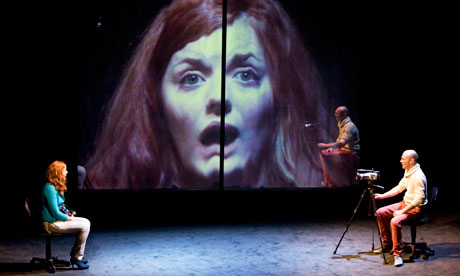
First scene: Alice is interviewed twice. Once as herself, once as Heidi, her porn persona. At various points in Wonderland, her projected face looms above the set. She whispers that she is frightened, that she fears that she is going to be killed. A knife is pulled on her throat.

She runs screaming from the filming, followed by her co-star. She is Alice again, not Heidi. She asserts herself, then returns to the film.

Following a spot of surrealism, the climax: Heidi is murdered. Symbolically, the murder is not enacted by her co-star but John, the viewer and her father. Then, she performs her exit interview, wiping the blood from her face, affirming that she gave consent to the filming. She is paid, she leaves. Her intention is to come back, for something more spectacular.

Alice is not a victim: even the pornographer wants to make sure she knows what she is getting into. Alice walks away from the set, cash in pocket. It is as if she has not been harmed. Wonderland tools about with fantasy and reality throughout - the murder appears real, John's blood might be a metaphor - but concludes with reality asserting itself.

It's difficult to see how Alice has been damaged by her experience. Of course, it can be assumed that she is damaged in the first place, or that she ended up getting into the ugly business at the end of a series of bad encounters.

That John is both the consumer of her product and her father might allude to a history of child abuse, but it feels more likely that Vanishing Point are using this amalgamation to make a broader point about how every porn actress is somebody's daughter.

The moment when the pornographer asks her about money hints at poverty. But these are mere suggestions, and need to be imposed on the performance.

Alice provides the most shocking moments: her original interview is degrading and uncomfortable to watch. Her murder is brutal. It might be her calling her mother. Her mother refuses her. Jenny Hulse convinces as both lively woman, degraded woman and corpse. Yet because she moves between these characters with such ease, Alice is impossible to grasp. The other characters have clear narratives - the pornographer is a little too stereotypical, her co-star is a hunk with a cock, John destroys his piece of mind. Alice just remains.

She is just a series of surfaces and projections, metaphorically and literally.

Strip away the backstory. Strip away her family relationships. Strip away a boyfriend, a life outside the studio.

Strip  away the compassion. Strip away her self-awareness. Strip away any knowledge of how the film is going to be used. Strip away everything.

Sunday, 23 September 2012

Wonderland: Take One

Vanishing Point do not shy away from difficult content: their reboot of The Beggar's Opera happily followed the original's vision of a world where police and thieves are essentially two extremes of the same system of exploitation, and Saturday Night opened up the precipice beneath the superficial safety of middle-class luxury. Wonderland grabs a few themes from Lewis Carroll's Alice stories, corrupting innocence and disappearing down a rabbit hole that is populated by surreal symbols of a world gone bad.

Director Matthew Lenton attacks on two fronts: the induction of Alice into violent pornography and the seduction of a husband by the increasingly brutal opportunities of the internet. The message, voiced by a mysterious, grubby character who exists only in the husband's mind, is that a darker, shinier reality exists beneath the bland surface of domesticity: both Alice and the husband - possibly her father - descend only to emerge covered in blood and guilt.

From the start, Alice is not presented as an innocent: her audition scene is a  clever mix of her sincerely nervous introduction and uncomfortably believable, but ultimately performed, terror. Her appearance, enlarged, brutalised and frightened, on the video screens at the back of Kai Fisher's brilliantly designed set, forces awkward questions about the reality of violence mediated through the industry that manufactures sexual fantasy. Yet in her final scene, Alice wipes away the blood and affirms that she made the film willingly and, indeed, she'll be back again tomorrow for some more.

It's in the husband's story that Lenton is more explicit about the consequences of violent pornography. If the actors aren't really injured, the husband has been sucked into expressing his  most brutal impulses. His final scene, sat on the couch with his wife, flicking through holiday brochures while covered in blood, is a bleak image of life on the home front. Having been initiated into the darker world, he can never quite return to the cosy domesticity of the first scene.

Wonderland is ambivalent about the cost of violent pornography - the creators are not seen as victims, only the consumers: the final scene suggests that while Alice's path is pretty miserable, it isn't as damning as the husband's fate. Yet the suggestion by the film-maker that tomorrow's filming will be 'spectacular' holds a sense of threat: lacking either a clear condemnation or sense of redemption, Wonderland refuses to judge, becoming all the more unsettling.


Tramway, until 29 September 2012


Wonderland: Porn and Parenthood


Over the past twenty years, partially thanks to the internet but also due to a softening of the laws around the representation of sexual imagery, pornography has become a big industry. Rumours abound that it has a larger income than Hollywood cinema, and art responding to pornographic's social impact has proliferated: Grant Morrison's The Filth is a bold attempt to innoculate the reader against the horror through the administration of a graphic novel, while Tumbling Doll of Flesh is a harrowing introduction to the extremities of  torture porn.

Wonderland engages with pornography's darker corners. A father and his daughter, in different ways, are drawn into the twilight world of violent, on-line pornography. Both are damaged - the daughter is rejected by her family, the father is alienated from his rather comfortable life - and Vanishing Point's dissection of the hidden brutality in sexual desire is unsettlingly ambiguous.

The father's story - he begins as a comfortable middle-class husband, at home with his wife, watching the television and enjoying domestic bliss - is the more forceful. Haunted by a grubby ghost, who insists that his desires are healthy, he gradually chases rougher imagery: an early encounter with a video-cam woman is replaced by full-blown torture and murder movies. The careful application of symbolic drama - it seems as if the father has committed a real murder - emphasises his brutalisation and his scene with the cam actress follows his decline from vaguely horny guy to vicious thug.

Director Matthew Lenton sketches out the reach of violent pornography: from the obscure location of the filming - probably somewhere in central Europe - to the polite middle-class homes of Scotland, it impacts on lives, alienating the husband from the wife, the child from the parents. Despite the flashes of nudity - male and female - it veers away from sensationalism, almost dour in its presentation of the filming. Lenton seems fascinated by the emotional consequences of watching violent pornography, illustrating the fragmented fantasies through a late intrusion of surreal visual theatre.

The almost casual finale shows the father, covered in blood and having lugged a suitcase across his front-room, attempting to reintegrate into his cosy life. Yet the ghost is now sat on the sofa, having previously been consigned to the outside, and the father's awkward gestures give the lie to the scene of marital unity. An earlier episode, when he frantically cleaned after a bout of on-line dirty action, pictured his guilt in a simple tableau. Lenton's awareness of the power of images - Kai Fisher's set allows the framing of certain moments as iconic tableaux- drives his theatrical imagination and doubtless informs his recognition of how watching violent pornography can corrupt.

It's perhaps telling that Wonderland does not follow many of the predictable narratives associated with pornography: the argument that it can liberating never comes up (interestingly, a moment of real danger during the filming reveals that the actors have no safe word, a commonplace in actual BDSM; the pretend pornography is potentially more dangerous than actual sex), the economic pressures that force women into pornography or prostitution are not explored, except in a brief, throwaway line. There's no attempt to identify pornograpy within a broader context of exploitation.

Since the characters are all unreliable witnesses - the father is a pervert, his taste for violent sex hinting at paedophilia, the ghost reckons himself to be some kind of Sadean messiah but looks like a tramp, the film-maker is a cynical capitalist, the daughter switches between her Alice and Heidi (her porn name) - and Lenton is constantly switching between the fantastic and the realistic, any grand statement would be as compromised as a man caught on the naughty pages by his mother-in-law.