Showing posts with label Citizens. Show all posts

Monday, 23 October 2017

Lampedusa Dramaturgy: Jack Nurse @ Citizens, Glasgow

LAMPEDUSA
CITIZENS THEATRE

8 November - 18 November 2017

Telling the stories of human kindness behind the headlines, Lampedusa was a sell-out during its premiere run at Soho Theatre in London in 2015.

The Italian island of Lampedusa
lies in the Mediterranean between Sicily, Tunisa and Libya. Once, fisherman Stefano made a living here.

Now, he uses his fishing boat to collect the bodies of drowned migrants from the sea. In the UK, Chinese-British student Denise is forced to go door to door for a payday loan company to finance her degree, meeting grinding poverty and racist prejudices as well as small acts of charity.

What was the inspiration for this performance?

The migrant crisis has been in the headlines for years now but is still nowhere near a resolved issue, for a myriad of reasons. When something has been in the news for a long time, it’s easy to become desensitized or passive but this is the biggest mass migration since World War Two and the issue is not going away. 

There’s a need to continue to talk about the crisis. A theatre show is one, small way of doing this.

Another inspiration was reading Anders Lustgarten’s work. His writing combines acute social and political critique with interesting theatre and this creates a thought provoking and often challenging piece of work. To direct one of his plays is a real privilege.

Is performance still a good space for the public discussion of ideas? 

Yes. Theatre and performance can interrogate ideas like no other medium. The very nature of the art form – performer speaks, an audience listens – creates an exchange of ideas, a dialogue. It’s our job as theatre-makers to make sure the ideas are worth interpreting and thinking about. 

We have a post-show discussion on the 10th November for Lampedusa, but every other night the audience needs to leave with a sense of being informed and challenged.

How did you become interested in making performance?

I studied Contemporary Performance Practice at the Royal Conservatoire of Scotland. Whilst there, I started Wonder Fools with Robbie Gordon. I wanted to apply the skills I was learning in contemporary performance to the creation of contemporary theatre, and we started experimenting with different forms. 

This culminated most recently with the presentation of our play, The Coolidge Effect, at the Traverse Theatre, Tron Theatre and Macrobert Arts Centre.

Is there any particular approach to the making of the show?

Lampedusa explores the migrant crisis
through two intersecting monologues and the focus of the play is very much these two characters’ stories.  Stefano is an Italian fisherman, whose heritage and family trade is fishing. 

Unemployed for three years, and in order to support his wife and two young children, Stefano now earns his living at sea by picking out bodies from the sea of the people who have not survived the journey from Libya to Lampedusa, an Italian island which is the gateway to Europe for many North African refugees. 

The second story follows Denise, a mixed-race Chinese/British woman from Leeds who works for a payday loan company in order to pay for her university degree and through her narrative we explore poverty, racial prejudices and misperceptions. To impose a grand concept on the play would detract from the power and poetry of Anders Lustgarten’s writing. 

Other than the focus on text, I will be working with the composer Stuart Ramage to create a livescore to accompany the piece – an atmospheric, haunting mix of guitar harmonics. Also, Anders has been in rehearsals for the early part of the process and we are working to bring the 2015 text into the present. That has meant looking at statistics and news stories to highlight what is happening in 2017. 

An unfortunate and saddening truth emerging from rehearsals is that not a lot has changed since the play first premiered.

Does the show fit with your usual productions?

It is a Citizens Theatre production in association with Wonder Fools. For the Citz, Alisa Kalyanova (designer), Benny Goodman (lighting designer) and I are hoping to continue its tradition of striking, bold designs by filling the Circle Studio with sand. 

Following on from The Macbeths, we hope to utilise the focused intensity of the Studio that that show did so well. As Wonder Fools, this is the first time we will be using an existing text by another writer. This is both exciting and liberating. Anders has written something dramatically powerful with a biting social commentary that is very much in line with what we hope to produce as Wonder Fools.

What do you hope that the audience will experience?


I hope they feel invested and engaged for an hour in Stefano and Denise’s stories. I hope they leave the performance emotionally connected to the narratives and angry about the status quo that is at the foundation of all the social and political problems the play pokes at. 

CREATIVE TEAM

Writer
Anders Lustgarten

Performers

Andy Clark and Louise Mai Newberry

Director
Jack Nurse

Designer

Alisa Kalyanova

Lighting Designer

Benny Goodman

Associate Director
Robbie Gordon

Assistant Director


Tess Munro

Monday, 3 November 2014

Charles Dickens’ A Christmas Carol @ the Citz

Citizens Theatre presents
Charles Dickens’ A Christmas Carol
Adapted for the stage by Neil Bartlett
Directed by Dominic Hill

The question throughout this entire post will be: can I stop myself from making the obvious joke... that Dominic Hill has consistently demonstrated an ability to bend classic texts to his will, and has used a variety of male protagonists to expose the frailty of masculine identity.

His Hamlet was a borderline psychopath and rapist; Crime and Punishment had an axe murderer strive for redemption while acting like a dick to the only woman who'd give him time of day; The Libertine was the life of the party, until his nose fell off due to syphilis. Is Scrooge going to follow their lead?
29 Nov 2014 to 3 Jan 2015, Citizens Theatre


Get ready to get cosy in the beautiful surroundings of the Citizens’
Victorian auditorium and enjoy a magical and spine-tingling theatrical telling of the most festive tale of them all: A Christmas Carol

Citizens Theatre Artistic Director Dominic Hill directs a new production of Neil Bartlett’s adaptation from 29 November 2014 until 3 January 2015, suitable for the whole family from 6+ who are looking for something a little different from the usual festive offering.

Ebenezer Scrooge is a notoriously bitter old man who is determined not to let Christmas interfere with his miserly routine. But one Christmas Eve, Scrooge receives some unexpected supernatural visitors who are determined to show him the true spirit of Christmas.

Dickens’ beloved and heart-warming tale is directed by Dominic Hill, whose imaginative, bold and distinctive theatrical productions for the Citizens has made him one of the leading directors of classic texts retold for contemporary audiences in Scotland.

They said it first - but I am surprised Dominic hasn't got for the nativity. There has been some heavy duty religious subtexts to his productions - Faust speaks for itself and Crime and Punishment only makes sense in the context of Christian redemption. And The Libertine's wife, who was the only spiritual character in the lad's life, ended up being right about the consequences of his antics.

Cliff Burnett, recently on the Citizens’ stage as Polonius in Hill’s production of Hamlet, will play Scrooge, leading a large ensemble cast. A weird and wonderful soundscape of Christmas carols performed live on stage will be created by Hill’s regular collaborator Nikola Kodjabashia. Kodjabashia has lent his distinctive style most recently to Hill’s Hamlet, and previously to Crime and Punishment and Christmas show, The Three Musketeers and the Princess of Spain, for which he earned nominations for the Critics’ Awards for Theatre in Scotland.

He is going to have live music on stage again. Ya beauty. I hope he has the rocking band with the horses' heads, too. I loved that bit in Hamlet when Ophelia went riot grrl.

Writer Neil Bartlett’s adaptation draws solely on text from Dickens’ classic novel. Bartlett was Artistic Director of the Lyric Hammersmith from 1994 – 2005. His plays, translations and adaptations are performed widely across the English-speaking world, and his third novel, Skin Lane, was nominated for the Costa Book Award in 2007.
other versions are available


Adapted for the stage by Neil Bartlett
Directed by Dominic Hill
Assistant Director Stephen Darcy
Designed by Rachael Canning
Lighting by Lizzie Powell

Sound & Music by Nikola Kodjabashia

Movement by Benedicte Seierup and Lucien MacDougall

Cast: Cliff Burnett, Laura Cairns, Cameron Crighton (Citizens Theatre Actor Intern), Martin Donaghy (Citizens Theatre Actor Intern), Cate Hamer, John Kielty, Stephanie McGregor, John O’Mahony
Suitable for 6+


Dates: Sat 29 November 2014 – Sat 3 January 2015 (times vary)
Preview: Sat 29 Nov 7pm
BSL interpreted performance: Fri 12 Dec 7pm

Audio Described performances: Sat 13 Dec 2pm

Captioned performance: Sat 20 Dec 2pm

Tickets: Adult £14 - £20 Child £8 - £12

Tuesday, 28 October 2014

The Citizens gets a spring in its step...

The Critics greet the news of the new season

Oi oi, Mad Cyril ere. Ready for the latest news from the Citz? Thought so.

Appy Birfday to the ol' fella in the Gorbals - 70 years young taday. An they've sent us all a press release. Let's ave a peek at wat they are up ta. 


· A new production of classic twentieth-century Scottish favourite
ga-ken wan
The Slab Boys, written and designed by John Byrne and directed by and featuring David Hayman in the cast.

Ayman's alright by Cyril. Did a tasty piece - two ov em - in the Fringe and as a passion fer the polemical art. Ee did Lear with Dom Ill a bit back, and ee's got those sweet actin chops. Byrne's shown is moves wiv a couple of translations of Chekhov in the past year. Nice. 


· A major new play by Douglas Maxwell, Fever Dream: Southside, a hallucinatory comic thriller set in Glasgow’s Southside.

Sarfside Massive shout out. Maxwell's got a free pass if ee's talkin baht my manor.

· Into That Darkness, an adaptation by former Citizens Theatre Artistic Director Robert David MacDonald of Gitta Sereny’s interviews with SS-Obersturmführer Franz Stangl.

Nice... here's one for Anselm Henrich off Glasgow Uni. Ardcore.

· Return visit by theatre company Headlong with The Absence of War, David Hare’s state of the nation play focusing on the Labour party.

Sweet, bit of a modern classic.

· A radical re-imagining of Macbeth by Filter.

It betta be very radical. Frickin Shakespeare. Still, Filter'll rip it like ya jaw on a sovreign. 

· Edinburgh Fringe Festival 2014 hit Lippy by young Irish theatre company Dead Centre.

· The Garden, an opera by Zinnie and John Harris and David Leddy’s Long Live the Little Knife in the theatre’s Circle Studio.

John Harris is sound. Zinnie is cool. Baht time they teamed up. 


· Top names on the UK comedy circuit including John Shuttleworth, Henning Wehn, Simon Amstell, Jon Ronson, Susan Calman and Des Clarke as part of the Glasgow International Comedy Festival.

A bunch of jokers, eh?


Announcing the new season Artistic Director Dominic Hill said

"This season honours the Citizens’ long-standing tradition of bold and daring work that speaks to Glasgow audiences. As well as welcoming back old friends and showcasing some exciting new talent, I'm particularly looking forward to directing Douglas Maxwell’s new work, set in the Southside of Glasgow and exploring universal themes of parenthood, community and belonging."


Aving all of it, big style...

Monday, 19 May 2014

CATS 2014: Shortlist for Male actor and Thoughts

BEST MALE PERFORMANCE:

Adam Best (Raskolnikov), Crime and Punishment, Citizens Theatre, Liverpool Everyman and Playhouse and Royal Lyceum Theatre, Edinburgh
Looking pretty hardcore in this photo (credit: Tim-Morozzo), Best got to play a dream part: the existential hero of Dostoevsky's novel that saved me from wondering whether it was okay to break the law if I was cool enough (it isn't). A big role, that addressed the audience on matters philosophical and went increasingly wild as the guilt heated up, Best's performance was an intriguing mix of bad-ass and sensitive poet. Just like Raskolnikov himself...


Jimmy Chisholm (Bob Lawson), The Collection, Rapture Theatre in association with the Beacon Greenock
While Tam Dean Burn played the guy you really wouldn't want turning up to the door, Chisholm pulled on his natural stage presence to present Bob Lawson, Scotland's answer to that one in Death of A Salesman. In a play that is earnest and horrific (shades of the fast-talking bastards who hide behind lovely adverts for extortionate loans), Lawson's tragedy is the problem of giving a shit in an industry of shits. 


Sandy Grierson (Ivor Cutler), The Beautiful Cosmos of Ivor Cutler, Vanishing Point and the National Theatre of Scotland presented in association with Eden Court
Being Ivor Cutler was always going to be a tough gig: add in (Grierson's own co-written) version of the man, who dances in his imagination, and a storytelling structure that has Grierson jump between himself and Cutler, then Grierson had a showcase for versatility. Sometimes he was Ivor the confused older man, sometimes the laconic singer, other times the cheeky outsider. 


Scott Reid (Thomas), A Perfect Stroke, A Play, a Pie and a Pint presented by the Traverse Theatre Company
A month after seeing this, I can't decide whether Reid's Thomas was a victim or predator. It's a tough ask to play a schoolboy having at go at seducing the teacher, and Reid's big red face when he got angry suggests he'll be playing Lear at some point in the future. With McKnight's script awkward and subtle, Reid's role was pivotal for the sense of sexual unease. He is doing some acting exercises in the photo (credit:  Lesley Black), I think. Perfectly innocent


Saturday, 15 February 2014

Miss Julie @ The Citizens

 Although Strindberg's Miss Julie is recognised as an important moment in the development of 'naturalism' in theatre, Dominic Hill's direction of Zinnie Harris' updating owes as much to Brecht and classical models of tragedy. The sparse, neutral set and the broad characterisations of the central couple, servant John and the daughter of the master Julie firmly define the story as the tragic destruction of a woman, drawing out both the proto-feminism of Strindberg's source script and the oppressive society that defines individuals less by potential or personality than by their status.

The heart of the plot lies in the seduction of Miss Julie by the servant, John: although Louise Brearley plays Julie with an initial haughtiness, Harris' John is clearly in command, his changes of mood less capricious than the calculated attacks of a bully intent on getting his way. There is a palpable lack of sexual frisson between this John and Julie: Keith Fleming performs John with a consistent brutality, rarely swaggering, never sensual. That Julie can be seduced by a braggart and a bully  - his confession of love for her is unconvincing but calculated to appeal to her romantic dreams - is alienating and uncomfortable.

It is here that Hill's Brechtian influence is most evident.  In his attempt to make theatre that has a socialist
message, and can promote political change, Brecht developed the idea of an audience that is more intellectual than emotionally engaged. By encouraging a distance between the performance and the audience, Brecht hoped to exposed the structures beneath the action, and allow the audience to observe how the events could have played out differently. With Fleming's brutish performance, it becomes difficult to understand why Miss Julie would be erotically fascinated by the servant: his kisses are rough, not in any animalistic sexual manner, but like an attack. When he suddenly drops her, after having had her, it is clear that he is interested in her as a means to satisfy his own ends.

Without the sexual chemistry that has made Miss Julie a morally ambiguous study of sexual and social power-plays, it is clear that Brearley's Miss Julie is not seeing the same John as the audience. Her clumsy flirtations in the early scenes suggest less maturity than she claims: the scripts descriptions of her father's savagery and Julie's treatment of her fiance imply that she is familiar with violence and is attracted by her seducer's thuggishness. From his scenes with his fiancee Christine (Jessica Hardwick), John is revealed immediately as arrogant and chauvinistic. Even before John confesses his love of Miss Julie - which he describes as a virus in a bluff, antagonistic complaint - it is clear that he is a bully.

Hill's production exposes Miss Julie's mistake: and it is here that the plot takes on a tragic tone. Miss Julie does follow some of Aristotle's 'guidelines' for tragedy: there is a unity of location, time and plot, and there are three actors, just as in the golden age of Athenian drama. Miss Julie's story  - like a tragic heroine, she is high-born - follows the predictable path towards her doom. Her failure to recognise John for what he is become her 'tragic flaw' (hamartia).

By presenting Julie as naive, and John as vicious, Hill's production both highlights the tragic line of the plot and alienates the audience from an easy emotional engagement with either character. It's a remarkable trick: Brecht regarded his approach as an antidote to the aristocratic bias of Aristotelian tragic theory. Naturalism - a theatrical movement led by Ibsen and Strindberg (which concidently overlapped with their mutual interest in the role of women in society) - is less of a bridge between the two modes than a specific response to the rise of science in the nineteenth century, rejecting supernatural interventions (like the gods of Greek tragedy of Hamlet's father's ghost) and following Darwin's ideas about evolution (exposing human personality as a product of natural selection).

This naturalism is a far cry from the 'gritty realism' of contemporary drama, and Harris' adaptation builds on the psychological depth of Strindberg's characterisation to explore the specific dilemma of a woman, like Miss Julie, who has been encouraged to act like a man (by her mother) and beaten (by her father). By delineating this characterisation so precisely, Harris reveals Strindberg's talent for expressing the motivations of his characters and allows the production to create the emotional distance between audience and performers without forcing the actors to slip into caricatures.

By updating the play into 1920s Scotland, during a strike, and recasting the Lord as a mill-owner determined to break a strike, Harris doesn't so much lend a contemporary relevance as locate the sexual battle within a wider set of social changes. John, like many bullies, is cowed by the master's presence - suggesting that his attitude towards women is based in insecurity - and Christine voices a conservative and religious faith in the rightness of hierarchy. Off-stage, the striking mill-workers celebrate (and are defeated): a reminder that the upsetting of the sexual hierarchy expressing in the tryst reflects wider conflicts.

It also adds to the claustrophobia of the final scenes, when Miss Julie realises that she cannot escape. Strikes
are preventing travel, and the father's guards are poised to prevent her leaving the estate. Both the old and new social orders are restraining Miss Julie: that John talks proudly of the workers' resistance (while failing to actively support them) is a reminder that supposedly radical political change may not address the oppression of women.

True to the tragic influences, the unfolding of the plot is pessimistic: only through death can Miss Julie escape. But Fleming's John provokes her suicide, turning back into the lowly servant on the return of his Lordship and using the threat of his wrath to terrify Julie. The lack of compassion from both Christine and John isolates Julie - Christine's sudden aggression is an explosion of emotion from beneath the placid acceptance she displays in the early scenes. It is only in the final moments that the mesh of Brecht, naturalism and tragedy is betrayed: the suicide is presented as a sudden black-out, Brearley holding the knife to her throat in a melodramatic pose.

The final is an act of bad faith in Hill's sophisticated direction: the subtle interaction between the subtext of the seduction and the performances is undermined by crass emotionalism. Fleming's John is reduced to a melodramatic villain, and Julie is stripped of her dignity as a tragic heroine. Throughout the play, there are shocks - the rough kisses, the sudden reversal of John's enthusiasm when he realised that he can't use Julie to fulfil his fantasy of being a businessman. Yet the last image is contrived to surprise, to present horror rather than fear and pity (as in Aristotle's strictures) or intellectual analysis (per Brecht).

Thursday, 9 January 2014

Miss Julie @ The Citizens

I tend not to know about such things -  I'm no TV, all theatre - but Dominic Hill's direction of Zinnie Harris' version of Miss Julie has got one of the stars of BBC's Sherlock in it. I do know that Harris relocates Strindberg's classic tale to 1920s Scotland, right in the middle of a strike against Miss Julie's capitalist father, and that it doesn't end well: the social and sexual tension between Julie and her dad's man-servant leads to fantastic dreams that end in a nightmare.

Press release begins:

Star of the BBC’s Sherlock Louise Brealey makes her debut on the Citizens Theatre stage .Prior to appearing in the Gorbals in the title role, Louise Brealey will be part of the nation’s festive viewing schedule when she stars as Molly in the eagerly-awaited third series of the BBC’s hit TV show Sherlock on New Year’s Day. Brealey has also played long-standing character Nurse Roxy Bird in the BBC’s Casualty and has appeared at the Bush Theatre, The Royal Court Theatre, the Young Vic and Bristol Old Vic.

Citizens Theatre Artistic Director Dominic Hill directs Zinnie Harris’ 2005 adaptation of August Strindberg’s thrilling tale of an upstairs-downstairs liaison, relocated to 1920s Scotland when the economic toll of the First World War was being felt, and the working classes were striking against falling wages and the privileges of the upper classes. 

Joining Brealy on stage will be Scottish actor Keith Fleming, who recently won praise as Macbeth in a new co-production by Horsecross Arts and Tron Theatre Company, and who starred in Dominic Hill’s award-winning Peer Gynt in 2007. Completing the cast is Citizens Theatre Actor Intern Jessica Hardwick, who appeared on the Citizens’ stage as Sonya in Hill’s 2013 production of Crime and Punishment.

Set in the oppressive heat of summer, Miss Julie follows the dangerous flirtatious games played by Julie and her father’s butler, John. As the night wears on, the couple from opposite ends of the social spectrum tease and fight towards an explosive conclusion. 

Harris’ version of the European classic, first created for National Theatre of Scotland, looks at the politics of the play through a new prism, setting the power-games played by Julie and John against a backdrop of wider social unrest. Harris has written extensively for theatre and television including the acclaimed The Wheel, Further than the Furthest Thing, Midwinter, Fall and the BBC’s Spooks.

Director Dominic Hill said: “This is a play about sexual politics: the battle of the sexes, sexual desire and the way men and women negotiate and manipulate to get what they want. For me, this is what makes the play truly timeless. I’m pleased that we’ll be presenting this landmark text on the Citizens’ main stage for the first time.”

Strindberg’s play defined a new naturalism in theatre when it was first premiered in 1888, with its shocking realism leading to it being censored. Since then, the universal nature of the themes contained in the play has lent the gripping story to a variety of settings, from the sectarianism of 19th-century Northern Ireland to the American Civil Rights Movement of the 1960s.  A major film version directed by Liv Ullmann and starring Colin Farrell and Samantha Morton is scheduled for a 2014 release.
  

Citizens Theatre presents
Strindberg’s
MISS JULIEA new version by Zinnie Harris
Directed by Dominic Hill
Designed by Neil Haynes
Lighting Design by Stuart Jenkins

Cast: Louise Brealey, Keith Fleming, Jessica Hardwick 
(Citizens Theatre Actor Intern)
Dates: Thu 6 – Sat 15 Feb, 7.30pm (no performances Sundays & Mondays)
Events:
Post show discussion
 and Q&A with Director Dominic Hill
Tue 11 Feb

Schools Workshop Miss Julie: Inside the Rehearsal Room
Wed 12 Feb, 5.00pm – 6.30pm (followed by show at 7.30pm)
A practical insight into the making of this production led by the Assistant Director. Supports writing about ‘a play seen in production’ for Higher and Advanced Higher Drama pupils.
To book contact Louise Brown 0141 418 6273 / 
louisebrown@citz.co.uk

Miss Julie: An Afternoon with Strindberg
Sat 15 Feb, 12.15pm (followed by show at 2.30pm)
Tickets £10 + ticket to the show. Price includes buffet lunch and refreshments. Tickets to the show sold separately.
Director Dominic Hill in discussion with playwright Zinnie Harris and academic of Scandinavian literature Peter Graves. 

Tuesday, 26 November 2013

SCOTTISH PREMIERE OF THE LIBERTINE HEADLINES CITIZENS THEATRE’S SPRING 2014 SEASON

No time to waste on making this sound like anything other than a cut and paste of the press release. I want to be one of the first people to announce this...

The Citizens Theatre today announces its Spring 2014 season including:
· Scottish premiere of Stephen Jeffreys’ The Libertine in a new production directed by Dominic Hill
Greek theatre meets post-dramatic tricks


· A new production by Dominic Hill of Zinnie Harris’ adaptation of Strindberg’s classic play Miss Julie

Two new Hill productions: and the fandom rejoices. Let us hope that this sees the continuation of 'Dominic Hill's trademark technique of blending multiple historical dramaturgies into a distinctive and focused style.' ((c) Gareth K Vile) 

· A celebration of the life and work of Ivor Cutler by Vanishing Point in association with National Theatre of Scotland.

From the most bracing Scottish entry into the International Festival to a man who was the most famous musician to support the Noise Abatement Society - Vanishing Point will surprise. 

· Work celebrating and reflecting Glasgow’s people and culture including the return of hit musical Glasgow Girls; a stage adaptation from West Yorkshire Playhouse of Benjamin Zephaniah’s Refugee Boy; David Harrower’s five-star Edinburgh Festival Fringe hit Ciara starring Blythe Duff and Sports Day, a large-scale community project celebrating the Commonwealth Games in Glasgow, with material from some of Scotland’s best-known playwrights and songwriters.

This is the fun stuff... if a play about the Glasgow Underworld counts as fun. Or the mistreatment of asylum seekers...


With 2014 set to be a landmark year in Glasgow and Scotland’s history, Citizens Theatre Artistic Director Dominic Hill has programmed a season of works which put Glasgow and its citizens centre-stage, alongside new productions of classic texts that have become his signature style since taking up his post in 2011. Headlining the season is a bold and bawdy new production of The Libertine, which reaffirms the Citizens’ role as the leading producer of courageous new theatre in Scotland.

Announcing the new season, Artistic Director Dominic Hill said:

“I’m really excited to be bringing The Libertine to Scottish audiences for the first time. It feels to me like such a “Citz” play, with everything that has made the Citizens famous: visual flair, grand theatricality, impressive spectacle and, of course, lavish and flamboyant costumes. There’s long been a tradition at the Citizens of theatre that’s risqué and bit outrageous, and I think the bawdiness of The Libertine will serve that tradition very well. I’m also very pleased to be directing a new production of Zinnie Harris’ adaptation of Miss Julie, the first time the play has been presented on the Citizens’ main stage. Zinnie’s version set in 1920s Scotland looks at the politics of Strindberg’s play through a new prism, with many of the issues explored in the play resonating with today’s political landscape.”


Traverse Theatre
CIARA
By David Harrower
Directed by Orla O’Loughlin

Designed by Anthony Lamble

Lighting design by Philip Gladwell

Sound by Daniel Padden


Main Theatre
Dates: Tue 21 – Sat 25 Jan, 7.30pm

Press night: Tue 21 Jan, 7.30pm
Matinee: Sat 25 Jan, 2.30pm

Tickets: £12-£19.50 (concessions available)
Tuesdays £12

**********************************************************************
Filter Theatre Company

TWELFTH NIGHT
By William Shakespeare

Created by Filter Theatre Company

Directed by Sean Holmes

Music and sound design by Tom Haines and Ross Hughes


Main Theatre

Dates: Tue 28 Jan – Sat 1 Feb, 7.30pm


Press night: Tue 28 Jan, 7.30pm
Matinee: Sat 1 Feb, 2.30pm

Schools performance: Wed 29 Jan, 10.30am


Tickets: £12-£19.50 (concessions available)

Tuesdays £12

Schools: £8.50 + 1 free ticket with every 10 purchased


*****************************************************************
Citizens Theatre
MISS JULIE A new version by Zinnie Harris

Based on August Strindberg’s original play

Directed by Dominic Hill

Designed by Neil Haynes

Lighting by Stuart Jenkins

Main Theatre
Dates: Thu 6 – Sat 15 Feb, 7.30pm (no performances Sun & Mon)

Preview: Thu 6 Feb, 7.30pm

Press night: Fri 7 Feb, 7.30pm

Matinee: Sat 15 Feb, 2.30pm

Audio Described: Wed 12 Feb, 7.30pm

Signed: Fri 14 Feb, 7.30pm

Captioned: Sat 15 Feb, 2.30pm


Tickets: £12-£19.50 (concessions available)

Previews £8 | Tuesdays £12

50p Tickets | 10 tickets, 10 performances on sale at 10am Saturday 2 February.
NB – 50p Tickets must be bought in person at the theatre, cash only.


***********************************************************************

National Theatre of Scotland, Theatre Royal Stratford East, Citizens Theatre, Richard Jordan Productions Ltd, Pachamama Productions in association with Merrigong Theatre Company (Australia)

GLASGOW GIRLSConceived by Cora Bissett
Based on the book by David Greig
Directed by Cora Bissett
Designed by Merle Hensel
Lighting by Lizzie Powell
Sound by Fergus O’Hare
Choreography Natasha Gilmore

Main Theatre
Dates: Thu 20 Feb – Sat 8 Mar, 7.30pm (no performances Sun & Mon)


Preview: Thu 20 Feb, 7.30pm
Press night: Fri 21 Feb, 7.30pm

Matinees: Sat 1 & Sat 8 Mar, 2.30pm

Schools matinees: Wed 26 Feb & Wed 7 Mar, 10.30am

Audio Described: Wed 26 Feb, 7.30pm

Captioned: Sat 1 Mar, 2.30pm

Signed: Fri 7 Mar, 7.30pm


Tickets: £12-£19.50 (concessions available)

Previews £8 | Tuesdays £12
Schools: £8.50 + 1 free ticket with every 10 purchased.
50p Tickets | 10 tickets, 10 performances on sale at 10am Saturday 15 February.
NB – 50p Tickets must be bought in person at the theatre, cash only.

*****************************************************************
West Yorkshire Playhouse
REFUGEE BOYWritten by Benjamin Zephaniah
Adapted for the stage by Lemn Sissay
Directed by Gail McIntyre
Designed by Emma Williams
Dramaturg Ben Jancovich

Main Theatre
Dates: Wed 12 – Sat 15 Mar, 7.30pm

Press night Wed 12 Mar, 7.30pm
Matinee: Sat 15 Mar, 2.30pm

Tickets: £12-£19.50 (concessions available)
Tuesdays £12


*****************************************************************

Scottish Opera

MACBETHComposer Giuseppe Verdi

Conductor Derek Clark

Directed by Dominic Hill

Designed by Tom Piper

Lighting design by Warren Letton

Movement Director Kally Lloyd-Jones

Cast: David Stephenson, Elisabeth Meister, Thomas Faulkner, Anthony Flaum, Katie Bird, Sioned Gwen Davies


Revival of 2005 production. Sung in English


Main Theatre

Dates: Sat 22, Thu 27 & Sat 29 March, 7.30pm


Press night: Sat 22 March, 7.30pm
Tickets: £14.50, £18.50, £22.50 (concessions available)


*****************************************************************

GLASGOW INTERNATIONAL COMEDY FESTIVAL


Main Theatre

Dates: Mon 31 Mar – Sat 5 Apr

RORY BREMNER Mon 31 Mar, 8pm. Tickets £15
SIMON EVANS Tue 1 Apr, 8pm. Tickets £14/£12
MILES JUPP IS THE CHAP YOU’RE THINKING OF Wed 2 Apr, 8pm. Tickets £13
AND THEY PLAYED SHANG-A-LANG Thu 3 Apr, 8pm. Tickets £15/£13
SHAPPI KHORSANDI LIVE Fri 4 Apr, 8pm. Tickets £14/£12
JAMES CAMPBELL COMEDY FOR KIDS Sat 5 Apr, 2pm. Tickets £7.50. Recommended for 6+
RUBY WAX – SANE NEW WORLD Sat 5 Apr, 8pm. Tickets £17.50/£15

*****************************************************************
Vanishing Point and National Theatre of Scotland
THE BEAUTIFUL COSMOS OF IVOR CUTLERCreated by James Fortune, Sandy Grierson and Matthew Lenton

Directed by Matthew Lenton

Text by Sandy Grierson & the Company


Main Theatre

Dates: Wed 9 – Sat 19 Apr, 7.30pm (no performances Mondays or Sundays)


Preview: Wed 9 Apr, 7.30pm

Matinee: Sat 12 Apr, 2.30pm


Tickets: £12-£19.50 (concessions available)

Preview £8 | Tuesdays £12


***************************

Wednesday, 11 September 2013

Here is my crime...

Although I frequently claim that the critic cannot be objective, I still find it difficult to identify my own subjectivity. Having now written a preview for The List and a review of Crime and Punishment, I am just about able to see a sliver of the preconception that I am bringing to Dominic Hill's direction of Chris Hannan's adaptation.

My first question for Hill offers a small clue: I am quite clearly attached to the original. I am torn between my respect for Hill's previous Citizens' directions (Beckett, Shakespeare and Pinter all delivered precisely and respectfully, but with flair) and my fear that adapting an already famous novel feeds into a theatre culture that already has too many repeats.

GKV: How do you feel about doing adaptations of the stage of a novel that has a strong reputation? In a way, it is a shift from your usual approach of taking great scripts and giving them a new vigour: my assumption is that there is something about C and P that made you go for it...

DH: I've always loved the theatricality of the novel - the characters, the dramatic scenes that Dostoevsky creates, the story, the interior monologues of Raskolnikov. It seemed right for the stage. And it doesn't feel like a departure for me - in fact a fusion: a classic story given contemporary relevance as well as being a new play.

Hill put my fears at rest (and the news that there would be live Orthodox psalms sung on stage swung me further behind the production). But my follow up question gets to the heart of my problem.

GKV: The release says that it has a modern relevance, and I guess that Crime never goes out of fashion, but I am wondering whether Dostoevsky's angle, which is in this slightly unfashionable Christian existentialist mode, makes the moral impact of the play more compromised in the more secular twenty-first century. How do you relate its values and (fairly austere) understanding of C and P to more contemporary ideas?

DH: For me its a story about a man's reintegration into society, about the need for society: no man is an island et c. And about compassion and valuing life, regardless whose life it is. Those themes are encapsulated in a Christian humanism that the story propagates. But whether you're a Christian or not - these are timeless important themes and values that go beyond the confines of any religion and are relevant to any person living in any society.

Even if I don't agree with Hill's assertion that certain values 'go beyond the confines of any religion,' his point is coherent and well-made. It is also supported by Hannan's comments on the Vile Arts' Radio Hour that the conversion experienced by Raskolnikov can be seen in all manner of traditions (he references William Jmaes' Varieties of Religious Experience). And the final scene of the play places this conversion (away from an almost nihilistic atheism towards a more compassionate reading of human life) in a context that is not specifically Christian. Raskolnikov finds his redemption in observing nature and reflecting. This could be pagan, pantheist or even a version of romanticism.

However, that finale was, for me, the least satisfying part of a superb production. The role of Sonya, the prostitute, becomes less important (I suggested that the lack of chemistry between Sonya and Raskolnikov caused this problem). While I am absolutely stand by this - and I don't blame director, actors or author for it- I wonder whether that is my own subjectivity, my resistance to Crime and Punishment as anything other than a Christian parable, that gave me the problem.

For the record, Crime and Punishment is a tour de force - the direction is imaginative and, when taken alongside Hill's King Lear suggests that he is working towards a recognisable style that pays respect to Brecht and the ideals of the Dogme film manifesto. Every cast member works hard, there are many exceptional scenes, especially when the law begins to close in on the idealistic murderer. Hannan respects Dostoevsky's obsession with ideas, and the script has enough philosophy for a month's conversations on issues of justice, freewill, redemption and the meaningless universe.

Even my dissatisfaction is slight. Sonya's character is pretty difficult for a contemporary reader, even in the novel (a Gospel reading sex worker seems to be too symbolic, too forceful a message). In some ways, it even improves my experience: my rejection of both Hill's and Hannan's universality of values clearly exposes my own world view. I don't believe in universal values, or that redemption can come outside of a certain set of religious behaviours. 

Fascinated as I am by my contradictions, I won't follow them up just now. I am content to reveal the possibility that I can be subjective, recognise it but still not take it into account. It could be that this restless self-examination undermines my critical project... I prefer to think not...


Tuesday, 22 January 2013

Robocritic reviews The Maids @ The Citizens

Preserve the public trust.

Genet used theatre as a weapon. Stuck in the margins of society - Stewart Laing comments that he has read an interview with the French author in which he complained that his acceptance by the literary establishment gave him serious writer's block - Genet embraced the idea of criminality as a virtue. Hence The Maids is full of anarchist content. The mistress, perhaps an avatar of God, is depicted as uncaring and thoughtless. The maids themselves are perverts, enjoying a series of role-plays and indulging sexual violence.

The public trust in the Citizens as a venue for entertainment could be seriously damaged by this production. The arrival of Laing on stage halfway through the production for a question and answer session, the musical interludes including a rendition of BDSM classic Venus in Furs, the unstinting representation of erotic bullying: these contribute to a disturbing atmosphere. The decision to follow Genet's instruction to have the female characters played by men, yet Laing's refusal to make them camp up the roles, offers a rare example of genuinely confusing gender identity.

Fortunately, Laing's skill as a director keeps Genet's balance between theatrical convention and mayhem. Laing highlights the ritualistic aspects of the script, and reminds the audience that this is not some kind of documentary but a surreal performance. Consequently, those values most prized by the audience - performances, set and scenery, visual spectacle and clear narrative - are held in place.

Protect the innocent

With the exception of David Bowie's Jean Genie, all material connected to Genet must be kept away from the innocent. In The Maids, the only innocent character (the unseen lover of the mistress) is arrested because the maids decide to grass him up to the cops. An exercise in corrupted desire, possibly influenced by the historical context of the 1940s (a France occupied by Nazis might encourage a writer to believe that his antagonism towards power is justified), The Maids is set in a universe where life itself is guilt.

Uphold the Law

The law in The Maids is the ultimate power. The threat of the executioner - and the bliss found in his arms - and the drama of punishment lies behind all of the servants' antics. Even the mistress is subservient to the law. It hovers in the background, provides the grounding for the various flights of fantasy. Not only is the law upheld, it defines the corruption of the characters.

Laing plays hard and fast with the laws of theatre. The curtain gets to do a funky dance, one scene is played out as a rehearsal, the director turns up (with a beard that really works) and chats to the audience. There is a video of Genet moaning at the BBC for making him a familiar face. The suspension of disbelief is shattered. It is as if the tyranny of the law within the play is mocked by Laing's freedom in staging.

(Classified)


Friday, 14 December 2012

FAUSTUS! Come get yer chips!

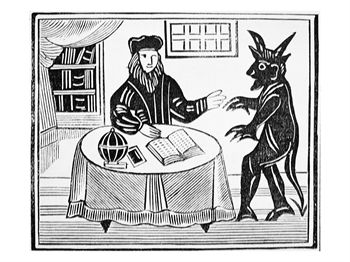
Okay, I'll admit it. I am excited about the new season at The Citizens. Not only are they putting on Stewart Laing's version of The Maids (see previous posts for how much I love this play), they are producing Doctor Faustus. The announcement that Siobhan Redmond is playing mighty Mephistopheles is a bonus - she knocked me out as Lady Macbeth in Dunsinane and a female devil is exactly what would tempt this critical Faustus. But what really excites me is the revival of a script that isn't Shakespeare but has the same verbal intensity as Old Bill.

Marlowe's script, although I hear that a couple of the acts are going to be updated by Colin Teevan, is one of the few works that excite me even as a mere text. Sure, Pinter's great on stage but takes ten minutes to read - it's a bunch of pauses and non-sequiturs. Marlowe, and this is unlike Shakespeare, isn't afraid to get serious about his theology and Faustus has kept its relevance even in an age where God is often reduced to a metaphor.

It's a classic story - man sells soul to the devil, finds out that he's got a bum deal - and each age has had a crack at retelling it. Becoming a symbol of the dangers of too scientific an approach to life - Marlowe's Faustus rejects the idea of hell in much the same phrase as brilliant biologist Richard Dawkins - it has been recreated at every level, from Callum MacAskill's one man Fringe hit through to the International Festival's epic hosting of Purcarete's remix. Alex Smoke even soundtracked the film version for the Glasgow Film Festival in 2011.

What makes Marlowe's version thrill me is that it refuses to give Faustus a happy ending - his final speech is a belter of absolute despair - and it grapples with the theology of its time in an accessible, poetic manner. Much contemporary atheism is so pleased with itself, as if it is the first generation ever to have worked out that there might not be a good. Marlowe - who got accused of it himself, back when it was less a shorthand for "being clever" than "being treasonous" - portrays a man who maintains a godlessness even in the face of seeing devils pop in for a cup of tea.

Mind you, he gets to sleep with Helen of Troy. That might have distracted him from worrying about his soul.


Citizens Theatre & West Yorkshire Playhouse
DOCTOR FAUSTUS(Christopher Marlowe and Colin Teevan)
Directed by Dominic Hill
Design by Colin Richmond
Lighting by Tim Mitchell
Music by Dan Jones
Thu 4 April – Sat 27 April, 7.30pm


Thursday, 13 December 2012

Maid in France (Reflections on The Maids, Part 1)

When Genet wrote The Maids, he was already far into his own self-determination as a criminal. Throughout his work, he more than embraces the dark poetry of sin: he posits it as a sanctified state. Jean Paul Sartre may have recognised him as a kindred spirit - although an existentialist makes for a bad character witness, what with their belief that personality is a fiction, in any case - but Genet's identification with the wrong side of the tracks goes further than a Marxist celebration of the socially excluded. Rather than reject the spiritual hierarchy of Christianity, he inverts it and makes the most despised the most elevated.

The sisters at the centre of the action- Claire and Solange - spend most of the play investing in role-play and rituals. They switch roles - Claire gets to be the mistress, Solange becomes Claire - outfits and authorities. Insults, even the brutal slap of the whip, become endearments. Death, suicide, murder, deceit are all glorified and the final, confusing, scene has mistress and slave, fiction and fact dissolve into a single, disorientating farewell.

It can be read as a damning indictment of the way that the oppressing class shapes its victims: the maids are at the bottom of the social heap, and, like Genet did, embrace the image of themselves as worthless. One maid possibly fucked the milkman, like a whore. The other has fantasies of being a cool, erotic murderer, whom even the hangman wants to kiss. Undeniably, the maids are distorted, disconnected with the acceptable values of a society that gives power to the mistress and her husband.

And it's based on a real story of a couple of murdering maids. And the left-wingers came out in their support, too. 

Simple, really. It all makes sense. The Maids is a political allegory. The only reason that it gives the audience a headache is the dizzying pace of the character's swaps. Frankly, that last speech is an incoherent ramble - nice portrait of a mind in meltdown, but it's not Shakespeare.

No, wait. Hold on. 

It's a play. Genet's doing that thing to remind the audience that what they are watching isn't real. Blather about "suspension of disbelief" aside, it is difficult to be completely fooled by the action when Genet insisted that the women be played by men. Sure, that might fit into a contemporary drag queen paradigm - threatening women with a sharp wit, perfect - but it doesn't do much to convince that this is supposed to be a serious representation of reality.

And that final speech. Solange imagines the end of the play. It's been jarring enough as she switches from top to bottom, person to person, but now she's jumping on the fourth wall. It's impossible to forget that this is a performance. 

The simple reading of The Maids was bound to fail - the experience of seeing it is like being caught in an opera company's tumble-dryer, and that never ends up with clarity. And for all the supposed sadomasochistic antics of the maids, they are too far out of control for this to represent any reflection of dominance and submission in a sexual context. 

If Genet is having a BDSM session, he has to be doing it with the audience...


THE MAIDS (Jean Genet)
Translated by Martin Crimp
Directed and designed by Stewart Laing
Citizens Theatre
Thu 17 January – Sat 2 February, 7.30pm


Tuesday, 6 November 2012

Glasgow Girls (Formal Review)

Photo: Drew Farrell
Even at the beginning of Glasgow Girls, both script and cast seem uncertain that a musical is the appropriate format for the true story of a brave battle against an impersonal system. Inspired by a group of teenagers, who stood up to the vicious treatment of asylum seekers by the British state - dawn raids, an assumption of dishonesty, an institutional racism - Cora Bisset, aided by David Greig, uses the musical as a tool to express the energy and friendships that helped the Glasgow Girls reinvent the art of protest.

There are various moments when Greig's script mock the conventions of the musical - Myra MacFayden refuses to sing just because her emotions are full (just before bursting into song) and the introductory number echoes Team America's parody montage song. Yet Bissett's unconventional choice of genre pulls the story away from simple agit-prop: both celebration and sinister threat, in particular through Patricia Panther's menacing r'n'b style vocals, are convincingly covered and even the most political moments - Tommy Sheridan's speech, taken verbatim from Holyrood records, or former first minister Jack McConnell's promise to end dawn raids - are given a humorous charm.

Despite excellent performances from the young cast, Bissett's intention to highlight the suffering of asylum seekers, and demonstrate how even a small group can make a difference, is never lost in the razzmatazz. The strict laws of the state are exposed as brutal, inhuman and even in defeat, the resilience of the Glasgow community is evident. Undeniably life-affirming, but with a bitter-sweet ending and a sharp political edge, Glasgow Girls is further evidence that Scottish theatre is capable of taking the debate back to the politicians.

Until 17 November @ The Citizens

Thursday, 4 October 2012

Medea: A Game of Two Halves, Brian.

For all the infanticide, marital strife and general gender warfare, the real tension in this Medea is whether updating the story from ancient Corinth to a contemporary housing estate can make the myth modern. Euripides' original is pretty unambiguous about Medea's power: she has real, nasty magical powers. Suburban housewives in the twenty-first century tend not to be able to conjure chariots led by dragons, and Medea's ultimate triumph does rather depend on her ability to pull off the murders and escape.

Mike Bartlett's version is faithful to the structure of the original: the central agon with Jason is preserved, as is the process of Medea from despairing, jilted wife to cunning avenger. The script is most comfortable when Medea is in full-flow: Rachael Stirling brings the right mixture of malicious rage and self-deprecating charm to Bartlett's words, building sympathy for her plight, respect for her intelligence and belief in the justice of her cause. Adam Levy, as Jason, sadly gets the worst of it: like Euripides' Jason, he is a bland, respectable and self-serving fool, easily seduced by Medea (and his future wife, Kate) and constantly wrong-footed by Medea's sharp intellect.

Despite an uninspiring opening scene - two women bitching about the closeness of their friendship to Medea, which diverts attention from the central battle between male and female into a side-bar on female rivalry - Medea successfully develops the tension: scenes between Medea and her silent son are fraught, Jason and his landlord Carter (the replacement for the original's King of Corinth) are appropriately boorish, and if Medea's seduction of Andrew (formerly King Aegeus, who offers her sanctuary, now a holiday home in Spain) is clumsy, the slow build to the climatic murders is both engaging and sinister.

Sadly, the finale destroys the good work. Opting not to find a modern alternative to the magic, Bartlett offers Medea's attack on Jason's new wife as mysterious - suddenly, after working so hard to translate Medea into a modern woman, he reverts to her as a mysterious witch. The messenger's speech - Bartlett uses the conventions well, and Amelia Lowdell rises to the monologue - is far too close to the original in both detail and spirit. At this point, all the modern trappings are cast aside.

The last speech is even worse: Medea is up on the roof, covered in blood, shouting about how her father liked hacking animals to death and her son's success in an egg and spoon race. She sets her house on fire - this is closer to the wonderful film version by Pasolini - and the police turn up. She's neither vindicated - hard readings of Euripides suggest that she is justified - nor condemned - killing children isn't a good thing. She just announces her fantasy of escape in a speech that will define theatrical bathos for the next year.


There's a real pleasure in watching the plot unfold, despite this absurd ending: Stirling nails the modern Medea, and the supporting cast are solid. There are many moments in the script of sly, dark humour and the various shifts in Medea's mood are carried off skilfully. It might simply be that there is nothing new to say about this skirmish in the war between husband and wife - certainly, children are used as weapons, but the moral is pretty unambiguous.

Until 17 October, Citizens

Tuesday, 18 September 2012

NTS Double Bill


The Monster in the Hall and Yellow Moon share a director, a writer, an interest in the way that music can define identity and an enthusiasm for communicating immediately with the audience. Consciously made for ease of transfer - the sets are limited to a few chairs and microphones - David Greig's scripts may be aimed at younger audiences but they refuse to simplify or pander. The Monster in the Hall addresses the anxieties of young carers - including a plug for the support group in Fife: Yellow Moon fearlessly considers domestic violence and absent fathers. Yet neither play can be reduced to an issue: through Guy Hollands' direction, and Greig's straight-talking scripts, the vitality and fantastic plots emerge through the detailed characterisation.

In both works, Greig mixes up story-telling and more conventional theatrical scenarios: the four actors slip in and out of character, inhabiting fantasy worlds, commenting on the action and narrating. Motorbike chases, visits from the social services, montages of farm work, bizarre visitors from Scandinavia, brutal knife fights: all are brought to vivid life by the cast, who jump from mime to banter to directly addressing the audience. The rough mixture of styles, only occassionally noted by the actors in brief moments of comedy, lends the stories a playful immediacy and good humour, allowing some of the more outrageous plot twists to race past without becoming absurd.

Yellow Moon is the more consistently serious: the old Stagger Lee Blues becomes a leitmotif, as a modern day teenager gangster runs into the wilds to find his long-lost father. Accompanied only by silent Leila - her attraction to this sometimes charming bad-boy is only slightly developed, a rare lapse in Greig's attention to detail - Stag Lee risks life and limb only to discover that his father is as irresponsible as the son.

Although Greig's conclusions are spotlessly moral - Lee's violence is eventually punished, and he is forced to confront his own behaviour - a sense of fun pervades even the most dire moments of the adventure. The beauty and danger of the countryside is conjured through Greig's language and the challenges of city life, along with the weight of celebrity culture on the shoulders of the excluded, are presented. Yet no grand conclusions are drawn: Lee and Leila are victims of the pressures of teenage life, and their attempt to escape is doomed to failure.

This uncompromising vision, and the respect given to teenage problems, makes Yellow Moon a mature example of youth theatre. Opportunities for preaching - Lee's loutish ambitions or Leila's self-harming - are sensitively handled, and acknowledged as part of life. Because the play imhabits a teenage consciousness, some of the minor characters are only roughly sketched, or played for laughs, yet the loose format suits the rough and ready story.

The Monster in the Hall is both more ambitious in scale and lighter in tone. Duck looks after her father, who is suffering from MS. Between trying to negotiate a romance with a potentially gay suitor - he wants a blow job to prove he is straight, she wants something more sincere - and avoiding the apparent traps of a concerned social worker, Duck longs to become a writer.

Alongside Duck's tough reality and fantasy novel escapism, Greig adapts an almost musical atmosphere: the cast sing interludes and  are plunged into comic scrapes. The tension mounts and the Monster - clearly defined as a metaphor for those hidden fears but also a literal motorbike being fixed in the house - is eventually resolved into an asset.

This time, Greig is more direct in his message: the chaos of Duck's life is mostly her own invention, and the finale, when Duck finally reaches out for help, is a less complicated resolve. The slapstick fun, however, skates over the encroaching darkness of Duck's desperate attempts to be normal and, again, the attention to teenage detail is winning.

Both Guy Hollands and David Greig are obviously committed to a youth theatre that is not patronising, that encourages discussion but rarely gives easy answers. Hollands has drilled his actors into a vibrant versatility, and chases through Greig's scripts, never rushing but always energetic. Double bills like this are in danger of giving theatre for young people a good name.