Showing posts with label Macbeth. Show all posts

Tuesday, 19 July 2016

Screw Your Dramaturgy: Klahr Thorsen @ Edfringe 2016


SCREW YOUR COURAGE! (or The Bloody Crown!)
Greenside @ Infirmary Street (Venue 236) 13:50 Aug 5-13, 15-20, 22-27

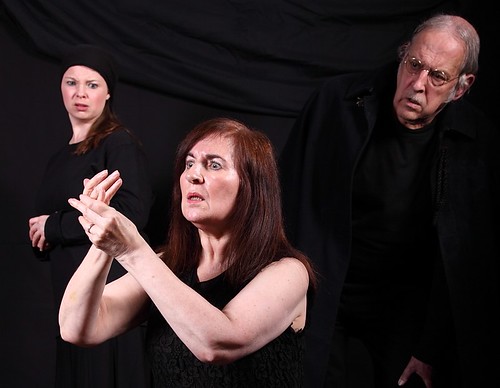
In this one-woman show, a Brooklyn actress confronts her most stubborn demons. Cursed with an unshakeable obsession to triumph in the role of Lady Macbeth, will she finally come to terms with Shakespeare’s most misunderstood heroine? Or will she succumb to madness, Serbians and enchanted bagpipers? Warning: Contains drama and insanity. 

What was the inspiration for this performance? 

I've always been fascinated by Lady Macbeth.  About six years ago, I was participating in a very intense program at Shakespeare & Company (here in the States) and was working on the role.  We were strongly encouraged to draw parallels between the trajectory of our characters and the trajectory of our own lives.  One night I was writing during a mandatory journal writing session (SO American!), and the idea hit me like a ton of bricks.  I knew that I could do it, and I knew that it had to be a solo show. 

How did you go about gathering the team for it?

That's a huge question because it's been six years in the making!  Matt Hoverman and his Go-Solo Workshop here in New York City was absolutely instrumental in the writing of the show.  My friends Autumn Mirassou, Kacie Laforest, and Perri Yaniv were my rocks during the initial staging, and now my director (and former teacher) Eileen Vorbach has joined on!  I've also relied heavily on my friends from Shakespeare's Globe for their continued support and guidance and, of course, my husband Sean who is possibly the most patient man in Brooklyn (imagine how often he's had to run lines with me!). 

How did you become interested in making performance?

When I was a student at The Second City Conservatory in my hometown of Chicago, making performance was the only thing we did!  Honestly, I was terrified of improv, but my Mom had just died and I needed a challenge and a distraction.  And, boy did I get one - when it goes wrong (which it easily can) it can be quite daunting.  But when it worked, it was pure magic! 


Was your process typical of the way that you make a performance?

That's hard to say because it was my first solo show, and it's worlds apart from improvising with an ensemble or doing a play.  I definitely used techniques from The Second City, but I also used a lot of techniques that I learned during my Fellowship at the Globe.  Performing at the Globe is an extraordinary experience because that theatre allows you to open up and have an intimate conversation with a thousand people.  Actually, it doesn't just allow it - it demands it!  I address the audience directly quite a bit in SCREW YOUR COURAGE, which was an intentional choice.  I wanted the audience to feel that they were coming with me on a journey rather than just observing me. 

What do you hope that the audience will experience?

I hope they're surprised by the show.  There are many elements in the piece (comedy, drama, Shakespeare, contemporary language, and... Shakespeare in Serbian).  It's a lot of fun, but it also deals with some very serious matters, such as my family's history of mental illness.  

What strategies did you consider towards shaping this audience experience?

I wrote three witches into the story for the purpose of exposition (and, yes, their lines are mostly written in trochaic tetrameter because... giant nerd).  Otherwise, I tried to use a comedic touch to move the story forward.  I think that helps the audience when things get serious.  After all, even King Lear had a fool. 

Do you see your work within any particular tradition?

Certainly it's part of the solo theatre revolution we've been having here in New York City, and it's part of the ongoing fringe theatre tradition as well. 


Wednesday, 13 July 2016

Dramaturge Macbeth: Susie McKenna @ Edfringe2016


C venues – C (Venue 34) ​
Aug 3-20 4.35pm

Music. Ambition. Greed. Murder – A musical adaptation of Macbeth


TWIST Theatre Company (The Way I See Theatre), Hackney Empire’s new graduate company, brings the premiere of a musical adaptation of Shakespeare’s Macbeth, set in the in the cut throat world of the British Music Industry, to C Venues, Chambers Street, for the Edinburgh Festival Fringe 2016 – Wednesday 03 to Saturday 20 August. 

TWIST’s Macbeth is a modern tale of lust for power, betrayal and murder within King Records, a thriving international music business based in London.  With an R&B, Grime and Afro Beat vibe, street dance and a lot of attitude this is Shakespeare meets Channel 4’s smash hit hip-hop drama Empire.

The production has been created and is performed by TWIST Theatre Company, a talented new company of young Hackney actors, musicians, dancers and singers (17-21 year olds), who have graduated from Hackney Empire’s Artist Development Programme (13 – 17 year olds). This new theatre company, supported by Hackney Empire, the Andrew Lloyd Webber Foundation and The Monument Trust, is the next step on the path to a career in the industry. 


TWIST Theatre Company - The Way I See Theatre - is a creative and political platform for a dynamic and diverse group of young emerging artists, based in Hackney, to tell stories through their own eyes and in a way that feels true. Company members represent different cultures and backgrounds and share and combine their talents, tastes and influences.  With the opportunity to refresh their minds, share their feelings and showcase their talent they create dynamic theatre that is a voice for their generation.

By bringing to life Shakespeare’s Macbeth with a mix of energy, passion and musical styles - Street, R&B, hip hop, afro beat, spoken word, and jazz - TWIST has created their own magic to inspire, challenge and connect with their audience.


What was the inspiration for this performance?
I worked with the young company to decide on an original and musical approach to Macbeth.
How could this version be a musical adaptation and what setting would work best for this.
Many of us had been watching FOX and Channel 4’s EMPIRE – set against the US R&B music industry and could identify the analogies to Macbeth. This lit the touch paper for TWIST’s adaptation setting it within the British Music industry and the rise and fall of a Hackney Artists who had used any means possible to become successful in the industry and conquer the World.

How did you go about gathering the team for it?
The TWIST ( The Way I See Theatre)  Theatre Company  are all graduates of Hackney Empire’s Artist Development Programme and they were chosen from over 40 applicants from within the programme to form a new graduate company. The creative team are all top professionals who had worked with the young artists regularly for about 4 to 5 years . The Company also has a shadow creative team that will lead the company from within during the Edinburgh run.

How did you become interested in making
performance?
These are young artists that I felt needed to make the next step into the industry and Edinburgh Festival is a great experience.  The story and issues surrounding Macbeth - especially set within the British music industry - demonstrates many of the problems some of these young artists face daily and in the future as they begin to enter the Arts industry. The Company also felt that the play and this approach to it would really speak to their peers and a young audience - making Shakespeare accessible to an audience who may not normally choose to see a classic play such as this.

Was your process typical of the way that you make a performance?
The process followed the normal practice we use for developing new work with young artists here at Hackney Empire. A week of Improvisation, music jamming, sharings for inspiration and then devising the piece in sections. Then move this along with more formal rehearsals to hone and polish the material created and consolidate the script into a rounded piece.

What do you hope that the audience will experience?
TWIST wants the audience to experience Shakespeare in a new and different way – that encompasses the music of today making it accessible and surprising to a young audience. 

What strategies did you consider towards shaping this audience experience?
Rather than a usual piece of musical theater the Company also approached the text using some recitative and rap merging with full blown songs - interspersed with the original text. At times the play will break the fourth wall asking its audience to become members of the MOBO’s audience.


Do you see your work within any particular tradition?
I think TWIST are very much developing their own style of musical theatre for their generation - and a 21st century sensibility.


TWIST Theatre’s Macbeth is directed by Susie McKenna (Hackney Empire’s Creative Director) with support from assistant director Patrick Miller (Hackney Empire’s Artist Development Programme Head of Drama / Byker Grove).  The production’s musical director is Renell Shaw (Rudimental), the choreographer is Leroy Dos Santos (Flawless) and the lyricist / vocal coach is Theo Llewellyn (1/4 finalist - The Voice 2016). Designer, Lotte Collett, has also worked on the visualisation and design of the project with the company.


In 2010 graduates of Hackney Empire’s Artist Development Programme formed their own theatre company, Hackney Harlem, and performed their production of A Midsummer Night’s Madness at C Venue, Chamber Street, for the Edinburgh Festival Fringe.  They won The Fresh Air award for Best show, gaining 5 star reviews and playing to packed houses.


Tuesday, 26 January 2016

Dramaturgy Without Words: Philippos Philippou and Vangelis Makriyannakis on Macbeth

credit: Sandra Franco
Life…is a tale

Told by an idiot, full of sound and fury

Signifying nothing…

A stark and stylised performance of this most familiar of tales, of boundless ambition and greed and the destruction it ultimately wreaks.

Visual technologies – video-mapping projections and animation – accompanied by a dynamic DJ set and darkly brooding sound world, transform Shakespeare’s words and narrative into a visual language of potent and symbolic movement and imagery. 

This dramatic canvas of images also draws upon the theories of Bertolt Brecht and silent era film aesthetics, creating an intriguingly alternative interpretation of Macbeth’s rapid rise to power and even more precipitous fall.


Ludens Ensemble is an Edinburgh-based theatre group which works with live music, masks, puppets, projections and animation, creating performances that ebb and flow between the aesthetics of critical distance and immersive experience. In 2017 Macbeth: Without Words will be performed in Cyprus as part of Pafos’ European Capital of Culture 2017 celebrations.

What was the inspiration for this
performance?
The initial plan was to create a performance using only movements and gestures inspired by the silent movies. Macbeth is funded by the European Capital of Culture Pafos 2017 along with our forthcoming performance of Alfred Jarry’s Ubu Roi, to be followed by a project called Forbidden Stories where we will be staging stories relating to the divide of Cyprus in non linear fashion. 

The first project we decided to do was Ubu Roi but that was for 2016 so we were then looking for a play that would precede it but also be connected to it. Ubu Roi uses many of Shakespeare’s plays as a source for parody and especially Macbeth. Both plays are treatments of the element of power, the one is part of the European canon and the other a precursor of the historical avant garde. 

One is a tragedy, the other an absurd comedy. So you can say that our work along with thinking about the nature of a performance is also an attempt to speak about the workings of power from different angles. Our take on Macbeth is influenced by Ubu’s ludic qualities but obviously the atmosphere is much more brooding.     

How did you go about gathering the team for it?
We followed the usual procedure. We announced an audition. 

Actually it was a workshop. 

How did you become interested in making performance?
Philippos: The real story was that I was fascinated about theatre since I was 10 years old when we did a performance at the school and I had the lead role. 

It was the Hippolytus by Euripides. I got obsessed with theatre and finally when I became 20 years old I decided to get into a drama school in Athens. Before I finished the drama school I won a directing competition at the National Theatre of Greece. From that point I believed that I belong to the backstage of the theatre. Since then I am directing.

Vangelis: My background is film theory yet due to the nature of my PhD research on the filmmaker Theo Angelopoulos who has a strong theatrical style, I came to study theater and especially Brecht. 

But as many people from my generation I had a strong interest in theater from quite early on. In relation to this particular performance Philippos wanted it to be accompanied by a DJ set. And basically this is what I do with silent films. I happen to be a DJ and I also curate and perform DJ soundtracks.


Was your process typical of the way that you make a performance?
Philippos: No. Usually I am starting by reading the play with the team. This time we started working from movements that could evoke particular concepts and sensations. Then we divided the play into different parts and we worked with the visuals and the music. It was a long process because we had a lot of work to do after and before the rehearsals. 

We were videotaping each rehearsal and then we had to sit down and examine and take of closer look of the whole process. What was common with previous performances is that I give space to the actors for improvisation. 

Also working with Vangelis was a new experience for me. We were discussing things at great lengths and this dialogical process benefited the performance. For Vangelis it was his first step at directing. 

What do you hope that the audience will experience?
We are open to any interpretation. During the performances at the Hidden Door Festival we gave some feedback forms to the audience. The forms were full of compliments and excellent reviews about the play. We were slightly worried if the audience will be able to follow the plot all the way through but everybody seemed to get a clear sense of the story. 


By answering this question we risk leading the audience towards particular reactions. Nevertheless we could say that we want to evoke the sensation of a dream or a nightmare and to show that dreams and therefore a performance is part of shaping our reality not merely representing it.  

We decided that we wanted to focus on a nightmarish quality for Macbeth. Our intention was to evoke the sensation of a dream on stage using minimal resources. Pierrot faces, video projections instead of real sets, expressionist lighting, morgue like cellophanes and a haunting soundtrack became an accompaniment to Macbeth’s murder of sleep.

We believe that in a dream the image acquires a more primary importance in relation to speech. Removing the spoken dialogue has allowed us to bring the actor’s body and gestures to the foreground and to deliver an acting style that has receded with the advent of naturalism. We basically love the acting in silent films. It is a different language. Gestures without words can acquire a strong sense of ambiguity.

Our three actors come to impersonate all the characters in the play yet it is somehow as if the witches are constantly there. Who are they? Are they in Macbeth’s head or are they external agents orchestrating his downfall and why? We want to raise questions without giving particular answers. Having an actor playing different characters while also commenting on them creates an ambiguity concerning their identity. 

Expressionism seems best to deliver this sensation while evoking a dream state. Bodies incorporate the movement of the puppet. Their status is suspended between the mechanical and the animate. We believe that this ambiguity retains its unsettledness today like it did over a hundred years ago.  

These are themes that are evoked in a quite subtle way. The attitude of the play is immersive yet there are breaks and this is where Brecht comes in. The actors then comment on their characters. For example we are commenting on the domesticity of women at the time when the play was written. Lady Macbeth seems to be breaking away from this state of affairs. So you see that the dream is not a means to escape a social reality but rather to comment on it more freely

What strategies did you consider towards shaping this audience experience?
We think that the answer lies in what we have already discussed
above. Combining expressionism with Brecht. Creating intensity through an ensemble of bodies, lighting, animation and music on stage and then breaking the flow.

Do you see your work within any particular tradition?
We do not see ourselves working strictly within a particular tradition yet our performances carry layers from the theater’s past and present. Although we rely on the use of technologies on stage we avoid at being overwhelmed by it. We always bear in mind that an actor with just one chair one a bare stage is enough to evoke an image of a stage-coach in motion.

Are there any other questions that might help me to understand the meaning of dramaturgy for you in your work?
To be or not to be, that is the question (laughter).

Wednesday, 5 August 2015

MacDramaturgy: Stuart Harvey @ Edfringe 2015

credit: chris de wilde
YOUTH MUSIC THEATRE UK BRINGS FUTURISTIC MUSICAL VERSION OF MACBETH TO THE EDINBURGH FESTIVAL FRINGE 2015

Creator and producer of Loserville, Youth Music Theatre UK showcases its musical reimagining of Macbeth, at New Town Theatre, 19-30 August (3pm), following a successful run at Belfast’s Lyric Theatre last year. The Scottish premiere of the show will feature a cast of forty performers and musicians aged 11-21, including six young actors from Aberdeen, selected through a nationwide audition process.


The Fringe
What inspired this production: did you begin with an idea or a script or an object?
Stuart Harvey: Garth and I had worked together the year before on another project for YMT investigating the ancient myth of Orpheus and Eurydice. The company's executive producer very much liked our take on the story and decided to offer us the chance to tackle Macbeth. As soon as we started the creative process we were hooked.

Why bring your work to Edinburgh?
We have been developing the piece for a few years now and the idea of sharing it with the Fringe audience is really exciting. We consider the piece to be challenging and thought-provoking and so us presenting it to a new, fresh audience seems the most logical step.

What can the audience expect to see and feel - or even think - of your production?
Our piece is a dark, epic, visceral movement theatre. Over the years I have seen many quizzical looks when I have said I am directing Macbeth the musical but it is completely different to what everyone imagines. I think we have got the balance right of staying true to the heart of the narrative but have found a way to enhance certain moments within the piece with the addition of music and movement.  

The Dramaturgy Questions

How would you explain the relevance - or otherwise - of dramaturgy within your work?
It has had a huge relevance- taking a well known play and trying to create a brand new piece of music theatre needs a strong sense of direction and structure. We are always going back to the text, back to the essence of storytelling and making sure that even if we pull away from the original form the heart of the piece is still true. I have tried to find the balance between what did Shakespeare want to say and what do I want to say.
What particular traditions and influences would you acknowledge on your work -  have any particular artists, or genres inspired you and do you see yourself within their tradition?
Garth and I grab a lot of inspiration from film- we will usually talk on the phone or over Skype about the piece and our main references will come from cinema. This piece has been inspired by a number of different films as it has evolved; we began by looking at the neon nightmare of Drive, this evolved into the futuristic dystopia of Blade Runner and now we are investigating the communist bloc and films like The Lives of Others and Goodbye Lenin. Garth and I are also huge fans of Caravaggio and so his use of chiaroscuro always plays a big part in the aesthetic of our work.

Do you have a particular process of making that you could describe - where it begins, how you develop it, and whether there is any collaboration in the process?
Collaboration for me is essential in theatre making. As a director I feel that I give everyone the freedom and space to bring their strengths into the process. I am very lucky to have an amazing team of people who all add something very special to the work. The initial idea and vision may well be mine and through hours of research and long discussions the piece slowly comes together. Research is key, I feel I should be in a position as the director to be able to answer any questions that the performers, creative team or technical team may have. 

What do you feel the role of the audience is, in terms of making the meaning of your work?
They are essential, if there is no audience than there is no point. All my work is trying to create a dialogue with the audience. I want people to leave the theatre and be moved in some way with what they have witnessed. I am always intrigued with what audience members have to say after a production- not so much as critics, if they see the piece as good or bad I'm not so interested in but how it made them feel and think is incredibly important.


YMT is the UK’s largest commissioner of new musicals, with Loserville receiving a professional run at the West Yorkshire Playhouse and the West End’s Garrick Theatre in 2012, plus nominations for Best New Musical at the Olivier, Whatsonstage and BroadwayWorldUK awards.  

Past alumni of YMT include Ed Sheeran, Sam Smith, Lauren Samuels (We Will Rock You/Bend It Like Beckham), Charlotte Ritchie (Call The Midwife/Fresh Meat) and many more.

This modern take on the classic tale of treachery, deceit and ambition is set in a future dystopia, where the digital world has come to a grinding halt. Featuring the original play’s abridged text set to music ranging from urban electronica to contemporary classical choral, New Music Theatre by Stuart Harvey and Garth McConaghie and choreography by Rachel Birch-Lawson create Shakespeare as you’ve never seen it before.


With grateful thanks to our funders: Arts Council England, Arts Council of Northern Ireland, NASUWT, Leverhulme Trust, Trinity College London, PRS for Music Foundation

Youth Music Theatre UK is also bringing its production of Not The End Of The World to the New Town Theatre 6-16 August.

New Town Theatre (venue 7), Freemasons Hall, George Street, EH2 3DH, 19-30 August, 15.00 (90 mins). Suitability: PG. Ticket price: £12/10,
family ticket: £8 per person, schools offer: please call 020 8563 7725.
Box Office: 0131 226 0000 / from 6 August 0131 220 0143, online sales: http://universalartsfestival.com/by-show/Macbeth.html

Thursday, 10 July 2014

Vile Banter

As sad as it might sound, Heinrich von Kleist's On The Marionette Theatre is one of my favourite philosophical essays. Not only is it the sort of conversation I'd like to have with my dancing friends, it covers everything from the mystery of grace, through the problems of conscious to an analysis of what makes performance so entrancing. It's short, sweet and has none of that cheerleading for the Big Thinker that makes Plato so frustrating at first.

Kleist meets up with his pal, a dancer, who is enthusing about the marionettes, favourably comparing their movement against that of humans. Kleist puts on his poshest voice, worrying that such vulgar entertainment might influence the professional. The dancer points out that the movements of the marionettes have far more elegance than that of his own company. He bemoans what he regards as an unnecessary self-consciousness in the human performer.

Again, I find myself returning to the dual nature of theatre: the split between what is literally happening, and what is supposedly being portrayed. With puppets, it is harder than usual to suspend disbelief. A full suspension of disbelief for TIP Connection's To The End of Love would end up in the audience running screaming from the venue, claiming to have seen costumes taking on a life of their own.

For Kleist's nameless friend, the marionette has a perfection because it has no will of its own. It doesn't spoil the performance by adding its own personality, or tiny spectacle, to the immediate movements. To apply this to human actors would be harsh, insisting that they remove any spark of themselves from the role - and counter to the exciting developments of the method technique (Polish and American).

When Kleist references Genesis, it's difficult to judge whether he is using it as a parable or literal truth - in 1801, both positions were more respectable. But if he is using it as a symbol of the problem of consciousness, it transforms the discussion from a simple chat about a show into a deeper questioning of human identity and potential. And within that, it is an early attempt to explain why performance is more gripping than representation.

Rather than emphasise the complete control of the body - something that the French tradition leading to Lecoq champions - Kleist sees it more as a matter of controlling the centre of gravity. The marionettes are moved so perfectly not by attention to detail, but to the core.

Perhaps Kleist, aside from his meditations on the nature of being human, was interested in the aesthetics of puppetry - the discipline was only then, at the turn of the eighteenth century, beginning to articulate itself. The mystery of transference, the way that an audience can identify with the puppet, is a function of the marionette's lack of personality. There is nothing to get in the way.

By contrast - Macbeth, as performed in the one man version by Alan Cumming. Cumming's celebrity feeds into his portrayal: it's impossible to see the show as anything other than a vehicle for his talents, especially since he jumps from role to role with disarming ease. There's a context to Cumming - I can't help thinking of him singing a song about Glasgow's West End with Forbes Masson, or painted as Nightcrawler in the X-Men film. This does feed his interpretation of Macbeth, but in the opposite way to Kleist's purity of intention.

The object being manipulated - whether it is a glove puppet, a lamp, a huge blue man representing depression - has only the life that it presents in the performance. There's nothing beyond the show. It is, in Buddhist terms, fully present. 

Kleist's dancer gets very excited at the possibility that he can make a marionette for the perfect dance. What he champions is the precision of the communication: movements so graceful that they transmit the ideas directly. It might be impossible to forget that the marionette is a fake person, but it expresses the truth behind the movement exquisitely.


Friday, 21 September 2012

No, I'm going to see Macbeth: Vile and Karoulla face over over Black Sun Drum Corp

Black Sun Drum Korps: Macbeth
as part of Arches LIVE 2012
Fri 21 - Sat 22 Sep 2012 | Fri: 6.30pm, 9pm | Sat: 6.30pm (30 mins) |£8/£6

SEX, MAGICK AND BLOOD. Warpaint masks and animal skins. Light the fires.

Led by Drum Major Russell MacEwan (Ron Athey & Company, US) and Glaswegian industrial trioBlack Sun, witness Shakespeare’s Macbeth as you’ve never seen it before – cut up and reworked to black metal standards.

Inspired by the automatic writing/cut up technique made famous by William Burroughs and Brion Gysin, highlander rhythms, dark magick and industrial witchcraft combine to create a primal, visceral and very loud experience only for the strong of heart.

Today

So... we both want to see and review Black Sun Drum Korp's version of Macbeth. I think that there is only one way to settle this, in the spirit of both critical discourse and Black Sun's brutal re-imagining of that hoary old myth...
The live battle of the critics. Who can come up with the best argument for being the chosen one to go tonight...
I'll start, since you seem frightened by the challenge. I deserve to go to see the show because I interviewed the drum major, and we share an enthusiasm for the loud, aggressive music of the 1980s. Although you have a taste for fiddly heavy metal, Black Sun, and the Vile Arts, approve the violent, measured savagery of No Wave music... and this Macbeth has its roots in that ferocity.

Well, yes, but I'm interested in the theatrical aspect of it - not only the music. I'm curious to see how they compressed the play's plot into what sounds like a half-hour metal manic's dream. Besides, you did say you thought you'd seen enough of Macbeth during the Fringe.

That's a fair point, but the drum major said that he aimed to annihilate the text. My complaint against Macbeth was the over-familiarity with the script, and Black Sun Drum Korp won't be pausing to give us some speech about "is this a dagger." They'll be hitting the shit out of their drums.

Surely for them to call it Macbeth, they are looking to follow the storyline? I'm intrigued by this annihilation of the text - there are plenty of modern warfare adaptations of the Scottish play as well as other Shakespearean plays. An adaptation of a story without the original text, but with that same, ferocious, dog eat dog message sounds exciting!

Macbeth is a historical figure: why do we need Shakespeare at all? But I think that the play does provide a starting point... however, there are plenty of other influences in there. All of which I have a stated track record of liking. I have referenced William Burroughs as an influence in my critical writing - especially the cut up technique, which Black Sun are using to deconstruct Shakespeare's text. There's only one person here who will really understand this version, and he doesn't have a wolf as his profile image...

Yes but if you already like them, how are you to review them critically? Perhaps a more honest response to their work would be from someone who doesn't know what the cut up technique is and who has only vaguely heard of No Wave music?

I am sure we would both be honest... and the point of Arches Live is to enter into its overall spirit. Black Sun are experimenting with forms - they are better known as a very heavy Glasgow band - and "critically" is this case does not mean "without liking them." It means bringing to bear the writer's knowledge. So I win.
oh- and the cut up technique? Try this, sunshine...
"without liking this,
of Arches writer's are known as a very heavy Glasgow Black Sun are mean with forms - bringing to bear critically the knowledge. sunshine... So I technique? win It means and the cut try bans Live is to enter up into its overall spirit. they - and "" is this case better does not experimenting

How does knowledge of that technique enhance the experience of the audience though? Your knowledge of it could inhibit your understanding in some ways, as well as increase your expectations for it, hence disappointing you personally (especially cause you met the drum major). My lack of knowledge in this case might allow me to go in uninhibited and without expectations. Besides, liking them would lead to bias, and i think we've established that we both like the idea of this version already.

You are still going on about bias. But the Radical Subjectivist Critic not only acknowledges bias, but embraces it. However, I take your point... and ultimately, neither of us has the "best" critical voice. We have different voices. You would see it from one position, I another. So, I guess, either one of us would be an interesting critic to write about it.
However, I would like to remind you that this Facebook argument is supposed to be an imaginative way to preview Black Sun - an example of the Radical Subjective approach to criticism that privileges the entertainment value of writing over some notional "right way" of writing about theatre... and we are supposed to be saying why we want to go and see it, not arguing about who the best critic is...
And since you got into that course and I didn't, we know that is you, anyway.

You didn't apply for it though. tongue It would certainly make a change from dance performances (or physical theatre) you've been throwing me into since Last Orders. Black Sun are interesting to me because they are not a theatre troupe, but originally started out as a 'subterranean metal' band. How does one interpret Macbeth as a non-play and something that is hopefully not a musical?
Okay. We need to wrap this up and get the tickets. I'll tell you what. We'll both go to Alien War at half five, and if you don't shit your pants in fear, you can cover Macbeth. But you have to edit the interview I did with the drum major for the soundcloud in exchange.

16:43
Ok, sure. smile


Tuesday, 14 August 2012

Our Soldier is not Your Daddy's Macbeth


You are reading the Vile Blog, Scotland's only blog dedicated to the ego of one lone critic who believes theatre can save the world. Today I am delighted to welcome Mr Joel Gatehouse, who has a show on at Zoo.

Now, I have start off by saying that I am suffering from Fringe Fatigue. I also have Adaptation Allergy, and a Macbeth Myopia. In other words, I am tired, grumpy and can't see the point in any more adaptations of the Scottish play. And yet, you are up here with a piece that is likely to irritate me beyond measure...

Well, there certainly seem to be lot of Bloodstained Hands and soldiers with dangerously ambitious spouses up at the Fringe this year. In fact, Macbeth isn't the only story we're seeing being retold, reinvigorated or rehashed. Multiple Miss Julies, lots of Lears... And exactly how many plays about soldiers are there? 

But the argument we make is that, although the many similar stories might be old and all too familiar, the message behind them rarely is. For us Fools it's not about the stories you tell but instead about how you tell them. We're handing out badges saying "Shakespeare stole ideas too" as a reminder to our audience that it's not about creating something no one has ever thought of before, but instead about truly owning the stories you tell. 

A Strange Wild Song and Grit are two shows about children effected by war at Bedlam this year. Yet they are two loveably unique shows that tell two very different stories in completely different ways. 

Our soldier contains exactly zero lines of Shakespeare's text. What does that make it? A adaptation? A reinterpretation? Does it matter? We think it doesn't and you'll come out at the end not talking about Shakespeare but about a lovably foolish war correspondent and a charismatic soldier. 

Okay, I'll show a grudging respect for your complete eradication of Shakespeare's text: if I heard another speech about a "a dagger before me" spoken by a bloke wearing a sub-machine gun, I'd be on the phone to Doctor Who to ask who is messing about with the space-time continuum. Then again, what's left of Macbeth if you get rid of the language? Is it a story about murder, the importance of having children to continue your legacy, or the problems or spending too much time trying to pick up weird sisters in the Forest?

So much is left! The power of a prediction. Of fate. The irresistible forces that push us everyday. Guilt. So much guilt. In Our Soldier we directly relate the guilt of a child stealing a Flump from her Grandma's purse to sending your husband off to kill someone... Possibly not the most obvious connection but for Alice Coggins, our plucky war correspondent, it's the only way she can relate to the horrific situation unfolding in front of her. 

Our Weird Sisters are Dali-esque businessmen with briefcases for heads, Half blind they select "Our Soldier" for greatness and the action of the play is set in motion. We ask the question "what if no one was left to tell this story of the boys and girls who are sent off to another country to play at war"? Not to make some vague political point about UK foreign policy but instead to make people connect with a story that is very much our story. Of our times. And no one else's. 

Perhaps you're right that we don't need a Macbeth set on the international space station or Much Ado About Nothing where they communicate only via Facebook but it might just capture something about right now that wasn't true yesterday... or that will be true tomorrow. That for us is the very thing that makes theatre so special. It's ability to react to the spirit of our times. 

Okay, I am starting to like this. By abandoning the original script, you've given yourselves free reign to explore the ideas and make it relevant again: much like the way the great Greeks did with the myths, showing respect to the source material as inspiration, not as the definition of how the story has to go. One last question before you go, then: how did you make the work and for a lazy critic like me, what categories does the production fall into - is it devised, physical, comedy or what?

We started by going through the play looking at the actions of the text rather than any psychology or language used. From this we created a framework in which to play around in. We improvise, mess around, try to make each other laugh. It was really important for us to find some light in a piece filled with so much darkness and our bumbling war correspondent helps this on its way. Our style is undeniably physical and visual and you'll find us in the Physical Theatre and Dance section of the fringe programme. 


Mack is back!


Monday, 2 July 2012

Macbeth goes Scots

I saw Macbeth last week. It was done by one actor, set in a mental asylum and got a standing ovation. It mixed up physical theatre vitality (Christine Devaney off Curious Seed was the movement director), the poetry of Shakespeare's script and got me as close to a genuine Hollywood star as I am likely to achieve in this lifetime.


Still, I have reservations about the whole Shakespeare industry. the NTS' Macbeth was a success because it had Alan Cumming: the actual script was far less memorable than the moments when Cumming pulled the guts out of the bird, freaked out at the memory of his character's crime, or camped up King Duncan in a knowing aside at the tradition of English actors who overplay the bard. 


It's not that I don't like Shakespeare: it's just that it is so much more interesting when his words are the basis of something, rather than the whole point. So, yes, Macbeth is Scots does fascinate me... and Mike Duffy, the director, was good enough to tell me more...

Mike Duffy: It is well known as “The Scottish Play!” It is played regularly in the Edinburgh International Festival and Fringe - and all over the world- in many different languages – we felt it was time The Scottish Play came home.  


It was written to please a Scottish King, James VI (later James I of England) who licensed Shakespeare’s company as The King’s Men within weeks of his coming to the English throne. The Scots language expresses the dark imagery of the original very well and gives new life to some of weel-kent speeches. 


Liz Lochhead had no doubts about the worth of the project: From a simple reading of Robin Lorimer's translation of MacBeth I know it to be muscular, passionate, dark, and very, very rich. It will certainly add an extra frisson to Shakespeare's most headlong and thrilling psychological horror story to hear it in such Scots.”  

There is no reason why anyone should take MacBeth in Scots to be more “real” than the original.  But in any case nobody expects Shakespeare’s plays to be historically accurate.  He wasn’t one to spoil a good story by worrying too much about facts.  Macbeth is one of Shakespeare’s Tragedies not a History. It is all about the struggle for power – a common Shakespeare theme. 

How does it fit in with the shakespeare festival that is going on around the UK?  
The Globe Theatre in London is putting on all 37 Shakespeare plays in 37 different language - but not in Scots.  We are very pleased to be filling the gap by performing the Scottish Play in Scots at the RSC’s World Theatre Festival in Stratford upon Avon .  The Edinburgh International Festival is featuring a Macbeth in Polish, a Midsummer Night’s Dream in Russian and The Rape of Lucrece performed by an Irish singer – but we will be  performing the Scottish Play in Scots for two weeks on the Edinburgh Festival Fringe.

Is shakespeare a writer who has much to say to scotland these days?
Shakespeare has plenty to say to everybody.  That is why his plays are performed all over the world (yes, in Scotland too!)  Struggles for power are universal. In the Scottish context we currently have the debate about Independence.  

In the particular case of Macbeth most schoolchildren study the play.  There is currently a Scottish Parliament backed movement for children to get in touch with their own Scots language.  The translation of Shakespeare into Scots helps to give the language the respect it deserves. 
 
When you produced it, did this version force any interpretations that surprised you?
The Scots language forces Gruoch (Lady Macbeth) to be strong and earthy – no holds barred – as she argues the case for Duncan’s murder. Also the importance of the English backing of Malcolm’s claim to the throne also comes out much more clearly.  Each time Earl Siward and his son speak the original lines in English it sound quite shockingly alien to the cast who are thinking in Scots. 


Not only does it reflect the reality of English interference in Scottish history, it has a contemporary frisson with world powers intervening in regime change. Most of all it is very moving when the actors bewail the state of Scotland in Scots rather than in R.P English.  


Monday 6th August  – Saturday 18th August 7.30 p.m
Saturday 11th / 18th August at 2.30 p.m. and 7.30 pm.
St Ninians Hall, Comely Bank Road, Edinburgh EH4 1AF