Theatre and Culture from Scotland, starring The List's Theatre Editor, his performance persona and occasional guest stars. Experimental writings, cod-academic critiques and all his opinions, stolen or original.
Showing posts with label comic books. Show all posts
Thursday, 11 May 2017
Is The Valkyrie a sex object?
The 'splash page' - here taken from The Defenders issue 5, page 1 (1973) - operates in the manner that Diderot suggests for the 'tableau'. Inspired by painting, Diderot encourages writers to include moments of mime or physical theatre that establish, visually, the relationship between the characters on stage.
Here, the splash also operates as a metonym for the comic book: Valkyrie is clearly the centre of attention and, without the usual violent action associated with the superhero, establishes her presence. Other, anonymous characters stare and gesture towards her, and the text hints that her mysterious public presence echoes her interior confusion.
Whether Valkyrie is a sexual object, or a source of fear, is not clear: a young lad in the foreground seems delighted but the older man, as he drops a lamp, appears as frightened as aroused. The single image is ambiguous, having the same problem often described for Wonder Woman: does her costume sexualise her and diminish her power? She even has the bracelets that are a feature of Wonder Woman's costume.
The crowd's variety of responses is telling: as Valkyrie is confused by her own identity, her digetic audience suggest the reader's own responses. Equally, they provide the conditions of Valkyrie's character. She walks alone, provoking pleasure and anxiety in those around her, but not caring.
Tuesday, 13 December 2016
Composite Scenes
I call 'composite' scenes those where several
characters are occupied with something, while
other characters are engaged with something different,
or with the same thing, but separately.
Diderot, Discourse on Dramatic Poetry
characters are occupied with something, while
other characters are engaged with something different,
or with the same thing, but separately.
Diderot, Discourse on Dramatic Poetry
Tuesday, 29 November 2016
Comic Book Funnies
Who said Jack Kirby isn't a prophet?
And... best meme ever?
Monday, 19 September 2016
Publication Format
It's a shame to dismiss Baetens and Frey so summarily: their conclusion that the graphic novel does not represent a clear break from comic books is even-handed, and recognises the weaknesses of their attempted definition. Unfortunately, the Wikipedia page provides a livelier discussion, including the historical evolution of the term and its format, as well as criticisms of the term from Alan Moore and Neil Gaiman.
These criticisms hit at the heart of Baetens and Frey's discussion: ultimately, the term is a pretentious cover for the true nature of the book, which is a comic within a specific history. Perhaps lumbered by a title that begs a definition, the two academics are forced to begin their study by defending their subject: the emphasis on quality as a characteristic drags them away from the accepted process of definition - which is on quantifiable elements, not the value of a form. They also get caught up in the genre wars (superhero is a genre, not a form), and draw comparisons between comic books and graphic novels which dissolve under cursory investigation.
I'd like to say their conclusion is, at least, honest, but when Wikipedia shows more academic rigour...
The Graphic Novel: it's not the form, is it?
Jan Baetans and Hugo Frey (The Graphic Novel, 2015) argue for a distinction between 'comics' and 'graphic novels'. Considering differences in form, content and publication format, they present a series of comparisons between the two forms.
Beginning with form, they consistently fail.
'Differences... are not always very clear-cut,' they understate, before noting that the great exemplars of the graphic novel, Watchmen and Dark Knight 'started life as comics and then were republished as graphic novels'. Suggesting that graphic novelists will try to give a distinctive 'twist' to their work (without defining what this might mean), they identify 'layout and narrative' as the key areas.
Apparently, the past century has seen a consistency in the use of a grid system which is designed to be read sequentially. Ignoring the shifts in the use of the grid pattern (for example, EC comics frequently separated text from image, Little Nemo made adventurous use of the standard grade without using the changes in perspective that characterise comics from the 1940s onwards), Baetans and Frey gesture vaguely at the ability of the graphic novelist to 'explore' the rules of composition.
Julie Doucet is then invoked as a 'graphic novelist' who deliberately aims at an ugly aesthetic. Never mind that Doucet's Dirty Plotte was published from 1991 by Drawn and Quarterly in a 'regular comic' format, or that she announced her retirement from comics in 2006, and her subsequent work has followed a more fine art path of collage and illustration. ("A Good Life: The Julie Doucet Interview" by Dan Nadel, The Drama, issue no. 7, 2006).
A stronger example is Will Eisner, who consciously experimented with breaking the traditional frame format throughout his career: his masterwork, The Spirit, however, was clearly produced in the era before the graphic novel became a defined term and his graphic novels, written from the 1970s in prestige formats, share with the comic book the inventiveness Baetens and Frey claim as a distinctive quality of the graphic novel.
Finishing off by claiming that 'the abstract comic' was unthinkable before the graphic novel enabled it, Baetens and Frey reveal a poor reading of Robert Crumb's 1960s' work, which frequently eschewed narrative or coherence for an illusive, psychedelic series of juxtapositions.
While this is only round one in their attempt to define the graphic novel - or their use of the term - pages 8 to 10 are a spectacularly poor effort, falling between the stools of vagueness and weak historiography.
Will their focus on content redeem them?
Sunday, 5 July 2015
Karrie Fransman @ Comic Con 2015
Talking to Karrie Fransman at Glasgow Comic Con was a rare delight: her work has been featured in The Guardian and The Telegraph, but it is her graphic novels - and various other projects - that make her an exceptional artist. Both The House That Groaned and Death of The Artist reveal her intellectual curiosity and willingness to play with the form of the comic book. Her talk was witty, and her self-deprecated humour belies her dynamic aesthetic.
Death of The Artist is an experimental take on story-telling, that plays post-modern games with the identity of the creator: if The House is a more recognisable narrative, it is a rare example of a British comic book that is intimate and cheeky. Her drawing style is vivid and energetic, evoking the busy panels of Where's Wally? even as she unfolds a delicate tale.
Yet Fransman's work goes beyond the graphic novel and draws parallels with visual art experiments. Her project on The South Bank for Alchemy is a beautiful collaboration that takes the loose comic aesthetic and applies it to an installation that acts like a full-size paper theatre. Another commission sat her circular self-portrait (which told a tale of eternal artistic creation and frustration) within a gallery in a contemporary take on that time-honoured painting training.
Fransman's approach to sequential art is subversive of the form, pushing it into new areas and asking questions about its nature: she has presented illustrated articles and longer form narratives that ask questions about the way that images and text react to each other, and integrate into a powerful way of exploring ideas and telling stories.
Labels:
comic books
,
Glasgow Comic Con
,
Karrie Fransman
,
sequential art
Sunday, 4 January 2015
Monday, 17 March 2014
One Issue, Many Minds
As much as I love Black Hearted Press, I hope that they haven't placed too much confidence in me. My own insecurity notwithstanding, the panel they've lined up for tonight's discussion (along with SICBA, and Stirling Maxwell Centre at Glasgow University) represents the breadth of comic book appreciation in Scotland, from the intellectual (Dr Laurence Grove and Dr Chris Murray) through to the financial (Maria Welch from DC Thompson). And of course, the critical - I am hosting the panel.

Besides, there is an exciting pair of aims: developing a sustainable industry and aspirations of creating a National Comics Academy and Art Gallery in the unused McLellan Galleries. I want to be able to nip into an exhibition of Kirby on Sauchiehall Street... one day.
Hosted by Gareth K Vile (Theatre Editor of The List), the event is in a 'question time' format, with everyone participating, including the question panel:
Dr Laurence Grove, director, Stirling Maxwell Centre, Glasgow University
Chris Murray, lecturer, University of Dundee
Sha Nazir, art director and publisher, Black Hearted Press Ltd
Jenny Niven, portfolio manager – literature, Creative Scotland
Kevin O'Donnell, retail manager, Forbidden Planet International
Phillip Vaughn, lecturer, Duncan of Jordanstone College of Art
Maria Welch, publisher (Children’s Entertainment), DC Thomson Ltd
Issue One is a response to 'the boom in comic book creators from Scotland making an impact on the world stage.' Names like Mark Millar and Grant Morrison are familiar for their tenures on the Big American Comics (Ultimates, X-Men), but there is another, dynamic comics industry - probably well explained by a quick look at BHP's catalogue - of artists and writers who are reaching wider audiences while playing a more sophisticated game.
There are a selection (six) of questions that will focus the conversation: they concentrate on how comics are perceived and how artists can sustain a career in the industry. Perhaps the biggest battle is to insist on the legitimacy and status of the comic book: in recent years, it has become an academic concern in the UK and, as Dr Grove can point out, this only follows the trend in Europe.
Like everyone over the age of twelve who still reads comics, another round of the 'comics grow up' headlines would make me wince - frankly, it's the journalists who write this stuff that need to grow up. But the quality of the work being produced in Scotland - in fact, even in the CCA, to give more props to BHP - grapples with ideas and content in a way that most novelists would envy.

Besides, there is an exciting pair of aims: developing a sustainable industry and aspirations of creating a National Comics Academy and Art Gallery in the unused McLellan Galleries. I want to be able to nip into an exhibition of Kirby on Sauchiehall Street... one day.
Hosted by Gareth K Vile (Theatre Editor of The List), the event is in a 'question time' format, with everyone participating, including the question panel:
Dr Laurence Grove, director, Stirling Maxwell Centre, Glasgow University
Chris Murray, lecturer, University of Dundee
Sha Nazir, art director and publisher, Black Hearted Press Ltd
Jenny Niven, portfolio manager – literature, Creative Scotland
Kevin O'Donnell, retail manager, Forbidden Planet International
Phillip Vaughn, lecturer, Duncan of Jordanstone College of Art
Maria Welch, publisher (Children’s Entertainment), DC Thomson Ltd
Monday, 7 January 2013
Using Comic Books as an Example of How The Internet Changes
Although my comic book reading is semi-detached these days - I'd like to pretend that it is maturity but it is more likely financial considerations - I've followed the last decade of Marvel Comics with vague interest. Like everyone else who grew up with a regular comic habit, I tend to resent any attempt to update my favourite characters (I still have a bizarre crush on Marvel's version of the Valkyrie, who pulled off a clumsy feminist consciousness while wearing a stripperiffic outfit): the speed of change in the Marvel Universe, however, impresses me even as I recognise it as a sign of panic.
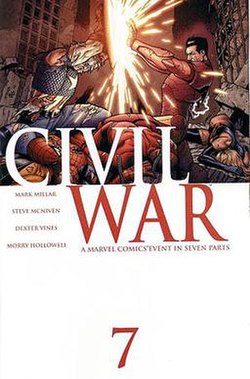
A quick summary: until the late 1990s, the Marvel Universe was relatively static. Despite the odd crossover, the continuity of characters - Spider-Man had women trouble and was hounded by the press, The X-Men fought to save a world that feared them and sold better than anything else, Captain America struggled to hold the values of 'The Greatest Generation' - meant that dropping in and out of reading was easy. Significant changes would eventually be reset, sometimes too quickly, and certain characters evolved, thanks to popularity (Wolverine started the 1970s as an ambiguous Canadian agent, good in a scrap but volatile, and ended the century as the sort of hero who could kill God).
The last ten years or so, however, have seen constant changes in the status quo. None of them stick for long, culminating in a dramatic crossover story-line that would set up a new status quo, which would culminate in a dramatic crossover... The stock heroes are still knocking about, but some new characters have been invented, risen to prominence and been killed off in the same amount of time it took Jack Kirby and Stan Lee to resolve a single minor plot point in the 1960s.
There has also been an obvious rise in the adult content and themes in comics. Back in the day, heroes would either be killers, and therefore slightly dodgy (viz. Wolverine) or have a frankly fatuous code against killing. When faced with genocidal maniacs, the heroes would defeat them then pontificate about how killing them would make them as bad as the villain.
It is generally accepted that the 1990s introduced the more brutal hero - known as 'The Dark Age,' it saw anti-heroes like The Punisher replace the playground adventures of the likes of The Fantastic Four as the top sellers. Contemporary comics have retained this brutality, and the increasingly ridiculous anatomies of heroines (it's even rumoured that a few artists use porn stars as models for their depictions of female characters). I've been trying to make a collection of comics for my nine year old nephew to read. I can't give him anything printed after about 1986.
Because my reading of comics is now filtered through discussion boards - cheaper and more fun than the actual comics, sadly - the philosophical discussion on the new, darker mentality of the hero can be hilarious. Back in the day, I would defend comics on the grounds that they presented a field guide to ethics. I might still be in the habit of making extravagant claims for art - like that one about how 'going to the theatre is an intrinsically moral act' - but the divorced between the real world and the four colour version is far more pronounced than it used to be. Ironically, the Dark Age was supposed to be the consequence of Alan Moore's attempt in The Watchmen to apply real issues to super-heroics. Instead, there's an uneven grafting of old fashioned moral debate onto images that are all-too-familiar from the news.
That aside, the constant change of the Marvel Universe has seen The Green Goblin become the head of the USA's homeland security, various teams of good guys having throw-downs (Civil War had Captain America get a pasting off his Best Friend Forever Iron Man, Avengers Versus X-Men explains itself), an invasion by an alien civilisation and the destruction of Asgard out of Norse mythology: there's a major shift of emphasis nearly every two years. Each shift causes a major row amongst the fans, who don't always seem to realise that it won't last, and the shifts often mimic the demands being flung about on the message boards.
This revolving door policy of status quo fascinates me because it appears to be responding to the massive and sudden changes in media. Two factors - the emphasis on The Event (each change has a mini-series that announces it), and the instability of the narrative. While I can't be certain that this is the result of the creators reading the on-line arguments and adapting the best suggestions, it does reflect the way that the internet operates.
There's a great South Park episode where the boys try to earn money off YouTube, only to find themselves in a waiting room with previous internet phenomena. In a short scene, South Park parodies the ability of the internet to create stars and drop them. The Laughing Baby was a celebrity, so was that bloke shouting at his dog. Remember them?
The Marvel Event is just like that - a sudden explosion of interest, then replaced by the next Event. As for the instability of the narrative - well, my research into puppetry has found a thousand and one different versions of its history.
This strikes me as a good example of the way in which the internet is changing the way that all media is consumed. It's not about the technology - comics have been very slow to realise that the internet is a very powerful and direct way to distribute - but the way that narratives are shaped. They are in a constant state of flux. It's a reminder of Alan Moore's prediction for the future of information as steam, when the 'heat' of innovation turns knowledge into the fastest moving state of matter.
It's even more interesting when the history of comics suggests a medium that is very slow to adapt to fashion. Much as I love the old 1960s comics of Jack Kirby and Stan Lee, there is little to suggest that their run on The Fantastic Four was responding to the events of the era. During their time on the comic, the USA went from a conservative, Christian nation to a madcap laboratory for alternative lifestyles. Rock'n'roll evolved from Elvis to psychedelia. Mr Fantastic spent the decade squaring off against communists and trying to make his marriage work. In the 1990s, the X-Men were sporting mullets, a good ten years after they fell out of style.
Quite where this all sits in my broader cultural commentary, I have no idea. Like so many things that occur to me when I am waiting for my invoices to be paid, it is intriguing. Nominally, comics are a popular medium, and express some old fashioned values in a relatively uncritical self-defeating way - the moral that might doesn't make right is usually expressed by punching someone in the chops. But they are not popular in sense of sales - I reckon more people know who came third in X-Factor than the current line up of the X-Men - or even reach: the audience is established and niche.
Niche - that's pretty much like the internet too.
Subscribe to:
Posts
(
Atom
)


