Showing posts with label pulse:touch 30. Show all posts

Tuesday, 27 November 2012

Electronic Musing and Sonatas for People

It’s debatable whether my contention that electronic music is not enhanced by live performance is a prejudice evolved from years of watching dance: the theatricality lacking from events like Touch 30 is as much about the process of creation not allowing or encouraging wild performance as any more specific problems of the concert format. Nevertheless, after Sonica, and Sonata for a Man and a Boy, the sight of three men fiddling with electronics is less engaging than either an orchestra in full flight or a cellist chasing around the stage after a mischievous student.

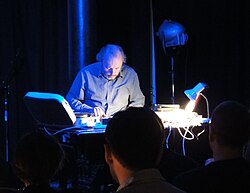
What Touch: 30 does provide is a statement about the range of electronic music being made outside of the classical, dance and pop spheres. Philip Jeck is a veteran artist – his set made up the middle portion of the night and a large projection cast up his intricate attentions to turntables and a keyboard. Like BJ Nilsen and Thomas Koner – both using a more contemporary laptop set-up, Jeck’s music is about the texture. All three artists emphasise the drone and the nuanced shift – Jeck’s analogue equipment includes surface noise and distortion while Nilsen goes for a collaged soundscape of found noises. Koner’s final set is the most bass heavy and illustrated through a series of dark projections, each one shifting slowly like the moods of his composition.

All three artists are immensely serious, but only Koner’s subsonic bass justifies the live performance – there’s a brutal reverberation to his seismic shifts. Sonata for a Man and a Boy isn’t really trying to imitate the musical sophistication of Touch’s artists – the music it uses is familiar and melodic, taking advantage of the cello’s eloquent melancholy.

The music is, indeed, only part of Sonata’s purpose: rather, it uses the format of a lesson to bounce around ideas about education and maturity. The skill of the man is mirrored by the humour of the boy and a simple cello lesson – a rare example of a teacher being represented positively within the arts – becomes the ground for games and life learning.

It’s almost irrelevant to group these two shows together simply because they are centred around music and yet their intentions – to find new ways to use music – are shared. While Touch: 30 emerges from the independent label scene of the 1980s, it has adapted the high seriousness of classical and visual art, shifting away from explicit meaning towards abstraction. Sonata embraces physical theatre but, despite interludes of idiosyncratic choreography, speaks of the relationship between childhood and maturity leaving enough ambiguity for discussion but clearly grounding the content.

Heroes...


In the past month, I have attended concerts by two of my heroes: Philip Jeck – mainly because of his Vinyl Requiem – and Michael Gira in Swans. Neither gig was as ecstatic as I might have hoped. In both cases, the live experience did not expand on my joy in their recorded output.

In many ways, Swans are easier to understand: it is clear that their live sets chase the ecstasy and the limitations of the venue’s sound – and a slight discomfort caused by the ritual of the gig, in which the audience are reduced to spectators – undermined the ferocious assault. 

There were moments of sheer brilliance: an unexpected version of A Coward proved that Swans’ latest incarnation can be as hard-hitting as Gira’s earlier line-ups, and there were several improvised moments when the guitars, and percussion combined towards a monumental majesty. Gira himself, reveling in his new, confident baritone, was appropriately messianic and my subjective experience was clearly not shared by the entire audience. The sheer volume, the interludes of droning distorting, the energetic runs driven by the twin drummers: even on what was not a perfect night, Swans are proving that there is an alternative to the nostalgia circuit.

Philip Jeck is harder to assess. In a triple bill of experimental musicians, his analogue approach stood out. The use of vinyl lends his performance a rougher, human edge (later, Thomas Koner would evoke landscapes that dwarf human scale, much like an icier vision of Swans’ scope). Yet, having worked with dancers and creating installations like the Vinyl Requiem, Jeck’s solo is oddly introverted. He builds layers of sound through adding recordings and even rolls out a few bass lines that sound fresh from a John Carpenter horror flick.

If he never quite reaches the scale of Koner, he does use his drones in a familiar, almost friendly manner. The awkwardness of vinyl makes the tunes distort under pressure – at times, the tone evokes a lost radio transmission. Yet the live dimension adds little.

While Swans battle the elements – and there were few moments of boredom and plenty of potential – it makes sense for Gira to tour. But for Jeck, the nature of his music seems more comfortable in a recorded format. Gira aims to be shamanic, ramping up the traditional rock egotism into something spiritual, while Jeck is tinkering with idea that are as immediate experienced in a solitary cell. There are two forms of mysticism at work – which explains why these characters became my heroes in my teenage years. One is liberatory, expansive, feeding on nature and the moment. The other is scholarly, monastic.


Saturday, 17 November 2012

Electronic Music: Pulse and Sonica (part 2)

What Jeck shares with fellow turntable fan - and sometime children's party DJ - Janek Schaefer is an interest in how this specific piece of outdated technology can be reused both as an instrument and a symbol. Jeck's Requiem and Schaefer's Extended Play present the turntable as an example of analogue technology, superseded by digital but stubbornly surviving: Schaefer's fascination with the physicality of vinyl is mirrored by Jeck's insistence on its fragility.

Perhaps due to Jeck's training at Dartington - this is the school that taught Ultimate Dancer and Gilbert and George - he is a consistent collaborator and often focusses on the values of live performance. He also belongs to a generation that grew up before the digital revolution, and the turntable becomes more than just a tasty piece of kit. It is effectively his musical instrument which he plays as others use a guitar or piano. Admitting that he was originally inspired by New York DJs in the late 1970s, he applied his training in visual art to sound collages: in many ways, his inclusion in the Sonica festival would have  been more logical than in Pulse, which connects more to the electronic music tradition than Jeck's own hybrid approach.

Jeck is startlingly old school as a performer - his appearance at The Arches in 2005 included choreography by Scotland's Karl Jay-Lewin, and his role was more musical accompaniment than star turn - but the use of vinyl adds more prowess to his presence than lap-top orientated composers can achieve: even Matthew  Herbert's One Pig, which crowded the stage with musicians - amusing dressed in lab coats, struggled to prove that the live performance was much more than a version of the original album, mainly thanks to the perfect sound reproduction of the computers.

Jeck says that he never consciously used vinyl for its nostalgic qualities, yet it is these qualities that link him into an older tradition than contemporary electronic music - the use of glitches and false starts, the emphasis on the surface contours of sound are thrillingly modern, but relate back to the early experiments of Stockhausen or Lucier: the echo of hip hop's star DJs places him in a more rock'n'roll lineage than even Ben Frost - Frost may quote Michael Gira, but his use of the lap-top distances him from the heavy thunder of Gira's Swans.

Thursday 22 November 2012, 8pm

Thursday, 15 November 2012

Electronic Music: Pulse! (Part 1)

Electronic music is still struggling to find a relationship between the seriousness of its compositions and the immediacy of live performance. Often being closer to classical music in terms of scope and ambition, it lacks the vitality of rock or pop but can veer into pretentiousness when aping the chamber concert. Ben Frost summed up the problems - his music vacillates between Michael Gira and Reich - in his recent gig at the Fruitmarket, which was less interesting as performance than as a soundtrack. 

Matthew Herbert's One Pig at Tramway was more successful, not least due to the sight of a lab-coated boffin bouncing about in a musical cage but for all the live remixing, fancy trickery and performance play - One Pig was recast as a performance for laptops, electric fence, boffins and chef - electronic music thrives on the sterility of the studio rather than the grubby confines of the gig.

While Sonica is going some way to present enough sound art to sketch out the boundaries of modern musical performance, Glasgow City Halls is beavering away with PULSE: Touch 30. Pulse is a new strand of programming - kicked off by Frost last month - and Touch 30 is a celebration of the London experimental audio-visual company.

The gig is a three way mash-up of talents: like a Scottish Ballet triple bill, it has something for different crowds. Philip Jeck gets busy on the decks; BJ Nilsen examines how sound hits humans and composes for film and theatre; Thomas Köner would fit nicely under Sonica's "sonic art for the visually minded" rubric, and has been known to mess about with a bit of dub-techno


Philip Jeck is a rare turntablist who, like Janek Shaefer, is less a hero of the dance floor than a determined sound artist. He brought his Vinyl Requiem up to Tramway in the 1990s: this immense piece is both a nostalgic tribute to the record-player, made at the point when CDs were still looking viable as a replacement, and a reminder of how the turntable has a versatility that makes it an instrument in its own right. 

Jeck is also worth seeing perform. His music may come from a secure intellectual foundation - he learnt his skills at Dartington College, not at the block party, and so shares a tradition with live artists or theatre companies like Fish and Game rather than Terminator X - but he has a presence that is unexpected from the man who won The Paul Hamlyn Foundation Composers Award.