Showing posts with label Arches. Show all posts

Friday, 13 May 2016

Scots Dramaturgy: Ishbel McFarlane on Hoolets and Languages

Ishbel McFarlane in association with Feral presents
O is for Hoolet

**WINNER The Arches and Traverse Theatre’s Platform 18: New Directions Award 2014
A passionate, interactive one-woman show about the Scots language using stories, memories, interviews and attitudes to challenge expectations and prejudices around minority languages
Scottish Tour: 22nd April – 11th June 2016

“A passionate call to arms for the study and preservation of minority languages.” ★★★★ The Times

Language is personal. Nothing gets closer to our hearts. And yet, by its own nature, it's always social. Who owns it? Who appoints it? Who governs it and why?

In this lively and detailed performance, Ishbel McFarlane portrays several historic Scottish figures and linguistic experts from Liz Lochead to Robert Burns. Audience members, prompted by a televisual bingo caller, read prompt cards addressing those famous alter egos and McFarlane at various stages and ages in her life. The revelations and stories challenge how we view the Scots language, and the ways in which it is taught and subdued to question the way forward for minority languages.

What was the inspiration for this performance?
I was brought up speaking Scots, but wasn't allowed to speak it at
playgroup or nursery, so I rejected it wholeheartedly. Even by the time I was six or seven, I was conscious of this thing that I had had but had lost. I remember telling my best friend that I spoke another language but then being unable to translate the words she asked me to as part of her test to see if I was lying. I was annoyed and embarrassed and sad even then. I kept thinking about Scots, using English and, often, being a real dick about language (it's amazing how many of us are dicks about language). 

When I was 19 I found a recording of my mum singing a Scots song when she was a teenager, in the archive at the School of Scottish Studies at Edinburgh University, and I was overcome with joy at the discovery. She was not joyful, though. She had felt ashamed of not being able to sing 'right' at the folk festival. She didn't know how to perform her own culture. This stayed with me and raised its head many times over the next years. In 2014 I did a wee show with Stellar Quines where I wrote Scots for the first time, and the process of doing that convinced me that it was time to try and tie down my thoughts on my experience of the Scots language into a show. 


How did you go about gathering the team for it?
When I first did the show I worked with Vanessa Coffey, a friend who I had worked with on the Stellar Quines show. She was my core dramaturg and was completely vital to the form that we devised for the performance - a question and answer, with the audience reading the questions and me playing different people (including myself) to answer them. I need to talk to think, and with Vanessa I felt like I had great ideas, but I couldn't have them when she wasn't there. 

She has a skill for asking good questions, and reflecting back at me what I was saying in an insightful way. So when it started it was just me and Vanessa. After winning the Platform 18 award, I was able to gather people together for my first ever team. I chose people who I really admired and had long wanted to work with - Ros Sydney was my mentor for the Platform 18 run, helping me with performance, and Gareth Nicholls is doing some consulting directing on the tour this year. One of the great bits of advice I've had is from Oliver Emanuel who always says 'use people who are slightly ahead of you, and make them make your piece better.'


How did you become interested in making performance?
My mum is an English and drama teacher, and put me into poetry reciting competitions from the age of six. I then went on to do speech making and debating (this is an accurate picture of how cool I was at school). That was such a strong training ground for me - I feel the influence of it all the time. 

I learned and performed poems several times a year from the age of six until I was at university. It meant that I didn't have much experience of performing in plays by the time I left school (you couldn't do drama as a subject at my school), but I was so comfortable talking directly to an audience. I find whenever I make performance, I always do that; even if I am a character, me and the audience are all in the same place together. I also find that when I get cast in other people's plays, they want me to do the same thing. I don't know if it's a niche or a comfort zone.

The other aspect of my training before uni was church drama. We
were really involved in the church in Kinross when I was growing up and there was often drama as part of worship. Once a year, at the Family Week summer camp, there was a daily drama for the 200 kids that came along. My parents always performed in that and I thought it was the most coolest thing ever. 

When I was 16 the church asked me to write the drama, so I wrote five, fifteen minute plays taking us through the life of Joseph (he of the coat). People putting their trust in me like that gave me the confidence to feel like I could do anything if I wanted. That what I had to say mattered. I think we minimise the power of am dram, or community groups when we add up our skills. We shouldn't. 

After school, I went to Edinburgh University and drowned myself in Bedlam Theatre, where the students do everything from the books, to running the cafe, to rigging the lights, to performing. I directed there, I performed, I was on the committee, I ran a new writing festival. It was a safe place to make work, and it was So. Much. Fun. 

We didn't tend to make anything edgy - I didn't really encounter live art until coming to Glasgow to study the Masters at the RSAMD. My practice was then totally molded by the kind of work that the Arches made. My work was probably always going to be at the 'conventional' end of the Arches bracket, but I found a place to learn there. 


Was your process typical of the way that you make a performance?
Yeah. I start with an idea which I want to learn about, that I think is interesting. I talk about it to everyone - particularly my other half and my dad. Talking lets me work out what I think about the thing. I then read and research - usually in a library because I used to be an academic and I feel at home there. I'm better at being an academic theatre maker than I was at being a theatrical academic, there. I read all day and make notes and have to be able to talk through what I've learned. 

I do that for maybe a week solid. I want to feel like I have a handle on the thing. Once I feel like that, I usually write in a splurge - though I am often not writing, so much as collecting. I do most of the forming and adapting before I write, and, so far, I've never made huge shifts in content or form once the thing is down to start. I tend to always try to do it on my own and then find I'm much better if there is someone else to help.


What do you hope that the audience will experience?
I have long accepted that I like the audience to learn stuff. I hope they will experience that sensation of having learned. It's such a pleasurable thing, I would love to make a show about that. It's very mainstream popular now - think about the popularity of QI or podcasts like 99 percent invisible. 

Anyway. I also hope they will feel connected to the story, the issues, apply them to their own lives - whether it is directly about Scots, or another minoritised language or culture. I also want the audience to leave talking about the things the show discusses. I want them to leave wanting to share their own experiences with each other and other people. Ultimately I would love people to see their prejudices and maybe begin to change their behaviour. But rather than aim for that, I go for conversation, because that's what 

I also want them to laugh

What strategies did you consider towards shaping this audience experience?
There is audience participation. Of various kinds. It was important to me that this was as safe and as unthreatening as possible. I don't mind if an audience member's heart rate increases when it comes to their time to voluntarily contribute, but I have some points to make and things to explain that I think are vitally important. The audience need to feel relaxed enough to think about those things and not just be scared. I am not interested in earning the trust of the audience in order to break it. 

I earn their trust and try to deserve it. A large part of the participation is there so that I can do a one woman show about an inherently social phenomenon. But it is also there so that the audience feel like they have already been talking about this thing, so that they will continue to do that when they leave. Audience members often chat with me after the show, tell me about their childhood, or their granny's use of Scots, or the way they are with their kids. 

I think that the fact that they have been talking to me all night, at one point with free question directly to me from an audience member, makes that conversation easier to have. 

I did briefly toy with the idea that all the questions could be free, but I decided that I wanted to control the arc of the show more closely than that would allow. Although there's no 'plot', I feel that the show has quite a carefully ordered-by-post-its dramaturgy. 


Do you see your work within any particular tradition?

Recently I have started describing it as non-narrative, text-based. But I do use narrative, and I often use storytelling. I like to use characters other than my own. I like to talk as myself. I am also in an educative tradition. 


Ishbel McFarlane is a performer, writer and director based in Glasgow, from Kinross-shire. She trained at the University of Edinburgh and the Royal Conservatoire of Scotland. Her work centres around social justice, history, place and language. For two years she worked with ScotRail on poetry shows on Scotland's trains, including Even in Edinburgh/Glasgow for the Fringe 2011 (★★★★★ Three Weeks). She directed The Translator's Dilemma, which was selected to represent Scotland in theaterszene europa 2012 in Cologne.

She collaborated with Amy Conway and Edd Crawley on an immersive piece about the experience of deaf-blindness and being a carer, I-HAPPY-I-GOOD, which performed at Arches Live 2013 and the Southside Fringe 2014 (★★★★ The Scotsman/The Herald). In 2014 she also collaborated with Vanessa Coffey making Newhaven Fishwives for the Stellar Quines show Untaught to Shine, at the Scottish National Portrait Gallery.


Feral are producers Jill Smith and Kathryn Boyle. They support artists making cross artform work and champion makers who explore new performance languages through their work.  They feel passionately about platforming art in unusual locations and “found” spaces that celebrate the urban canvas of Glasgow.  Both are former programmers of The Arches and have led on the delivery of some of Glasgow’s leading experimental festivals and one-off events including Behaviour and Arches LIVE.  They are currently working on projects with artists such as Al Seed, Nic Green, Company of Wolves and Sita Pieraccini


Devised and performed by Ishbel McFarlane                       
Dramaturg Gareth Nicholls 
Stage Manager Sarah Wilson  Producers Jill Smith & Kathryn Boyle (Feral) 
Set Design Lisa Sangster         Lighting Design Martin McCulloch

Touring dates


23 April                          Platform - Outskirts Festival
                                       The Bridge, 1000 Westerhouse Road, Glasgow,                                              G34 9JW
6.45pm | £10/£7.50 (Festival Pass)
Box office: 0141 276 9670? 
www.platform-online.co.uk

30 April                          An Cridhe
Arinagour, Isle of Coll, Argyll, PA78 6SY
7.30pm | £10
Box office: 01879 230000
www.ancridhe.com

5 May                            MacArts Centre
Bridge Street, Galashiels, TD1 1SP
7.30pm | £9/£7
Box office: 01896 756852
www.macarts.scot

6 May                            Eyemouth Hippodrome
Harbour Road, Eyemouth, TD14 5HS
7.30pm | £8/£6
Box office: 01890 750099
www.eyemouthhippodrome.org

11 May                          Kinross Parish Church
10 Station Road, Kinross, KY13 8TG
7.30pm | 01577 862570
http://www.kinrossparishchurch.org/

12 May                        The Lemon Tree
5 West North Street, Aberdeen, AB24 5AT
7pm | £12/£5
Box office: 01224 641122
www.aberdeenperformingarts.com

14 May                        Macphail Centre
Mill Street, Ullapool, IV26 2UN
7.30pm | £8/6 (£2 for under 18s)  
Box office: 01854 613336
www.macphailcentre.com

15 May                        The Mill Theatre
Millbank Rd, Thurso, Caithness
7.30pm | £8/£6
Box office: 01847 893572
www.thursoplayers.org.uk

18 May                        Drouthy Cobblers
48A High Street, Elgin, Moray, IV30 1BU
7.30pm | £10
Box office: 01343 596000 
www.thedrouthycobbler.co.uk

1 June                         The Gaiety
Carrick St, Ayr, KA7 1NU
7.30pm | £12/£10/£8 (full-time students) 
www.ayrgaiety.co.uk
Box office: 01292 288235

10 June                      Tynron Village Hall
                                    Main Street, Tynron, Dumfries & Galloway
                                    7.30pm | £9/£7 (conc U18s)
                                    Box office: 01387 253 383
                                    www.dgartsfestival.org.uk
                       Local Ticket outlet: Watsons Grocers, Moniaive

11 June                      Swallow Theatre
                                   Mosspark Whithorn, Whithorn, Newton Stewart,                                              Wigtownshire DG8 8DR
                                   7.30pm | £10
                                   Box office: 01988 850368
                                   www.dgartsfestival.org.uk 

                                   Local Ticket Outlet: Swallow Theatre
Isabel McFarlane said: "Most of the world are essentially Scots speakers, people brought up using a language which is considered 'lesser' than the 'real' language of state. I want to encourage conversations about Scots language, and minoritised cultures. Why is it we put language varieties into a hierarchy? Why do we think a 'language' is better than a 'dialect'? Why do people who would never discriminate against someone for the colour of their skin, openly discriminate based on their word-choice? I love to talk, and, delightfully for me, talking is a vital part of the solution. The way we talk and the way we hear is the heart of the matter. This is a universal issue. I've had people come up to me after shows to tell me that everything I said applied directly to their experience of northern France, or urban Boston. We think we're in a unique situation, but we're really not. Most of the world are essentially Scots speakers, people brought up using a language which is considered 'lesser' than the 'real' language of state." 


Wednesday, 3 September 2014

The Performance Geography of Glasgow: City Centre

The concentration of theatre venues in the City Centre suggests that diversity is Glasgow’s hallmark. From The Arches - a re-purposed collection of warehouses beneath the train station - to the Theatre Royal, the venue of choice for both Scottish Ballet and Opera: Glasgow runs the gamut of styles and spaces.

The Arches’ programme reflects artist director Jackie Wylie’s enthusiasm for experimental and emerging artists. During her tenure, two festivals (Arches Live! and Behaviour) have shaped the programme into two distinctive strands. There are the local and emerging artists - most frequently seen at Arches Live! or in works-in-progress throughout the year - and the makers of ‘expanded theatre’. 

As the chosen venue for the National Review of Live Art until 2010, it has strong associations with performance art and its atmosphere - somewhere between a dungeon and a night-club - conjures up an underground den where anything seems possible. When David Overend studied The Arches for his Ph.D, he recognised that its multi-purpose space (it is also a nightclub, and has a rather nice restaurant) lends performances a spectral resonance. 

Further east, Andy Arnold, formerly of The Arches himself, has
reclaimed The Tron as a theatre where words are celebrated. The annual Mayfesto, originally a celebration of political theatre, has tackled themes of identity and post-colonialism, while affirming The Tron’s commitment to scripted theatre. The opening production of the 2014 Autumn season, John Byrne’s adaptation of Chekov’s Three Sisters is typical only in so far as it is based on a script: Arnold is more likely to book or direct classic texts than find a relatively recent work, possibly from an Irish writer. 

The adaptation of Ulysses in 2012 revealed how effectively Arnold could channel language into bold theatricality, and a rare commission - The Tron tends to use existing scripts - Land And Sea and Sky (2010) married a naturalistic staging with a script that examined World War I through arguments as much as action.

Both The Theatre Royal and The King’s Theatre are run by the Ambassadors’ Group, and are part of a national chain of theatres, which includes The Playhouse in Edinburgh. Although they do produce shows - most recently, West Side Story with the ‘original’ choreography - these are made nationally, not in Glasgow and the majority of performances are from touring companies. 

Occasional amateur productions fill out the King’s calendar, but the majority of productions are of musicals or popular plays, including work from John Godber , Alan Bennett and The National Theatres of Scotland and England. 


Other venues that include theatre in their programme include the CCA and The Glue Factory. The CCA has an ‘open source’ strategy - artists can book the theatre - and this has included a recent Butoh festival Moving Bodies and a production of The Madness of Lady Bright by Cardboard Fox Company. The CCA has a long history in Glasgow’s alternative arts scenes . Previously The Third Eye Centre, director Francis McKee has done much to research its past glories and consciously models its current identity on the freedom and eclecticism of its earlier years.

The Glue Factory was, until recently, the home of 85A, the

collective who have made a splash with their cross-platform, post-industrial entertainments. Although The Glue Factory is still in a state of redevelopment, with part of the premises acting as rehearsal space for The National Theatre of Scotland, the nights staged by 85A, including an interactive film Chernozem, and the Fringe for the Glasgow International Art Festival (GI), suggest it is an untapped resource for performance. 

Sunday, 31 August 2014

2011 Theatre Venue of the Month: Arches Live

Live Art young team gather with a programme of over 30 performances
FEATURE BY GARETH KURT VILE.
PUBLISHED IN THE SKINNY 29 AUGUST 2011


As inevitable as the annual migration of English actors from Edinburgh back to milder climes after the Fringe, so September's Venue of the Month is the Arches. Arches Live! is the big gathering of the young live art teams, new performance crews and wild outsider artists from the East and West coasts, and 2011 is the largest edition yet, with over thirty acts in a little under a fortnight.

Aside from the obvious highlight of The Skinny's own Mr Criticulous, fresh from fighting Ontroerend Goed in Edinburgh, in a one-to-one confessional, Arches Live! has spots from established names – Little Johnny is taking over the cafe, and Kieran Hurley presents a new work, Beats, that captures the current mood of political agitation in his trademark compassionate style. The eclectic range matches any Fringe venue, from Tony Mills throwing some hip-hop inspired shapes to Rosana Cade and Laurie Brown finding out what the tariff is for same-sex sins in Glasgow's confessional booths.

The joy of Arches Live! is that it sets veterans alongside newcomers: Nick Green is back on the block, after touring the world with her Trilogy, and Solar Bear's artist in residence, Ramesh Meyyappan, returns from swinging Snails'n'Ketchup on the Fringe with a look at the fishy treat from Arbroath. Meanwhile, the latest generation of graduates from the RSAMD make their first steps into post-student production.

The Arches has built up a reputation for challenging and imaginative performance, alongside its comprehensive clubbing and gigs programme. Its subterranean atmosphere, complete with passing train sounds, lends itself to the experimental theatre. When Andy Arnold was artistic director, before he began his revitalisation of the Tron, The Arches became the perfect home for his versions of Beckett, echoing the hollow terror of mundanity through its stone walls. Now, it has become a place where the usual rules of theatre can easily be ripped up.

That isn't to say that traditional theatrical craft is discarded. Stef Smith, award-winning writer of Roadkill, will be reading through her latest script and Tom Pritchard will be using his experience as an improvising dancer to rock his body in a free foyer performance. It's this mixture – like that of the National Review of Live Art – which makes Arches Live! so powerful. And with so many spaces, all levels of theatrical engagement, from the intimate to the grandiose, are included.

The importance of the Arches cannot be overstated. Edinburgh does not have anything similar, although Summerhall is hoping to follow in its alternative path: in the meantime, the Arches functions as a crucible for new work, a meeting place for radical performance communities, a bridge between student and professional theatre making and a champion of the challenging and provocative. With Arches Live!, it insists that the festival season is longer than just a single month.

Friday, 7 June 2013

Live Art and the Fetish Club (Reprise)

Being lazy, I thought I'd revisit some Classic Vile Blog Posts. This one was originally published in The Skinny, and talks about an event that could be connected to the upcoming Surge festival, in that I am sure it was part of an earlier incarnation of the July located festival of live art.

Oh, and isn't there a Torture Garden at the Festival of Erotic Arts?


PUBLISHED 20 JULY 2010
A man stands on stage, a row of silver chains attached to his forehead by hooks. He removes them gently, allowing the blood to pour down his face. Cinderella is abruptly transformed into a hard rocking rebel. A woman in a plain black dress tells me her story of childhood deceit. In a dark room, I am tied to a woman who encourages me to push against the wall. I am dispatched to mysterious rooms to meet Judgement, Muscle Control and Survival. I lead a man on a chain into a room filled with women and men wearing latex, leather or little. A backwoods preacher enjoins me to find a friend, before whirling flames around her head. A bruised, battered burlesque dancer stumbles past me. In the dark room, a mirror is held to my face. I notice how tired I am.
Seeking outre performance has brought me to this: a night at Torture Garden, followed by a plunge into the Venus Labyrinth. One is the world's most famous fetish club, sprinkled with burlesque dancers, a latex fashion show and a lively gathering of clubbers, Masters, Submissives, the curious and the exotic. The other is an intimate performance in The Arches, a guided tour around aspects of the female brain.
Gathering my thoughts in the decompression chamber, thoughtfully provided by Cantabile 2, as a coda to the Labyrinth, I consider that this is exactly why I shifted from "theatre" to "performance" critic. Individual performers are submerged into vast, curatorial projects. The script is either abandoned or a side-bar. The auditorium and the gap between stage and audience is irrevocably dissolved. Intimate, personal encounters replace the structured narrative. And the critic, weaving through unique encounters and trying to capture a thousand impressions in a battered notebook with a chewed pencil stub, is reduced to just another subjective voice.
It is easy enough to explain what Torture Garden is for. It is a safe place for people to explore how they choose to express their sexuality, and a massive big party that celebrates difference. The Venus Labyrinth has equally clear objectives. Across twenty eight rooms, aspects of the female brain are given a one-on-one performance. It uses performance to consider the nature of consciousness, femininity, the relationship between the physical and the notional. Simple.
What they share is the challenge. The individual entering the Garden or Labyrinth is forced to find their own way. I follow ideas that appeal to me, watch friends get hand-cuffed, meditate on Dominic Johnson's bloodletting Live Art, coolly observe the fashion parade and men and women undress. Of course, it reminds me of my alienation, the essential disconnect between the critic and the crowd. They are having fun: I pompously remind them that I am working. In the Labyrinth, I am guided, at first by an Oracle standing at a switchboard, who directs me around the building. I am forced into the presence of one other person, who coolly observes my response to their stories. Being at these events does not allow me to sit back and relax into someone else's narrative. I am structuring my own.
Today, I am overwhelmed. I am not quite sure what was revealed to me in those dark stone rooms- both Torture Garden and The Venus Labyrinth evoke memories of ritual, compulsive intimacy and childhood duplicity. A moment of revelation in The Arches, when I lift the veil from a woman clad in white and she simply smiles at me, suggests a dream- I half expected a face of unspeakable ugliness- and is countered by an equally vivid moment at TG, when Wild Card Kitty deconstructed burlesque down into a tired undressing, the remainder of a wild night out. I juggle words, erase and rewrite, trying to find the correct sequence. I am not sure what I saw, what I felt, and the unpacking of experience is exhausting me. If it is not clear, The Labyrinth is an essential experience.

Monday, 20 May 2013

A New Recipe For Old Scraps


The genius of Gob Squad’s Kitchen is in its ability to provoke radically different interpretations. On one level, it is another formal exercise in testing the limits of the fourth wall: members of the audience gradually replace the players, and the use of a large screen, upon which the actions of the play are projected, highlights the expected division between stage and auditorium. On another, it’s a eulogy to the spirit of the 1960s, a close-up on the moment when the potential of the age was about to become a radical questioning of social and aesthetic values. And it is a complaint about the way in which this energy was dispersed, until the imaginative gestures of Warhol’s art became a series of mannered tropes, replacing the genuine inquisitive approaches with a series of recognisable strategies.

Gob Squad set out their idea quickly. They are going to recreate the filming of Warhol’s film, to get back into the state of mind that allowed the cast and crew to abandon the usual details of creativity – stuff like learning lines, or having a plot. There are several lengthy monologues that fake excitement for this past – usually with an undertow of anxiety and fear – and a couple of interludes that ponder how even getting sexy is fraught with irony, these days. At the height of the performance, the cast wig out, in a horribly rigid way, pretending that they are either at an orgy, or on LSD.

It is so terribly melancholic, with the overwhelming sense that the good times have long since disappeared. Knowing that the same people who were Warhol’s superstars went on to become casualties of their freedoms undermines an unabashed celebration of sex and drugs.

From this very self-conscious foundation, Gob Squad manage to come up with something original. By taking younger members of the audience to play them, they set up a delicious tension between their younger selves and their more knowing present identities. A woman questions her stand-in about the difficulties of balancing “the rock’n’roll lifestyle” with the desire for a stable family life. A man tries to fake hipness, only to have details of his real life beyond the stage revealed which deconstruct his veneer of cool. The constant play between “the real” and “the performed” undercuts both Warhol’s attempt to capture the authentic in art and Gob Squad’s journey back to an innocent time.

Most tellingly, Gob Squad use an apparent exercise in art archaeology to comment on cultural
anxiety. While the 1960s promoted the belief in change, its triumph only replaced one set of expectations with another. In particular, Warhol’s Factory was the nexus for a certain sort of experimentation, a social and artistic experimentation so successful that it became a bohemian establishment. Revolutions, both artistic and political, are exposed as a natural process that might change the surface details but can never depose the tyranny of time, which revolves the provocative into the predictable.

The various speeches appearing to praise the adventure of the 1960s are ironically the bitterest condemnations. Speculating on a future audience, which looks aback at the filmed moments as the origin of a brave new world, Gob Squad emphasis the failure of the experiment. The very performance they present, for all its wit, good humour, generosity and imagination, is, in itself, an almost ritualistic repetition of the past, another attempt to break free of influence, doomed to failure. 

Friday, 12 April 2013

Gary McNair is not Joking

The comparisons with stand up comedy in Gary McNair’s previous work were always misleading: he did stand up on stage and make the occasional joke, but his seriousness connected him more closely to the spoken word artists. But by taking these comparisons as inspiration for Donald Robertson is not a Stand Up Comedian, McNair has made peace between his intelligence and amiable persona. He does tell a couple of jokes around the middle of his monologue, but the thrust of his story is a sharp deconstruction of both the need to be funny and the state of contemporary savage stand up.

If McNair hasn’t become a shock comedian, his persona has certainly toughened up. His asides to the audience, explaining each comic strategy, operate as sardonic deconstructions of the comedian’s art and soften his more aggressive moments. After warming up with a series of failed jokes, using Paul Claydon’s stark lighting design to give the impression of a montage, McNair eases into his story. He meets a young boy and tutors him in the way of the comic. Through imbibing McNair’s advice, young Donald becomes a success by stabbing his master in the back.

McNair’s vision of comedy is bleak: it becomes a survival strategy in a world of bullies and victims. Donald has the dream of escaping his victimhood through bad jokes, but McNair encourages him to take a more aggressive approach. The two strands of the tale – a meditation on getting laughs and an ironically poetic version of The Karate Kid – mesh elegantly, allowing McNair to expose the viciousness of the stand up, undercut sentimentality and temper the humour to his thoughtful conclusions.

McNair is at his best when he reveals the tactics behind his monologue, or describes a specific episode of Donald’s journey. He avoids representing too much vicious comedy, preferring explanations of how its nastiness performs a social function. The joke is inevitably aimed at someone, and is an attempt to order a hierarchy. Anger, muses McNair, connects people.
Against the increasingly unpleasant roughhousing of comedians like Frankie Boyle, McNair considers the role of the joke in building communities. It’s a technique to create insiders and outsiders, to affirm one group’s superiority. Even the self-deprecation, which McNair has used in past pieces and is a feature of Reginald D Hunter’s skill at disguising his nastiness, is exposed as a trick to gain sympathy.

McNair’s analysis is unsparing – without mentioning particular acts, he attacks the fashion for brutal comedy, assimilating it into his own reflective process and draws an unsentimental picture of school-yard brutality. That he takes time to win over his audience, and adds an epilogue that smartly deconstructs his persona’s confidence adds to both the charm and the bite. 

Tuesday, 27 November 2012

Heroes...


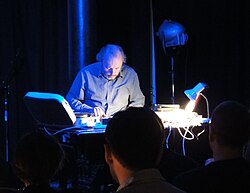
In the past month, I have attended concerts by two of my heroes: Philip Jeck – mainly because of his Vinyl Requiem – and Michael Gira in Swans. Neither gig was as ecstatic as I might have hoped. In both cases, the live experience did not expand on my joy in their recorded output.

In many ways, Swans are easier to understand: it is clear that their live sets chase the ecstasy and the limitations of the venue’s sound – and a slight discomfort caused by the ritual of the gig, in which the audience are reduced to spectators – undermined the ferocious assault. 

There were moments of sheer brilliance: an unexpected version of A Coward proved that Swans’ latest incarnation can be as hard-hitting as Gira’s earlier line-ups, and there were several improvised moments when the guitars, and percussion combined towards a monumental majesty. Gira himself, reveling in his new, confident baritone, was appropriately messianic and my subjective experience was clearly not shared by the entire audience. The sheer volume, the interludes of droning distorting, the energetic runs driven by the twin drummers: even on what was not a perfect night, Swans are proving that there is an alternative to the nostalgia circuit.

Philip Jeck is harder to assess. In a triple bill of experimental musicians, his analogue approach stood out. The use of vinyl lends his performance a rougher, human edge (later, Thomas Koner would evoke landscapes that dwarf human scale, much like an icier vision of Swans’ scope). Yet, having worked with dancers and creating installations like the Vinyl Requiem, Jeck’s solo is oddly introverted. He builds layers of sound through adding recordings and even rolls out a few bass lines that sound fresh from a John Carpenter horror flick.

If he never quite reaches the scale of Koner, he does use his drones in a familiar, almost friendly manner. The awkwardness of vinyl makes the tunes distort under pressure – at times, the tone evokes a lost radio transmission. Yet the live dimension adds little.

While Swans battle the elements – and there were few moments of boredom and plenty of potential – it makes sense for Gira to tour. But for Jeck, the nature of his music seems more comfortable in a recorded format. Gira aims to be shamanic, ramping up the traditional rock egotism into something spiritual, while Jeck is tinkering with idea that are as immediate experienced in a solitary cell. There are two forms of mysticism at work – which explains why these characters became my heroes in my teenage years. One is liberatory, expansive, feeding on nature and the moment. The other is scholarly, monastic.


Friday, 21 September 2012

SWANS

Nostalgia makes a mockery of youth's enthusiasm for radical change. Thanks to an accident of history, I experienced several cod-revolutionary musical movements during my youth: the early years of "indie" when it referred not to an insipid soft-rock but to the legion of independent record labels; the rising hopes of the acid house explosion, which ended in legislation against the beat and not a few drug casualties; the surprising rise of grunge rock; the political ambitions of late 1980s hip-hop. I also got to experience the waves of nostalgia for previous moments of popular radicalism: 1986's anniversary celebrations of the Summer of Love; the curious period when Channel 4 decided to define the past as a series of "greatest moments", reducing Bowie's androgyny on Top of the Pops to a memory equal to that of the space-hopper; the jubilee year reprise of punk's longings for an egalitarian society.

All of which makes me old enough to look down on the youngsters today and say that their revolutions are just cosmetic. And sigh in disappointment at the hopes and dreams carried along in the wake of Lady Gaga's number about being born this way.

I don't really have much time for nostalgia. I found the reformation of Public Image Limited depressing - if I want to hear Metal Box, I'll download it. I won't pay money to see the guy out of the advert for butter dress up like a clown and pretend he is still fighting the system. Yet the resurgence of one band, SWANS, has me excited. Not just because I was a huge fan back in the day - their transition from monolithic noise to an exotic folk behemoth mirrored my own maturity from antagonistic teenager to melancholic young adult - but because their return doesn't hark back to a notional past glory. As I remember it, most people hated SWANS in their first incarnation.

Listening back to their early albums - albums I once trawled record stores to find - I understand why. Sure, Cop has an intensity and a plain-speaking ferocity - the title track reduces police brutality to a despairing chant - and the freezing of various musical forms to a juddering crawl is both intelligent and thuggish. But before Children of God, Michael Gira was really just about the shock tactics. The sparsity of the sound - loud, but with minimal content - allowed me to weave my own fantasies into the music. But Raping a Slave is exactly as obnoxious as its title suggests. It's not really an ultra-hip take on the inherent power imbalance in human relationships.

Gira was never an idiot, and he abandoned the Big Bangs for dynamism and nuance. Children of God remains a favourite album, mainly because of the studied neutrality the music and lyrics bring to a controversial topic. The rumours that the double album would deal with the entire history of Christianity weren't far off, and Gira's ambiguity about the divine and organised religion make this a meaningful contribution to the tradition of works inspired by God. Atheists will find plenty of support for their assault on religious morality and certainty, while the themes of sacrifice and the eroticism of Holy Love are palatable for the thoughtful believer.

The following albums pursued Gira's interest in spirituality and exotic sounds. The Burning World was marred by Bill Laswell's production - if he could bring out SWANS' bucolic interludes, he masked their raw power. But White Light From the Mouth of Infinity and Love of Life were astonishing: complex orchestration, traditional instruments used like psychedelic guitars, Gira's confidence as a baritone and a marked use of dynamics that was classical in its application. Nobody really gave much of a shit: a similar change in direction from Nick Cave gave the former Birthday Boy a new lease of life. SWANS gradually fell apart and Gira went solo.

Although his Angels of Light project was more popular than SWANS ever were, they lacked something of the band's ferocity and precision. When he reassembled SWANS, I had lost interest but didn't see it as a backwards move. If anything, the subsequent album surprised me by recalling exactly the qualities his recent work had lacked.

And so to the recent solo show by Gira in Glasgow. He suits his older look - the cowboy hat he sports sets him in that long line of American  mavericks who have grown into their music and deny the assumption that rock is a young man's game. His acoustic guitar is more vicious than most band's electrics: the hammering chords encourages spontaneous head-banging, and the single instrument arrangements gave space to his baritone's sinister drawl. It's strange that a simple name change has reignited his passion, but the new SWANS are building on a reputation that grows with the years.

Once upon a time, I longed for a world where SWANS were understood, the whispered intimacies of his SKIN albums were the soundtrack to impossible romances and the masculine aggression of Body to Body, Job to Job were recognised as terse political and social commentary. Now, I find all the early albums unlistenable: not in the way that they were intended, as to be slabs of assaulting noise - frankly, Slipknot can do all that far better, and I don't like Slipknot - but for the rough recording values of the 1980s. Drum machines do not age well.

Perhaps all those failed revolutions took their toll on my idealism, but SWANS today are a more palatable beast. The vitality of the music isn't just an end in itself, but a vehicle for a songwriter who, aging and recognising the flow of time, still has a story to tell.


Swans

Sir Richard Bishop (Sun City Girls)