Showing posts with label electronic music. Show all posts

Sunday, 22 June 2014

Branding the Serocell...

Good evening, my comrades in art. Russell Brand here. You may remember me from such television programmes as Big Brother or that one where I rambled on about stuff to the lowest audiences that can be measured by E4. Most recently, I performed a free gig outside of the BBC HQ, in front of a large crowd who thought that they were protesting austerity. Turns out that even that can't get me back on the old google box.

You might notice a few things about this article. First of all, it has proper punctuation. When The Guardian gets me to write a piece for them, they are so pleased to have something on their site that might be interesting, they don't bother to edit my words. This time, however, I am being impersonated by a bitter Scottish critic, and he knows the difference between 'who' and 'whom.' So this is less a stream of old Russ' consciousness than usual.

The reason for this little interlude is both to make a few satirical points about the celebrity version of politics and suggest a relationship between the statement 'all art is political' and a rather splendid release by serocell. While I often make trenchant remarks on the corruption of the British democratic system - and even more pertinent insights on the role of the state in continuing the absurd war on drugs - my status as a very rich comedian and self-righteous clown tends to cloud the issue.

And so - yes, my anarchism is all well and good, but lets not forget that austerity for me merely means one less All You Can Eat buffet at the China King, not a trip down to the Gurdwara for a free curry. And I might note that for all of my support for absenteeism, I have really worked out how that is going to make anyone notice the protest.

This leads us nicely to Trim, the first track on serocell's Fourth Estate EP.


Here's the thing. Political art - you know, like that poem Alan Bissett wrote, is all well and good. But it is usually as good as the audience's commitment to the cause it espouses. The wonderful music writer Simon Reynolds would often ponder The Redskins during the 1980s. He could not understand why a band schooled in music he liked (black American soul) and the politics he, at least, respected (Marxism through British socialism) were so bloody dreadful. The answer is, of course, that the accepted modes of popular music become fundamentally conservative as soon as they are defined.

In other words, it is no good having a radical agenda if you are aping the moves of earlier talents.

Now, I love me some James Brown and I love me some LFO. But I know how their beats are going to sound, and so my thought patterns are consoled, not challenged.

Check out the beat on Trim. That ought to freshen up those bio-rhythms.

The varying tempos on Trim break down both the traditional four to the floor and needlessly complex signature shifts, replacing them with a stuttering yet fluid propulsion. Towards the end, a melody sneaks in, underneath the beat, but suggestive and eloquent.

I am not saying it is a template for a new society, but this experimentation with form manages to replace the hierarchical structures of rock without sounding like a jazz band falling down the stairs.

Tuesday, 27 November 2012

Heroes...


In the past month, I have attended concerts by two of my heroes: Philip Jeck – mainly because of his Vinyl Requiem – and Michael Gira in Swans. Neither gig was as ecstatic as I might have hoped. In both cases, the live experience did not expand on my joy in their recorded output.

In many ways, Swans are easier to understand: it is clear that their live sets chase the ecstasy and the limitations of the venue’s sound – and a slight discomfort caused by the ritual of the gig, in which the audience are reduced to spectators – undermined the ferocious assault. 

There were moments of sheer brilliance: an unexpected version of A Coward proved that Swans’ latest incarnation can be as hard-hitting as Gira’s earlier line-ups, and there were several improvised moments when the guitars, and percussion combined towards a monumental majesty. Gira himself, reveling in his new, confident baritone, was appropriately messianic and my subjective experience was clearly not shared by the entire audience. The sheer volume, the interludes of droning distorting, the energetic runs driven by the twin drummers: even on what was not a perfect night, Swans are proving that there is an alternative to the nostalgia circuit.

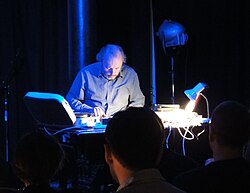
Philip Jeck is harder to assess. In a triple bill of experimental musicians, his analogue approach stood out. The use of vinyl lends his performance a rougher, human edge (later, Thomas Koner would evoke landscapes that dwarf human scale, much like an icier vision of Swans’ scope). Yet, having worked with dancers and creating installations like the Vinyl Requiem, Jeck’s solo is oddly introverted. He builds layers of sound through adding recordings and even rolls out a few bass lines that sound fresh from a John Carpenter horror flick.

If he never quite reaches the scale of Koner, he does use his drones in a familiar, almost friendly manner. The awkwardness of vinyl makes the tunes distort under pressure – at times, the tone evokes a lost radio transmission. Yet the live dimension adds little.

While Swans battle the elements – and there were few moments of boredom and plenty of potential – it makes sense for Gira to tour. But for Jeck, the nature of his music seems more comfortable in a recorded format. Gira aims to be shamanic, ramping up the traditional rock egotism into something spiritual, while Jeck is tinkering with idea that are as immediate experienced in a solitary cell. There are two forms of mysticism at work – which explains why these characters became my heroes in my teenage years. One is liberatory, expansive, feeding on nature and the moment. The other is scholarly, monastic.


Thursday, 15 November 2012

Electronic Music: Pulse! (Part 1)

Electronic music is still struggling to find a relationship between the seriousness of its compositions and the immediacy of live performance. Often being closer to classical music in terms of scope and ambition, it lacks the vitality of rock or pop but can veer into pretentiousness when aping the chamber concert. Ben Frost summed up the problems - his music vacillates between Michael Gira and Reich - in his recent gig at the Fruitmarket, which was less interesting as performance than as a soundtrack. 

Matthew Herbert's One Pig at Tramway was more successful, not least due to the sight of a lab-coated boffin bouncing about in a musical cage but for all the live remixing, fancy trickery and performance play - One Pig was recast as a performance for laptops, electric fence, boffins and chef - electronic music thrives on the sterility of the studio rather than the grubby confines of the gig.

While Sonica is going some way to present enough sound art to sketch out the boundaries of modern musical performance, Glasgow City Halls is beavering away with PULSE: Touch 30. Pulse is a new strand of programming - kicked off by Frost last month - and Touch 30 is a celebration of the London experimental audio-visual company.

The gig is a three way mash-up of talents: like a Scottish Ballet triple bill, it has something for different crowds. Philip Jeck gets busy on the decks; BJ Nilsen examines how sound hits humans and composes for film and theatre; Thomas Köner would fit nicely under Sonica's "sonic art for the visually minded" rubric, and has been known to mess about with a bit of dub-techno


Philip Jeck is a rare turntablist who, like Janek Shaefer, is less a hero of the dance floor than a determined sound artist. He brought his Vinyl Requiem up to Tramway in the 1990s: this immense piece is both a nostalgic tribute to the record-player, made at the point when CDs were still looking viable as a replacement, and a reminder of how the turntable has a versatility that makes it an instrument in its own right. 

Jeck is also worth seeing perform. His music may come from a secure intellectual foundation - he learnt his skills at Dartington College, not at the block party, and so shares a tradition with live artists or theatre companies like Fish and Game rather than Terminator X - but he has a presence that is unexpected from the man who won The Paul Hamlyn Foundation Composers Award.