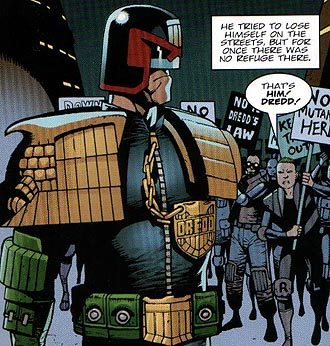
If one man has shaped the dystopian vision of British science fiction readers, it might be
John Wagner. Responsible for the long running anti-hero Judge Dredd - soon to be appearing in a cinema near you, with a massive 3D chin - his visions of a future police state and the no-nonsense law-giver lent 2000AD the tough, macho tone that defined its identity as the most successful UK comic of the last thirty years.
Wagner, who has used a variety of pseudonyms which make the full extent of his work difficult to gauge, was brought up in Scotland, and a terse presbyterian morality infuses his writing. The world becomes the domain of the morally suspect, the corrupt and the violent. Like a series of Jacobean revenge tragedies, it is only the compromised who can right the wrongs, but forgiveness and redemption are distant.
His Button Man takes a tired trope - a secret murder game, funded by the bored rich - and stretches it into a violent conspiracy thriller, implicating American senators and revealing a world where trust is a virtue found only in dogs. Dredd is a difficult creation: a facist in all but name, he is the hero of his own stories and it took a series of explicit stories to remind readers that this future wasn't something to aspires towards. This deep ambiguity - it is Dredd's point of view that dominates, despite its obvious ugliness - introduced a complexity to 2000AD long before American comics recognised the power of the dark side.
By the time 2000AD had established itself, Wagner's dystopian views expanded to encompaass the Universe: one saga had Dredd visiting alien worlds, all trapped in various forms of oppression and savagery. Even the hoped for Messiah turns out evil, while Dredd's attempts to find him involve an any-means-necessary approach that kills colleagues and overturns entire civilisations.
Whether this analysis reflects on Wagner himself - his interviews are marked by a graceful generosity - his work upholds the most pessismistic strands in science fiction. Now the new Dredd movie is getting ready to wipe away the stain of Stallone's badly miscalculated version, it might be worth getting along to Plan B and buying up a few of the volumes that developed the legend.