Showing posts with label comics. Show all posts

Wednesday, 10 May 2017

Semi-review: The Supergirls

Maybe in the most basic sense, superheroes are the modern day descendants of the ancient gods. The ancient goddesses held the power of life and death in their hands... compared to men, comic book superheroines may have been short-changed in the power department, but these women had a secret weapon that has kept thme in the game for the past sixty years - sex appeal. 
The Supergirls, Mike Madrid 
(299:2009)

Complaint
It's unfair to say that Madrid's book on the comic book superhero (female) embodies all of my frustrations with contemporary popular comic book criticism, but it did irritate me. Lacking any illustrations or even consistent references to particular comic book issues, it takes an obvious concern - the representation of women in superhero comic books - and advances an argument that concludes that... perhaps there is a problem here.


Are they like Gods? Prove it
The notion that superheros constitute a 'modern mythology' has been thrown around for the past fifty years - Jack Kirby's Fourth World seems to have been deliberately created to draw the parallels - without any serious attempt to draw precise comparisons. Madrid throws it in at the end of a chapter without having developed the idea. A grounding in classics or anthropology might allow for some kind of analysis, a compare and contrast chart between the DC Universe and the gods of Olympus, perhaps. Anything would be better than a vague suggestion. The most comprehensive work on the subject, Supergods, is as much an artistic autobiography by Grant Morrison as a study of the deus in pictura


The Obvious
Madrid's publishers were probably saving money and time but not actually putting any pictures in The Supergirls, but he does give detailed descriptions of the heroine's outfits. He makes the points that these outfits are inappropriate for crime fighting (4: 2012), that the female body in comic books became more eroticised during the 1980s and 1990s (297: 2012), that 'the bad girl' look was more enticing (288: 2012) even to women viewers and... so and so on...

The Valuable
The most interesting parts of Madrid's analysis comes from his comparison of DC and Marvel during the 1960s. The Marvel Age - as Stan Lee described it - is recognised as a the period defined by Lee (and Kirby and Steve Dikto et al) through a radical 'realistic' approach to the superhero. But, as Madrid explains, it was over at DC that women were given more progressive roles. While the Invisible Woman was still playing Damsel in Distress and The Wasp was more fashionista than action girl, DC's Elasti-Girl was a key member of The Doom Patrol and Wonder Woman is getting a starring role in The Justice League. And Batgirl is stepping out of the shadow of the bat...

She doesn't don a costume.. to prove her love for Batman... she is not his girlfriend or faithful handmaiden... Batman did not have power over Batgirl's emotions.. this was, perhaps, the key to Batgirl's liberation... a female who Batman can actually regard as a brilliant peer and a partner in the war on crime, the same way he would a male.
(124 - 125: 2012)

The Obvious (Reprise)
Madrid majors on the sexual anxiety of USA culture - the 'nation's Puritanical roots' (245: 2012). The tension between the sensual bad girl - whether she is a villain (Eisner's P'Gell in The Spirit), morally ambiguous (Catwoman in Batman) or a heroine (Storm's 'punk period in The X-Men) - and the pure superheroine (Mary Marvel, Supergirl or Invisible Girl) dovetails elegantly with the 'Madonna/Whore' dichotomy. So elegantly that it is predictable. It probably needs to be restated, just because it is so present in comic books. 

The Interesting
Comic book history frequently revolves around certain moments, that are recounted because they do something unusual. One day, I'll make a list of them... it's the scene where the black man tells the Green Arrow and Lantern how they deal with 'coloured' people. It's that time Northstar comes out of the closet in the middle of a battle. Madrid does add in The Valkyrie and Ms Marvel, 1970s' attempts by Marvel to address the rise of feminism. The Valkyrie has a special meaning for me (Madrid says her 'all black Wagnerian garb, with its menacing silver nose cone breasts sent a clear verboten message to any male she encountered' (149: 2012) but there was at least one seven year old boy who would have begged to differ), and I'd like to see her become one of those 'certain moments'. Her tenure on The Defenders straddled a suspicion of feminism and the desire to tell a story about a woman's journey to self-knowledge and...

Hold on. That's the story. I'll be back later...


Monday, 19 September 2016

Turns out it isn't content, either.

If Baetens and Frey's attempt to define the graphic novel by form is an echo of the traditional division between pornography and erotica, the subsequent concentration on form appears even less viable. Given that the association of comic books and superheroes is so strong that nearly every serious criticism of comic books begins with the disclaimer that they are not the same thing, trying to define the graphic novel through its content falls into a trap that Baetens and Frey seem unlikely to evade.

Content matter is adult, not in the sense of pornographic, but in the sense of serious and too sophisticated... for a juvenile audience... disposed towards realism (here we mean contrary to the science fiction... of superheroes comic books)

Aristotle, in the Poetics, did a far more elegant job of characterising tragedy and comedy through their content, but merely through the type of story and personalities that could be presented on stage. That this notion has fallen out of fashion - probably because Shakespeare demonstrated that the rules did not need apply for popular, intelligent and serious drama - is reflected in most definitions of art forms. Content usually defines genre, and that the pair go on to claim that the graphic novel can encompass documentaries and autobiography, even history writing.

It's a shame they have forgotten what a novel actually is, by this stage: when Joe Sacco is evoked as 'journalism' (not inaccurately), the notion of 'fiction' as a key element of the novel is abandoned.

They also get ridiculous when autobiography is identified as a possible content: Ghost World is associated with creator Daniel Clowes' personal life, quoting a generic comment from an interview about the relationships between the female characters, even Frank Miller's Batman lives in a world informed by the writer's experiences in New York. 

Yes, writers and artists work from their life experiences. Using this to define the difference between two formats is trite. 

Why on Earth did they set themselves an unnecessary task?

Tuesday, 17 May 2016

It's Road Force!

Not available anywhere
Over on Tempo House, I suggested that Road Force could be nominated for the worst comic ever. I also insisted that I would not look up other issues of the comic, and that they had a character called R.A.D.D. (a good twenty years after the two minutes that was, like, gnarly, dude).

The second and third points are lies. I am obsessed with Road Force, and R.A.D.D. was the name of an entire team of Harley-Davidson riding heroes. And they had a way cool adventure with Iron Man, in which Kang invades the earth because he wants to get hold of some Harley-Davidsons. 

I least I think that's the plot. It doesn't matter. 

Road Force are an example of Marvel's Custom range: 'business solutions' for businesses who think a comic book would play well with their customers. I'm hoping that a major political party decides that this would help them expand the youth vote.

Living Lightning in the Origin of The TRUMPeters, perhaps?

one for the dads
Ah, there's little to say about the second Road Force adventure. Iron Man, explosions, a new team (one has the code name Pyra Pavee, which I can't understand. It's just a name, right?), some more explosions, and no change in any continuity. You see, there is no way Marvel is going to allow these Custom comics to matter.

War Machine introduces the BERNers, maybe?

Even within the limitations of the form, it's difficult to work out whom Road Force intends to please. The level of plotting is low (there's a flying magic castle, Kang camping it up, Tony Stark looking like he needs a dump in most panels), the motorbikes aren't that cool (they have guns on the front which make funny noises). One of the characters is called Backfire, which isn't what you want your Harley to do, is it? 

The Amazing Spider Ham meets Call Me Dave?

It's that special moment, where lazy writing meets corporate tomfoolery meets lack of purpose that makes Road Force so special. I wonder how many really expensive motorbikes got sold on the back of this? Maybe a few t-shirts? It's not that comic characters are sacred, but even war profiteer Tony Stark must have felt a bit dirty after this...


Friday, 1 April 2016

Unvisible Dramaturgy: Kirk King on reviving a cult classic comic

Following yesterday's press release for Unvisible, there has been considerable discussion about whether this is a hoax, or the kind of ambitious performance that will change Scottish theatre. Saturnalia productions have refused to reply to my emails all day - increasingly angry as I thought my desire to have an exclusive had led me to be fooled - until Kirk King agreed to some email questions. So, in the spirit of my dramaturgy database...

First of all, is this an April Fool's joke? 
Kirk King: First of all, have you read The Invisibles? One of the main points of the series is that reality is a consensual hallucination, a mad juggling act with the balls all kept in the air by faith. 

Then there was that time when Grant realised that DC were going to cancel the comic, and asked the readers to perform a ritual masturbation to save it. Chaos magic is a major theme through the books - fake it until you make it, honey. The membrane between prank and perception is thinner than you think. 

So you are serious?
The answer to that depends on which side you are on, doesn't it?

Okay. So, you have described five performances. How do these relate to the source series?
Well, these performances are happening now, and Barbelith landed in 2013. King Mob is the only character who is carried over from the comics, although Ragged Robin might be in the first play. You'll have to come and see to find out...

Basically, King Mob has spent the last three years trying to live a life in the aftermath of a phenomenal victory. He can't do it: he's addicted to danger. Like Coriolanus, off Shakespeare, he's a warrior who can't do peace. He tries to medicate himself, which is how he ends up in the pubic triangle. The heady cocktail of sex, performance and alcohol opens him up to a message from Barbelith, and he realises that, far from being over, the war is still going on.

Is it still the archons versus the invisible college?
Again, wait and see. We follow KM as he tries to get a cell back together in a world where some of Grant's predictions have come true, others, not so much. He realises that the real enemies are not the Conservative politicians who are doing their best to destroy civil society, but another set of archons, The Universals. They insist on purity rather than order. And Aristotle is involved, inevitably.

Hold on, the Greek philosopher?
Yes. In The Invisibles, Grant was dealing with queer theory and post-modernism. If you look at the themes - BDSM, alternative history - these things have become the mainstream now. It's possible to say that we are living in KM's world. What do you think all those YouTube videos are about?

So queer theory is busy getting The Scottish Government to recognise gender fluidity. That's great, only once you start talking to those people, your revolutionary potential is out the window. Grant is taking on the people who started it - Plato, Aristotle. This is a classical take on The Invisibles' mythos.

Plus there's a mad finale on Arthur's Seat, where massed ranks of Bollywood dancers use subliminal bass to attack The Universals.

Can I be one of the people giving lectures in the fourth episode, Flexin' Mentallo, please? 
I'm glad you've mentioned that, because that is the part that I'm most excited about. We realised that there were some heavy duty ideas floating about, and there was a book, a critical book, that accompanied the series. We have some wild ideas for that day - apart from the academics - to replicate the dynamism of the old Barbelith website.

Send me a CV.

Where does Bollywood fit into this?
Appropriation. It's a big theme in the whole thing. Bollywood has some of the least 'pure' music in the world. It can be like a history of sound in five minutes, everything gets chucked in there. Disco, metal, the lot. Who better to fight The Universals than the absolute opposite of their rigid purity? 

It looks as if the time of The Unvisible has come.
When Grant wrote The Invisibles, he was ten years ahead: The Matrix ripped off his plot and his interest in the esoteric. It's only fair that he gets a voice in the current debates around queerness, gender fluidity, sexual subversion and intersectionality. He's always been at the cutting edge, of comics and philosophy. 

Thursday, 31 March 2016

Unvisible

I said that I would not cut and paste anymore. This release is an exception... so excited...


New production company announce ground-breaking project that will change theatre, and comic books, forever.

Saturnalia Productions are delighted to announce a new theatrical production, Unvisible, which brings together some of Scotland’s most critical lauded and famous artists. With a script by Grant Morrison, based on his awarding winning series The Invisibles, and legendary actor Tam Dean Burn in the central role of King Mob, Unvisible will continue the adventures of his creator-owned characters from his best-selling Vertigo graphic novels. Directed by a fantastic collective of internationally renowned stars, including Stewart Laing, Katie Mitchell and Dominic Hill, Unvisible is a cross-platform, multi-media, site-specific spectacle that promises to challenge the audience’s perception of reality. It will feature design from some of Scotland’s finest visual artists, including Frank Quitely (New X-Men) and Sha Nazir (Laptop Guy).

‘Since The Invisibles ended in 2013, Unvisible picks up the story in modern times. King Mob, the revolutionary hero of Counting to None, finds himself isolated after his victory at Westminster Abbey, wondering what happened to the glorious future that the arrival of Barbelith was supposed to bring.’

‘There was only one choice for the role of King Mob,’ explains designer Sha Nazir. ‘Tam Dean Burn is a Glaswegian icon, associated with the exciting theatre of the 1990s – he starred in the original stage production of Trainspotting – and he happens to look exactly like Morrison’s hero!’

Following the format of the graphic novel series, and in the style of director Stewart Laing
ground-breaking Paul Bright, will be performed in five episodes in various locations across the central belt of Scotland. Although they combine towards the grand finale on Arthur’s Seat in Edinburgh, each episode will be a stand-alone event.

The Invisibles was a revolutionary moment in comics,’ says producer Kirk King. ‘It challenged the form, bringing in ideas from queer theory, post-modernism and conspiracy culture, to shake up the reader’s very sense of what is real. Unvisible returns to these themes, but now it is time for the theatre audience to receive a dose of Morrison’s mind-bending intellect.’

Each episode will happen in a specially selected venue, beginning in Edinburgh’s notorious ‘pubic triangle’. Each episode will also happen in real time, since Morrison and co-writer Jack Lothian have followed the theories of Aristotle.

‘It might look like an archaic thing, the theories of unity,’ says Lothian. ‘But adopting it is an important part of Morrison’s intention! Like much of his work, there is a clever mix of art and philosophy, and audiences should not expect a classical tragedy… at least not immediately’

NOTES TO EDITORS
LISTINGS
UNVISIBLE: The metaphysical striptease
Venue: The Western Bar, Edinburgh
Dates: 21-30 September 2016, 12pm – 1am (every twenty minutes)
Prices: £4 entrance
In this immersive introduction, audiences are invited to join a down at heel King Mob as he drowns his sorrows in wine and women. When he recognises one of the dancers as his former lover Ragged Robin, however, he begins to remember his destiny.

UNVISIBLE: The Edith Manning Experience
Venue: Sneaky Pete’s, Edinburgh
Dates: 1 - 10 October 2016, 7.30pm
Prices: tbc
Venue: Bloc, Glasgow
Dates: 10 - 28 October 2016, 7.30pm
Prices: tbc
Featuring a band made up of members of Arab Strab, Mogwai and Holy Mountain (Chemical Underground), this punk ceilidh play follows King Mob’s attempt to bring back his old revolutionary comrades. ‘Think of it as The Blues Brothers meets Fellini,’ says Morrison.

UNVISIBLE: Bollywood Babylon
Venue: The Glue Factory, Glasgow
Dates: 1 - 10 December 2016, 11pm
Prices: tbc
Venue: The Voodoo Room, Edinburgh
Dates: 12 – 23 December 2016, 11pm
Prices: tbc
In the middle of a live DJ set by Glasgow’s Hush and dubstep legend Kode-9, King Mob and his cell prepare a new weapon for battle: sound generated by the appropriation of Bollywood and subliminal bass.

UNVISIBLE: Flexin’Mentallo
Venue: University of Glasgow
Dates: 10 January 2017, all day
Prices: Free
Part conference, part performance, this day is both the fourth part of Unvisible and a critical discussion of the series. Lecturers invited so far include Dr Carl Lavery (Absurdism and the Apocalypse, Morrison and Ionesco), Steven Greer and Dee Heedon (Autobiography when there is no self).

UNVISIBLE: Apocalypstick Now
Venue: Arthur’s Seat, Edinburgh
Dates: 23 June 2017, 7.30pm
Prices: tbc
Details to be released nearer the date.

Please contact Kirk King unvisibles23@gmail.com for further details. Interviews are available. Further collaborators will be announced in the forthcoming months.

Biographies
Tam Dean Burn  was born in Leith and grew up in Clermiston.

Previous stage adaptations include: Disco Biscuits (Arthrob); The Cutting Room (Citizens' Theatre).

Acting work includes: Tutti Frutti, Home Edinburgh (National Theatre of Scotland); Mary Stuart (Donmar Warehouse and Apollo West End); The Cutting Room, Venice Preserved, The Cherry Orchard, Observe the Sons of Ulster Marching Towards the Somme, Scrooge, Peer Gynt, The Pleasure Man (Glasgow Citizens); Filth (Citizens, National Tour and Calgary, Canada); Platonov (Almeida); Berkoff’s Messiah (Edinburgh Assembly); Headstate (Lemon Tree and tour).

Television work includes: Wedding Belles, Longford (Channel 4); River City (BBC); Taggart (STV); Helen West (ITV).

Radio work includes: Velvet Love (Radio 4); ongoing solo show on resonancefm.com including The Complete Poems of William Blake. Tam has also directed and performed in many live radio plays for resonancefm.com.

Directing credits include: William Burrough’s Caught in Possession of the Rime of the Ancient Mariner (Citizens Theatre); Sniperculture (Traverse); Cruel Brittania (London Scala) all written by Johnny Brown for Underground Utopia.

Audiobook work includes: Trainspottng, Filth, Glue, Porno (Irvine Welsh), The Cutting Room (Louise Welsh, RNIB).

Grant Morrison is highly regarded as one of the most original and inventive writers to work in the comic book industry. He is recognised as being one of the best-selling writers in the medium in the last 20 years.
His revisionist Batman book ARKHAM ASYLUM (with artist Dave McKean) has sold over 600,000 copies worldwide and won numerous awards, making it the most successful original graphic novel to be published in America. In 2009, Eidos released the best-selling video game BATMAN: ARKHAM ASYLUM inspired by the book.
Morrison is renowned for his ability to revive and re-imagine established characters, and has been orchestral behind runs of popular stories for the major companies including DC Comics characters; BATMAN, SUPERMAN, JUSTICE LEAGUE OF AMERICA, DOOM PATROL, ANIMAL MAN and for Marvel Comics the best-selling monthly, NEW X-MEN, MARVEL BOY and FANTASTIC FOUR.
His Graphic Novels and Comic Book collections have been translated into twenty languages and are sold worldwide to international acclaim.
In September 2011 as part of the new 52 re-launch at DC Comics, Grant began writing Superman again in the best-selling ACTION COMICS franchise, as the cornerstone book of the line.
In 2014, work at DC Comics includes a revisionist take on Wonder Woman for the Earth One Graphic Novel, WONDER WOMAN: THE TRIAL OF DIANA PRINCE. The epic, long-awaited maxi series, MULTIVERSITY, is due for release in June 2014.  
As part of his remit at DC Comics, Morrison has also acted as a Consultant, developing updated approaches on minor characters and recreating them as springboards for other writers. He has also had award winning and critical success using this revival method for his own maxi-series, SEVEN SOLDIERS in 2006. His take on Superman for ALL-STAR SUPERMAN cements his ability to breathe life into old franchises and his four year story run on Batman has woven a complex and intriguing best-selling tale the likes of which has not been seen in decades.
In 1997, Grant was the first comic book writer to be included as one of Entertainment Weekly's top 100 creative people in America.


Saturday, 27 June 2015

David Lumsden discusses his graphic novel and film Boat

After completing an MA at the Edinburgh College of Art, David Lumsden worked on independent projects from short dramas to behind the scenes, working internationally with acclaimed talent.


His achievements include award winning shorts films, awards at the Roses creative awards and a movie viral award. His current position is Director and Editor at Freakworks Edinburgh.
David’s has just finished his short film Boat, a post-apocalyptic short film, and is in the process of developing ‘Prion’ his first feature length project about the return of the 1645 plague to Edinburgh.
He was recently selected for the 2013 Edinburgh International Film Festivals Talent lab scheme.
Boat premiered in competition at the Glasgow Short film festival 2015 where it was nominated for Best Scottish Short & the Channel 4 Innovation in Storytelling Award. It recently won Best Design at the Bafta New Talent Awards.


GKV: Tell us about the book you're nominated for...
Boat Vol 1 is based on my short film Boat . It is a post apocalyptic Scottish drama about a father and son looking for home in a futuristic flooded world. I wrote the script in 2011 and completed the film in 2014 after a long post production process. From the beginning, I wanted to create a comic book version of the film.

We had some really stunning graphic concept art of a flooded Scotland, created by Anthony Devine, which we used with the film as a guide to create the comic book with artist Mark Weallans. We completed the Graphic Novel while finishing the VFX on the film last year. It was a great experience and I am hoping to continue the story with the next volumes this year.

How did you get into comics?
Since I was a pretty young I've always loved film, my mum remembers taking me to the cinema at the age of two and i never made a sound or took my eyes of the screen for the whole movie. I discovered comics through reading comic books set in similar worlds such as Newt's Tale and Predator.

How far is your work a collaborative process?
Its a very big process and hugely collaborative, just like working on the short film I've had help from many talented people. It was my first comic so I was making lots of mistakes, but Mark (artist) and I discussed illustration style and panel story boarding. The lettering and additional artwork was by Andrei Stariuala and Tammy Le Vasan: everyone involved brought something unique that made the book better. I loved collaborating with them, it was a big dream to make a graphic novel and they really made it possible.


Do you see yourself as part of any particular Scottish tradition?
I don’t really know if I do, but as I've grown up in Scotland you kind of get immersed in its dark history. I like to feature an element of Scotland in my work, as it is my home and what I have known for many years. There are so many Scottish styles and literary traditions but it is definitely the darker side that I lean towards.


If I saw a film that I really loved, I'd try to find out every detail about it, the writers and the actors. I remember it started with Aliens and this was how I discovered comics, through reading comic books set in similar worlds. I used to spend all my wages at Dead Head comics and Forbidden Planet in Edinburgh. I was a big fan of 2000AD, The Crow, Punisher, anything I could get my hands on. I was pretty hooked on certain writers and artists and I always wanted to get into writing my own comics. I was developing Boat for a long time but I couldn’t draw to save myself so I went down the film-making road. Now I try and do both. The good thing about comics is there aren't the same budget constraints when telling a story.


Tuesday, 23 June 2015

John Grieve on The Beast of Barton

John Grieve’s The Beast of Barton is an example of how a comic can be a solo work of art, with Grieve responsible for every aspect of creation and production. Steve Morris, on The Spire website describes it as ‘a rhyming tale of Mad Kings, monsters, kill-happy townsfolk and all manner of whats-else… a pretty solid bit of entertainment.’ It has also garnered him a nomination for Best Newcomer at the 2015 SICBA Awards.


Tell us about the book you're nominated for...
The Beast of Barton is a rhyming tale set in the aforementioned fictional town of Barton. It is a story of greed, murder and the balance of good and evil (told in as lighthearted a way as possible). Being the first in a trilogy, it serves as an introduction to the troubled town and a hint at things to come.

Tell us how you got into comicsI had always read comics as a kid and think my first half serious attempt at one was when I was about 11. As time went on, priorities changed and comics and art in general kind of got put on the back burner.Additionally, a lack of confidence presenting my art/writing to the public ensured that until recently things were not taken any further. 

A few years back, I attended some of Garry Mac’s excellent comic workshops and that kind of rekindled my passion for comic creation. Also my wife has been an amazing support and has pushed me to get stuff out there which has helped immensely.

How far is your work a collaborative process?
Not at all. I bounce ideas off of my wife occasionally and ask opinions from others, but in general I am a bit of a hermit when it comes to working.
It’s not that I’m averse to working with others and have done in the past but writing/drawing/colouring/editing everything myself means I’m working to my own timeline and enjoying the creative process to the full.

Who would you say your inspirations were?I’m a huge fan of everything Bill Watterson has ever done. Terry Pratchett, Dr Seuss, Lewis Carrol (The Hunting of the Snark) and Tim Burton (The Melancholy Death of Oyster Boyamong many others.

What are you reading right now?
I kind of dip in and out of reading graphic novels nowadays to be honest. For instance I only got round to reading Maus last year!
That said, The Walking Dead is a pretty regular read for me.
There are no pictures, but I’m also reading Terry Pratchett’s A Slip of the Keyboard at the moment.


Friday, 2 January 2015

Ontology of comics: the bitter end

It is not that I am bored with Meskin's ontology of comics - I keep getting distracted by things that make me angry. Like that Jezebel website. Today, it has an article about this woman who didn't die when she got hit by a car because she was wearing a tight dress. 

Look, I'm not saying that commenting on media representations of women is a waste of time, or that the slightly sarcastic comments of the writer don't suggest a residual, sly feminist humour, but it's all getting a bit too 'First World Problem' for me. I know that the press is full of dumb-asses who don't know what is a story and what is a thinly concealed excuse for printing a picture of a curvy babe... and I keep getting these adverts for Russian women in my area who want to date older men whenever I get click-baited...

Sorry.

Finally, when do we have an authentic instance of a comic?
I argue that comics (even digital comics) are best understood as autographic—they admit of referential forgery and direct transcription will not suffice to produce an authentic instance of a comic.


This is all about whether it is possible to forge a copy of a comic: to make a version of the comic that refers to a source, presents itself as being the source, and can get sold (I presume) for the same price as the source, if you sucker an expert or a thirteen year old who really needs that Fantastic Force #12

Apparently, you can. 

Okay, to sum up, here's how a comic exists, according to me via remorseless theft of Mekin's source article.

A comic exists as a multiple - simultaneous copies exist, all of which count as 'the event'. 

There is a source, a manuscript, against which each multiple can be judged.

It is possible to forge a copy of the multiple. 

I've lost the best bit of Meskin, though: his encoding style of replication offers a potential conflict with the possibility of it being forged (if no manuscript exists, how can it be forged et c). 

All sorts of fun stuff here, but I found this thing about countering sexist arguments about the representation of women in comics (and it has that add for Russian women, too)....

Totally distracted

Finally, when do we have an authentic instance of a comic?
I argue that comics (even digital comics) are best understood as autographic—they admit of referential forgery and direct transcription will not suffice to produce an authentic instance of a comic.

I have to admit, I am not sure how Meskin's conclusions fit into general ontology of comics... he says that he is only having a quick peek at the subject (and is pretty adamant that the ontology of comics is not going to help much with broader questions of ontology). 

I have this idea that ontology, the examination of different ways of being, is tangled up with consciousness: the recognition of being itself relies on some high level awareness, and I can't see dogs sitting about barking about how they are in different states when they are licking their balls or farting in the kitchen. 

But I am wrong. Consciousness is a prerequisite of having a chat about the nature of being, not a necessity for actually being. I remember being well into the Zen once, and I'd say things like 'think like a mountain.' Well, that was stupid too, and I ended up with people climbing all over me while I gradually eroded. The point of the exercise was probably to admit that there are other states of being than the human. Or, like Dr Manhattan said in Watchmen, I am 'life insisting on life's viewpoint when alternatives exist.'

I don't think Mekin would claim that his ontology is an attempt to find out what it feels like to be a comic (he's an academic, not a blogger who can't get into his office to do proper work). But he is looking at comics (as objects) and explaining the nature of their existence. It's blowing my head right off. 

I guess a strict biologist would see this as being a big load of post-modern bullshit. There's no evolutionary purpose to this (unless there are people out there who would like to have sex or eat dinner with me (I am open to offers (although the former won't lead to reproduction (but what if we apply evolutionary psychology to comics (do they try to reproduce by being good? (and they have totally evolved from the simple morality tales of the golden age to the metaphysical complexities of Grant Morrison (who always seems to have his characters realising that they are in a comic book (because he ran out of ideas after The Filth (that might be a little unfair)))))))).

Meskin, Twoskin

In part one of this fascinating new part-work (I'll be selling a folder for it in about March), I understood that comics exist in multiples. Then I got distracted and wondered whether this meant that comics had super-powers. 

Tune in for part two and get this statement explained.


The art form of comics is typically a two-stage art in which instances are produced by means of what Stephen Davies calls encoding and decoding. In normal cases, decoding (i.e., printing) is required to produce an authentic instance of a comic. But this is only in normal cases—in some cases no decoding is needed to produce an authentic instance of the comic since the encoding is itself a proper instance of the comic. And in some of these cases comics are produced by means of a one-stage process (i.e., they are finished when the artist’s work is complete). 

Okay, pass the crack pipe. Meskin quotes Davies, who elucidates three different ways in which multiples can be made. It's the process of encoding that Meskin picks as the most applicable to the comic - that is to say, there is no 'instance' of the comic, no source, just the copies.

Right - yes, when I saw the exhibition in the Victoria and Albert of Kirby/Lee Fantastic Fours, they just slapped a few issues in a case, and didn't worry about getting the versions from which they were printed. 

But I disagree with Meskin that this makes comics 'multiples without a source.' The novel is called by Davis 'an exemplar based multiple' - there is a manuscript, and all copies, or multiples, are authenticated by comparison to the exemplar manuscript. Exactly the same thing is the case for a comic. I know I am always trying to distance comics from being literature (they are something other, more complex), but I think that the parallel between the novel's manuscript and the completed art work of the comic is much closer than the magical 'encoding' that Meskin suggests.

Mind you, a copy without an original is a seductive concept. I am thinking of Baudrillard, and how he says that we live in a world of simulcra, in which 'real things' have been replaced by signifiers. 

I'd love to run with Meskin's definition of the comic as an encoding/decoding medium, and shout that comics are, in fact, an expression of a universe that is without a source. But either I have misread his intentions - most likely - or he has put a bet on the wrong multiple horse. 


Meskin and Me thoughts on Me Being (part 1 of 40 000)

Let's see how complicated I can make this. 

I'm interested in ontology, which I think is something to do with states of being. Like just about every other philosophical term that I throw about with gay abandon, I haven't really got to grips with how it is used, or what it really means.

Being a post-modern semiotician, I use the word in any way that I see fit. However, today I intend to try to understand ontology, via Aaron Meskin's Ontology of Comics.

Ladies and gentlemen, may I present the futility of my life?

We shall begin with Meskin's conclusions...


Must comics be multiples? 
I have argued that they need not be, although the generic statement ‘comics are multiples’ is true. 

How are instances of comics produced? 
I suggest that the art form of comics is typically a two-stage art in which instances are produced by means of what Stephen Davies calls encoding and decoding. In normal cases, decoding (i.e., printing) is required to produce an authentic instance of a comic. But this is only in normal cases—in some cases no decoding is needed to produce an authentic instance of the comic since the encoding is itself a proper instance of the comic. And in some of these cases comics are produced by means of a one-stage process (i.e., they are finished when the artist’s work is complete). 

Finally, when do we have an authentic instance of a comic? 
I argue that comics (even digital comics) are best understood as autographic—they admit of referential forgery and direct transcription will not suffice to produce an authentic instance of a comic.

Holy shit. I have no idea where to start with these conclusions. I probably better read the whole article.

What is a 'multiple'?
Comics and graphic novels are typically multiple works of art rather than singular: they are repeatable, admit of instances or occurrences rather than mere copies, and—in virtue of this—they allow for simultaneous but spatially-distinct and unconnected reception points.

That is clearer: a comic can exist simultaneously in multiple forms - like a complete print run of Fantastic Four Essentials, and be experienced in different places at the same or different times. They are printed and distributed, and no single copy can be seen as the 'original'. I guess they share this quality with scripts. 

A comic is a bit like Multiple Man off the X-Men: it can exist as several identical versions at the same time. Although whereas there is a Multiple Man prime (he's the one who makes the first copy of himself, and has certain rights that his copies don't have), the comics are all 'originals'.

(Note, if Vicky Price out of the University of Glasgow is reading: I know the word 'original' is problematic. But if I talk about a 'source' text here, I am going to get even more confused.)

So a comic exists in a different state of being to a human, who is stuck in one particular time and space. Far out. 

Apart from the suggest that a bit-part player in the X-Men is some kind of meta-commentary on the nature of the medium, here's a reflection. If a comic can exist in an almost mythical state of being (effectively timeless and spaceless, since its existence is not dependent on a particular anchor in the space-time continuum but can exist simultaneously at several points in the same moment), does this make it an ideal medium for expressions of timeless narratives, like myths? The superhero, rather than being some idiosyncrasy of comic book history therefore becomes a logical subject for the medium, being located in a similar boundless ontology. 

Even something like Maus, which always gets mentioned as worthy of study (because it is about a Very Serious Subject, the Holocaust), is lent a mythic dimension by Spiegelman's conjuring of comic book tropes. 

(Note: myth here means a story with meaning, not a false story.)

And isn't Spiegelman a cool name for a comic book creator? It's like a superhero name. His special power is, like, making the low become high. 

Come back for part 2, I dare ya.


Wednesday, 30 January 2013

Comic Con IV

There is a moment in Comic-Con IV: A Fan's Hope that captures the ambiguity of contemporary geek culture. Before Kevin Smith signs off with a stupid comment about emo chicks, or Stan Lee gives a self-conscious encomium to the joy of meeting the fans, a complaint is made. Comics, which started the San Diego Convention back in the 1970s, have been reduced to a side-show at their own event. Throughout the film, the sight of Hollywood studios using the Convention as an expensive focus group for the new products obscures the struggles of young artists to get their work seen, or Mile High Comics to save the business by making a Big Sale. Sure, the geeks have inherited the earth, but only on the terms of the businesses who have been dominating the industry for decades.

In theory, the synthesis of Big Money and Emerging Artists ought to be fertile. The large companies keep their art fresh by the influx of new talent, and get a bonus of currency within the hip world. Small artists get the platform they need to present their work, and everyone has an enhanced Comic Convention. A parallel exists with the National Theatre of Scotland's policy of supporting artist led projects: in recent years, they have engaged with young theatre-makers, supported them and got back some fascinating shows (Pony Pie's Santa Muerta, for example).

But it doesn't seem to work like that. More likely, the majors develop diluted versions of the emerging artists' vision, and the emerging artists imitate the major's style rather than find their own voice. While comic books have become more complex, more self-conscious, superhero films are languishing in the "might makes right" stage, and the crop of artists and writers who have come along in comics in the past decade are frequently imitating styles of the previous generation. 

By titling the film A Fan's Hope, Morgan Spurlock identifies with the fundamental tension around the san Diego Comic Convention, and tells a story that is moving and funny. There is a romance - that culminates with Kevin Smith acting like a priest (which is a rare moment of charm from Smith). There is a high drama as the owner of Mile High comics considers selling a rare comic to save the company. There are talking heads from the business, including Grant Morrison (who continues his war with Alan Moore by mocking a Dr Manhattan cos-player). And there's co-producer Stan Lee, giving it his Uncle Stan routine, trying to remind us that he is the writer of the Fantastic Four and a genius, and not the increasingly desperate character who spent much of the last decade trying to write comics based on large-breasted female celebrities.

This is both a film for the comic fan (the range of guest commentators is superb) and fans of Spurlock's documentary style (the narrative threads are elegantly weaved together). It does celebrate the comic book without losing sight of the irony contained in a community that is delighted to have become a free focus group for the film industry.

The big theme of the film is, ultimately, love. Many of the creators who appear still have the same joy in the Convention as the fans and Stan Lee, despite his detractors, is maturing nicely into the grand old man of comicdom. And throughout it all, the spirit of enthusiasm will find a way to propose to its beloved...

20 Feb (GFT)
21 Feb (CCA)


Sunday, 9 September 2012

John Wagner at Plan B


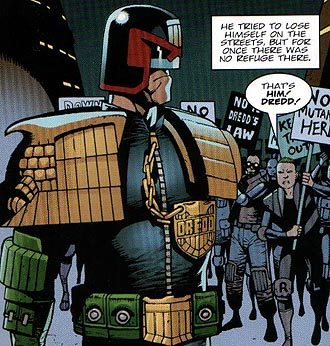
If one man has shaped the dystopian vision of British science fiction readers, it might be John Wagner. Responsible for the long running anti-hero Judge Dredd - soon to be appearing in a cinema near you, with a massive 3D chin - his visions of a future police state and the no-nonsense law-giver lent 2000AD the tough, macho tone that defined its identity as the most successful UK comic of the last thirty years.

Wagner, who has used a variety of pseudonyms which make the full extent of his work difficult to gauge, was brought up in Scotland, and a terse presbyterian morality infuses his writing. The world becomes the domain of the morally suspect, the corrupt and the violent. Like a series of Jacobean revenge tragedies, it is only the compromised who can right the wrongs, but forgiveness and redemption are distant.

His Button Man takes a tired trope - a secret murder game, funded by the bored rich - and stretches it into a violent conspiracy thriller, implicating American senators and revealing a world where trust is a virtue found only in dogs. Dredd is a difficult creation: a facist in all but name, he is the hero of his own stories and it took a series of explicit stories to remind readers that this future wasn't something to aspires towards. This deep ambiguity - it is Dredd's point of view that dominates, despite its obvious ugliness - introduced a complexity to 2000AD long before American comics recognised the power of the dark side.

By the time 2000AD had established itself, Wagner's dystopian views expanded to encompaass the Universe: one saga had Dredd visiting alien worlds, all trapped in various forms of oppression and savagery. Even the hoped for Messiah turns out evil, while Dredd's attempts to find him involve an any-means-necessary approach that kills colleagues and overturns entire civilisations.

Whether this analysis reflects on Wagner himself - his interviews are marked by a graceful generosity - his work upholds the most pessismistic strands in science fiction. Now the new Dredd movie is getting ready to wipe away the stain of Stallone's badly miscalculated version, it might be worth getting along to Plan B and buying up a few of the volumes that developed the legend.