Showing posts with label multimedia theatre. Show all posts

Tuesday, 8 March 2016

The Inferno Dramaturgique: Lechedevirgen Trimegisto and Sorshamn Lara @ Buzzcut 2016

Inferno Varieté 
Lechedevirgen Trimegisto / Sorshamn Lara (México) 
International Performance Art Festival Buzzcut 2016 

Can you tell me a little bit about the work that you are bringing to Buzzcut?
We are bringing our performance project Inferno Varieté. This projects comes from the importance of creating  alternative and radical ways to fight against the system of oppression, violence and homophobia in Mexico and around the world, from the perspective of radical artivism and body art, the relation between violence and masculinity as a place of power relations, where the bodies and beings that don't fit in with the hegemonic image of “man” live a living hell, while those who enjoy the privileges of masculinity are conditioned by the bonds of virility, bravery, strength and the fear of being linked to the feminine, all in an environment of homophobia that subdues everyone equally. 

The concept of Inferno Varieté comes out as a critic compilation of popular Mexican culture, religious iconography, mass media stereotypes of Latino masculinity, gay ambient sceneries and aesthetics, as a hybrid space where the violence that follows traditional masculinity appears. 

This project is integrated by myself, as a performance artist, and the multimedia artist Sorshamn Lara, in which is combined video, sound, performance art and theatrical imaginary background. 

What is it about Buzzcut that attracted you to perform as part of it?
I think Buzzcut represents in a perfect way the type of performance and live art festival who cares about its artists, and also creates links between them, the audience and the organizers, making possible a strong sense of community. I also believe it's an international showcase for ones work as a live artist in the contemporary scene. 

Do you see your work within any tradition - and are there any artists (performance and beyond) whom you regard as a peer or an influence?
I see my work within the tradition of Mexican magic and spiritualism, among the theatrical background of the cabaret and variety shows. 

My influences are very different and eclectic, I take inspiration from Mexican horror cinema from 60's to 90's, writers and poets as Pedro Lemebel, Yosimar Reyes or Gloria Anzaldúa, icons of drag and trash culture as The Voluptuous Horror of Karen Black, Leigh Bowery or Pandemonia, artists like Ron Athey, Alejandro Jodorowsky, Mago Melchor or even holy figures like Sarita Colonia, Niño Compadrito or the lonely souls of the purgatory, but the figure that I find the most influential in my work is Fidencio Constantino "El Niño Fidencio" thaumaturgist and curandero from the north of Mexico who became famous between 1920-1930 by creating new and unusual methods of healing. 

He fully embodies what I understand as an "artist": someone who makes possible the miracle of transformation and healing, helping to create a better world. 

How 'typical' is this work compared to other pieces that you have made? Did the process follow a familiar or new pattern?
I've been working on this project about 2 years. Inferno Varieté is a complex artistic project that constantly keeps shifting and expanding, there are some actions that are held together inside the project among adding new strategies in the process of execution of the performance. Although it follows a familiar pattern, it always appears new things, making the work evolving. 

Buzzcut is concerned with the idea of 'community'. Does community have a special meaning for you, and what relationship do you feel your work has within wider communities?
I believe performance art has to create communities. Making strong bonds and connections, opens the radical possibility for change in a micro/macro collective, local/global groups, it depends on the trade-offs between the artist and the audience where the value of live art and performance art resides. 

It's something that goes deeper than it seems, it is rooted in the symbolic space of the ritual interchange for the construction of cultural, social and political structures and transactions, where the body becomes the gravity center. I believe in my work as an ephemeral space where community fears and hopes are embodied and exposed. 

What are you hoping that the audience will experience?
For me, a Mexican artist who has built most of his work from Latin American culture, it's a challenge capable of transporting my performance art work to other latitudes with other characteristics and qualities than my country, like, in this case, Scotland. I'm really hoping to carry out a connection between my work and the audience, and to deliver with more than words a powerful message.  

Are there any strategies which you used to direct the audience experience towards this?
I believe in the power of the body as a political and poetic space, where emotions and actions take place to bring metaphors and voices alive. 

My strategies are pondered by exposing the vulnerability of the body and the human conditions that are neglected by the margins and extreme situations, to generate a bond of empathy between the public and the issues that my work describes. I trust in the aptness of the audience and people to understand the pain and suffering of the others and to take a moment for social reflection. 

What is it about performance that enticed you - and kept you making it?
Performance Art is a space I found where I can create without any restrains, where I feel totally free to pull out new and strange ideas without the incumbency of any academic issue or discipline exigency. I truly believe that artists need to have all the possible liberty in our own creative process. 

Performance Art erases the lines between life and art, it’s something that gives me life and keeps me searching for new ways to transform my world. 

Are there any questions you feel that I ought to ask to understand how dramaturgy works for you?
I think I have answered most of the important and interesting questions, I’d just like to add what I consider art is very similar to what others consider "magic", been said that, I believe my work is located somewhere between dramaturgy and the spiritual practices, with a sharp teeth approaching in gender/sexuality themes.

Thank you so much for this interview. Lechedevirgen.


Saturday, 17 January 2015

Alien Dramaturgy: Fiona Soe Paing @ Edfringe 2015


ALIEN LULLABIES


Out-of-this world live music/cinema hybrid set to take off at Made in Scotland Showcase 2015 during Edinburgh Festival Fringe at Summerhall


“Very, very cool!” Vince Clarke (Depeche Mode)

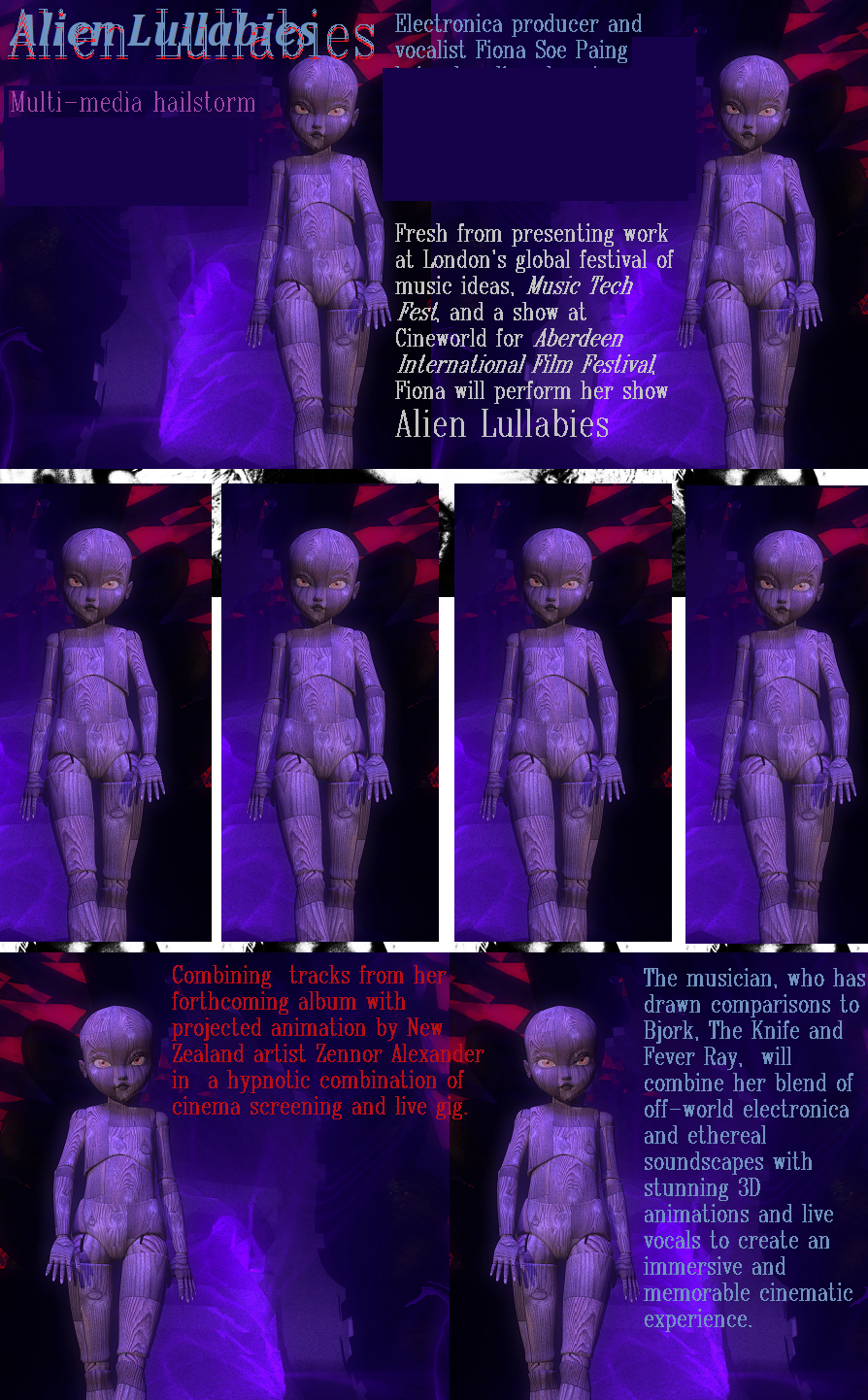
Cutting edge electronic producer/vocalist Fiona Soe Paing’s unique and immersive show Alien Lullabies combines otherworldly electronica soundscapes and compelling live vocals with 3D animation by New Zealand artist Zennor Alexander to create an unsettling and mesmerising live music/cinema hybrid. The show features tracks from her forthcoming album, and the new single Heartbeat due for release on Hotgem Tunes this Friday 19.6.15 alongside a video premiere on on-line music and culture magazine The 405.


"...you won't fail to be hypnotized by the parallel world created by Paing's haunting electronic arrangements and Alexander's deeply creative design….so fantastically disturbing and unsettling that you can’t help but be enveloped..." Stephen Bevan, The 405


What inspired this production: did you begin with an idea or a script or an object?
This has been a slowly evolving project since about 2007! It started with one song, which needed a video. That song/video needed another.... and another... there wasn't any overall plan... we just followed what the work seemed to need to do naturally... until we had a whole set of songs which when viewed/listened to in one sitting, from beginning to end... seemed to have an underlying, unstated narrative... so we then added a beginning and an ending, and decided to present the whole package in a more theatrical format, and so ta-dah, it became a show.
Why bring your work to the Edinburgh Fringe?
It's been quite hard finding audiences for our work, as it's not the kind of music that you'd find at a regular gig, and neither does it fit iinto film or theatre... and being based in rural Aberdeenshire there's not a big "scene" to tap into... so I decided to apply for the Made in Scotland funding, as it gives a platform to innovative and cross-discipline work, and since Summerhall is known for it's adventurous programming, I think it might find a supportive audience there for the Fringe. I also wanted to challenge myself to see if I could pull it off, and to see if I can up the game a bit... I'm also looking forward to making some new collaborations with other artists and companies in the fringe and meeting some new and inspiring people!

What can the audience expect to see and feel - or even think - of your production?
It's like watching a surreal animated film with an electro score and a live singer... it really takes you off somewhere else and is quite mesmerising ... some of it's quite unsettling... but some of the music is really danceable too.... The animations combined with the music and live vocals, is something quite different I think


The Dramaturgy Questions

How would you explain the relevance - or otherwise - of dramaturgy within your work?
It became clear during the making of the music and visuals that the overall piece needed to be presented and structured into a story-like form, rather than as separate songs or music videos.... the recurring images that we use in the separate pieces imply an underlying narrative, without spelling anything out.... and we shaved off some edges of the puzzle pieces to fit into the overall picture that was fuzzily emerging! So yes, that was really relevant, for the work to make more artisttic sense, rather than being just eye and ear candy.


What particular traditions and influences would you acknowledge on your work - have any particular artists, or genres inspired you and do you see yourself within their tradition?
There are so many traditions and influences it's hard to know where to start.... punk rock maybe? Dance music of all kinds, from ballet to house, electro and techno... experimental theatre and dance, Brecht, Martha Graham, Laurie Anderson, Meredith Monk, Bjork, David Lynch, Kraftwerk, free jazz, PJ Harvey, Peaches, opera.


Do you have a particular process of making that you could describe - where it begins, how you develop it, and whether there is any collaboration in the process?
Working on my laptop, I play around to see if i can find some sounds that are unusual or that have a sort of character of their own, and usually build something rhythmic around that... usually looking for sounds that suggest a specific atmosphere or feeling... other instruments fit around that and then I improvise some vocals sounds... sometimes I write lyrics to fit the melody, other times just keep the original improv and fine tune it and memorise the "words" so that I can do overdubs or harmonies. When there's a finished song with a structure, I send it to Zennor and he uses whatever images it sparks off to him to create his animations. 


What do you feel the role of the audience is, in terms of making the meaning of your work? 
They make all of it.... I still don't know what it means yet...   It has to be reflected back to you by the audience before you can start to see it clearly. 


Fiona will perform Alien Lullabies for ten dates at Summerhall for the Made in Scotland 2015 showcase during the Edinburgh Festival Fringe.

“I’m delighted my work has been selected for Made in Scotland - its a great opportunity to perform alongside world-class artists on an international platform.” Fiona Soe Paing

Made in Scotland Showcase performance details

Dates: Wed 12-Sun 16 / Wed 19-Sun 23 August

Time: 10.35pm

Venue: Red Lecture Theatre, Summerhall, Edinburgh EH9 1PL (Fringe Venue 26)


Tickets: From Summerhall www.summerhall.co.uk or the Fringe Box Office 0131 226 0000


Of Scottish/Burmese origin, and living in rural Aberdeenshire, electronic producer/vocalist Fiona Soe Paing has been crafting her sound since 2005, and since 2007, has been collaborating on visuals for her live shows with New Zealand animation artist Zennor Alexander.

Her first home produced demo which she sang using random words from a Burmese tourist phrasebook, was found on Myspace by the legendary BBC world music DJ, the late Charlie Gillett, who included it on the album "Sound of The World 2007" on Warner Music, one of his annual compilations of the best in world music.

Her EP release in 2012 ‘Tower of Babel’ was widely praised in the media, receiving a Four Stars rating in The Skinny.

Fiona recently worked with Brit Award winner Beth Orton at a collaborative residency for Brighter Sound Manchester, and performed at the Wide Days music convention at the Pleasance Theatre, Edinburgh.


Review - Alien Lullabies review

Wednesday, 1 August 2012

1960s

As much as I'd love to start off this article with a grand statement that "the 1960s was a watershed moment," I realised that just about any decade from 1890 is a watershed moment of some sort. Having undermined my reason for writing this top five, I shamble onwards, hoping that you'll buy something about how the 1960s were the moment when popular culture met political protest, and social change was not engineered by architects or politicians, but stinky guy and girls with long hair who liked rolling in the mud and guzzling drugs.

First up, there's Not My Cup of Tea. It's a new play by Polly Goss, has had a run at the Tristan Bates Theatre down in London, which supports new ways of linking actors and those with a story to tell. And it's set in 1970. So that's the theme broken already.

Forgive me. The press release talks about Bob Dylan, flares and a belief in changing the world, and it is set in a rural commune. It's multi-media, has a cool retro soundtrack and looks at the cost of fighting the system. Since it seems that the bloody system has won - mostly thanks to the sort of characters who inhabit this play selling out in around 1973 - it's an apposite tale for the Olympic Britain, or whatever desperate brand the government is calling itself this week. 


Not My Cup of Tea  at 3pm at The Radisson Hotel -The Space on the Mile (V39) from 3rd- 25th August 


Chances are that I am going to be going on about this company in a later post (there are a bunch of French-style physical theatre companies hitting the Fringe, and I am not missing the chance to have an article called "Respect Lecoq"), but Letslip are taking a different route to re-examining the 1960s... one that contradicts my earlier definition of what made them a watershed moment.


Machines For Living comes out of the Jacques Lecoq Theatre School in Paris and stars a pair of architects who delude themselves that they can design a tower block into a perfect lifestyle enhancer. Yes, those whacky 1960s Brutalists, with their concrete flats and dreams of a utopia based on shoving people into tiny boxes a mile up in the sky are back.


Of course, it's a black comedy: here in Glasgow, we've been watching the results of that smart social engineering get blown up over the past year, and this is another chance to mock the idiocy of a movement that ignored the concept of beauty in design. My only worry is that the Morning Star called it an unexpected gem - and I am still not convinced that Marxism and aesthetics are comfortable together. 

Machines for Living @ ZOO (Venue 124) 3 to 27 August (not 14th or 21st) @ 3.30pm


Not that I am getting desperate to keep the theme together, but Forever Young does take its title from a Bob Dylan track, and has a soundtrack of tunes from the 1960s (and 1950s). Red Cloak Productions use the poetry of Blake (he is a bit like the 1960s' spirit given romantic form, isn't he?), Wordsworth and Coleridge (he liked drugs, like hippies did) to examine what it means to be a youngster and what it costs to leave youth behind.

In many ways, this is an allegory of the 1960s, as the decade started with the rise of the teenager, but the grim meat-hook reality of Vietnam, Tricky Dicky Nixon forced the generation to grow up.  I am sure that the company didn't mention this in their press release because it is so obvious. 

This is another show with live music and a touch of physical theatre, and looks as if it fits nicely in the fashion for devised work coming from younger companies. 


Forever Young @theSpace@Symposium Hall (V43)
13th - 24th August 2012 @ 11.15am


I don't want to be accused of being partisan, but I am enthusiastic about Summerhall's programme throughout the Fringe - and if the rumours are true, it is set to become a year round haven for Edinburgh's avant-garde. And even their films are exciting: they've got a selection from KinoKlub (the surreal film collective) of a 1960s' classic, Les Yeux Sans Visage.


It might have inspired a song by Billy Idol, but Les Yeux has the appropriate awkward credentials to get on any self-respect psychedelic warrior's wish list. It was made at the start of the Love decade, has plenty of body horror (the plot stars a plastic surgeon's attempt to fix up his disfigured daughter) - and this showing comes with a bonus short about animal slaughter.


There's a great deal of sentimentality about the 1960s - an innocent time, and the hippies just wanted a nicer world, maan. Nothing better than a spot of vicious surreal nastiness to put this in context.


Summerhall, 24 August


Finally on the old school top, there's Black Comedy. Written by Peter Shaffer (the Amadeus guy), Edward's Theatre Company get busy with a tale of artistic ambition and financial possibilities. Shaffer was inspired by a performance of the Peking Opera, and emphasises the dark part of the comedy: it all ends in mayhem.


Black Comedy is a nice ending to my 1960s' special, as Shaffer is one of the few playwrights of that era who has both a popular and experimental following. I remember him most from the TV version of Equus, which is just dark with no comedy


The Quaker Meeting House  Monday 6 - Saturday 11 August