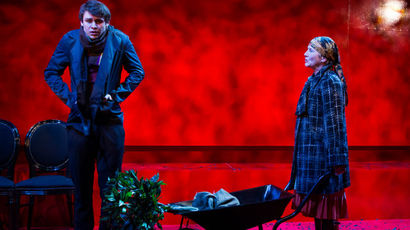
Harold and Maude does offer a brief maxim for all times and places: Maud describes a wise man passing onto her the slogan "this too will pass." It becomes the closest thing she has to a philosophy: this exuberant pensioner, the idiosyncratic love interest for morbid teenager Harold and survivor of wars, revolutions and beloved husband, is too occupied with living in the moment to regard any grand statement as being worth deeper analysis.
 |
| Isn't that him out of the BT advert? |
Theatre Jezebel's decision to give the play of the film extends the company's interest in American theatre: their
Autobahn convincingly opened up the dark heart of Neil Labute's picaresque visions of lives on the road,and
Doubt was an unsettling deconstruction of religious belief, power and child abuse. Yet Colin Higgins' script lacks the social bite of these plays, and the romance between Harold and Maude is too idiosyncratic to connect effectively to the themes of social constraint, the importance of living through joy and the possibilities of love.
As always, Kenny Miller's design is precise, dividing the stage into Harold's cold, palatial home and Maud's lovingly cosy shack. And Paul Sorley uses a muted lighting design to contrast Harold's emotionless family against Maud's extravagant lust for life. The story - which begins with a faked suicide and ends with a real one - is a deceptively undramatic and gentle narrative, stressing how Harold's preoccupation with death - and his desperate attempts to provoke his mother into caring - is immature against Maud's genuine hardships which have only encouraged her zest.
Glasgay!'s support for the project, given this year's theme of union, is easy to explain. Rather than being concerned with the intergenerational nature of the affair - the social reactions are dispatched in a few shocked complaints -
Harold and Maude reveals how love, however unexpected, can change a life. And for a play so obsessed with death, it is a subtle message, played out in tender moments, shared intimacies.
However, this is not a play about the grand statements: seeing it live does not necessarily improve or even equal the film experience - the slight moment when Maude is recognised as a holocaust survivor is beautifully concise and moving on celluloid, but lumberingly alluded to in this script. It retains the humour, the slight charm, but could have done with a big car chase, involving the theft of a police motorbike.