Showing posts with label Glasgay. Show all posts

Sunday, 3 November 2013

Burning Bright...


Aside from a natural, human sympathy and a considerable aesthetic respect for their artistry, I don’t feel any particular affinity for the generation of Scottish theatre makers currently on the rise. That isn’t to say that their work isn’t powerful  - Stef Smith’s Cured is a fast-paced and unexpected comedy, making demands on the performers that allows them to respond with appropriate pathos and humour. Indeed, the emphasis on New Writing – found in the Tron, in Glasgay!’s annual programme, at the weekly Play, Pie and Pint sessions, upstairs at The Playwright’s Studio and across various university departments – has given Scotland a distinctive crop of contemporary authors. 

And while I maintain a lofty critical eye, I often find reflections of my own experience in the sharpest lines and most doomy dialogues: despite the attention given in national newspapers to London’s theatre, it is not parochial to suggest that Scottish performance is in rude health.

Both Smith’s Cured and Natasha Gilmore’s Tiger are strong examples of this confident culture. Although Tiger is paired with a truncated ‘children’s’ version (Tiger Tale) that is little more than an edited version that invites the audience on-stage at the end, it is emotive and fluid enough to stand alongside the best choreography in Europe. A simple tale of how a nuclear family is redeemed by the arrival of a wild, unpredictable energy, it impresses through the precision of the three dancers movements and the telling symbolism of Gilmore’s choreography. Cured is a generous romp through one woman’s flirtation with the ‘ex-gay’ movement, allowing Smith to reveal her smart wit and deft characterization – as well as a mastery of structure, which allows her to throw in a twist and happy ending.

The magic in Cured and Tiger comes from similar attention to detail, although Cured is an archetypal well-made scripted play and Tiger is contemporary dance. Both Smith and Gilmore are able, in a tiny slither of time, to capture a recognisable and resonant scenario: in Tiger, when the child dances around the stage on her parents’ bodies, never touching the ground, Gilmore expresses the devotion of the family in a direct, poetic image; in Cured, apparently trivial conversations about TV comedy The Golden Girls provides an important connection for the mother to accept her daughter’s sexuality.

The beauty and compassion of these moments eloquently express the artists’ profound humanist concern. This compassion runs through both works. If a play at Glasgay! is never likely to present a sympathetic ex-gay evangelist, Smith avoids setting up a predictable God-bothering straw woman. Gilmore’s unhappy couple, meanwhile, are not blamed or caricatured. This insistence on the worth of the individual is how both artists connect to their audiences – although Gilmore has a more detached presence as choreographer than Smith as writer, and dance encourages a more abstract interpretation.
The experience of watching Tiger and Cured is to be held by confident, clever creators: the combination of passion and intelligence they manifest might qualify them for the over-used and rarely explained category of ‘genius.’

Yet, this is not my theatre: Tiger comes closest, as it slices open the conformity of the married couple to reveal their heartache, caused by the exclusion of the wild in their domestic security. But resolution triumphs, and the human is the measure of the resolution. Even here, the wild is welcomed only as a tool towards domestic reunion. I am a determined anti-humanist, happier in the absurdity of Beckett or the uncomfortable acceptance of the strange found in Les Ballets C de la B. There is another theatre, perhaps unfashionable and maybe discovered in the interruptions of Forced Entertainment’s The Coming Storm that better reflects my world and temperament.

This could present a problem to my authority as a critic – if anyone was bothered to read this far. Since I am uncomfortable with their conclusions, I am tempted to recall Plato’s complaint and accuse both works of being dishonest. The discomfort is purely philosophical, because I left the performances happy, smiling and impressed. I’d argue that, if anything, my rejection of their content makes me, if not objective, a more impartial critic. The substance is not what makes me appreciate Tiger, but its expression. Equally, my applause for Cured is not at the romantic finale, but at the skill of Smith’s writing.


Friday, 2 November 2012

Harold and Maude (2)

Harold and Maude ought to be right up my alley. It's got a death fixated teenager, a spot of intergenerational sex, shows the world through a variety of different perspectives. There's even a rather charming film from the early 1970s which, as Neil Cooper mentions in his review, was made in the face of social chaos in America, as the hippy dream receded into a more cynical reality.

Colin Higgins' version of his screenplay does struggle to replicate the detail of the film - it is far easier to believe in Harold's alienation when he is wandering around a huge house - and his relationship with Maude is surprisingly gentle, given the grand themes of social disapproval, the twentieth century's violent history and the meaning of life in the face of death that bubble beneath the surface. And despite the breezy humour, it is the substance of the script, which begs deeper analysis, that gives the play its fascination.

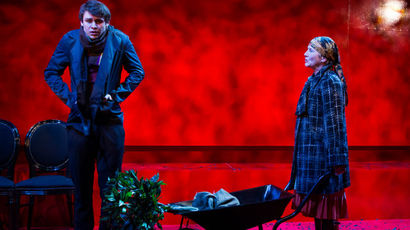
Kenny Miller's production, which divides the action into two grand spaces, struggles to catch the nuance of the film version: a solid cast gets the laughs, but  the chemistry between Tommy Barstow's Harold and Vari Sylvester's Maud is only occasionally powerful.

The problem might be in the characterisation: Harold comes across as a sulky teenager, never the most intriguing personality,and the supporting characters - Harold's mother, a sleazy psychiatrist, are caricatures. It makes for a lightweight entertainment, a perky version of social satire but lacking the bite to be directly relevant


Harold and Maud


Harold and Maude does offer a brief maxim for all times and places: Maud describes a wise man passing onto her the slogan "this too will pass." It becomes the closest thing she has to a philosophy: this exuberant pensioner, the idiosyncratic love interest for morbid teenager Harold and survivor of wars, revolutions and beloved husband, is too occupied with living in the moment to regard any grand statement as being worth deeper analysis.

Isn't that him out of the BT advert?
Theatre Jezebel's decision to give the play of the film extends the company's interest in American theatre: their Autobahn convincingly opened up the dark heart of Neil Labute's picaresque visions of lives on the road,and Doubt was an unsettling deconstruction of religious belief, power and child abuse.  Yet Colin Higgins' script lacks the social bite of these plays, and the romance between Harold and Maude is too idiosyncratic to connect effectively to the themes of social constraint, the importance of living through joy and the possibilities of love.

As always, Kenny Miller's design is precise, dividing the stage into Harold's cold, palatial home and Maud's lovingly cosy shack. And Paul Sorley uses a muted lighting design to contrast Harold's emotionless family against Maud's extravagant lust for life. The story - which begins with a faked suicide and ends with a real one - is a deceptively undramatic and gentle narrative, stressing how  Harold's preoccupation with death - and his desperate attempts to provoke his mother into caring - is immature against Maud's genuine hardships which have only encouraged her zest.

Glasgay!'s support for the project, given this year's theme of union, is easy to  explain. Rather than being concerned with the intergenerational nature of the affair - the social reactions are dispatched in a few shocked complaints - Harold and Maude reveals how love, however unexpected, can change a life. And for a play so obsessed with death, it is a subtle message, played out in tender moments, shared intimacies.

However, this is not a play about the grand statements: seeing it  live does not necessarily improve or even equal the film experience - the slight moment when Maude is recognised as a holocaust survivor is beautifully concise and moving on celluloid, but lumberingly alluded to in this script. It retains the humour, the slight charm, but could have done with a big car chase, involving the theft of a police motorbike.


Monday, 29 October 2012

New Queer Cabaret?

As part of Glasgay!'s restless programming - and emerging from the Buzzcut promotion stable - Tranny and Roseannah's cabaret at Rose and Grants reaffirms a core values of Glasgay!'s identity, an interest in presenting new work and new ways of understanding LGBTQ performance. Although Tranny and Roseannah's secret identities are familiar to Live Art audiences - they follow on from Fish and Game's successful double act in Strange Hungers in the fusion of drag humour and political intelligence - their cabaret format is far looser and their bill (on Thursday night) shows less focus and more eclecticism.

Tranny and Roseannah hold together the proceedings with their parody of TV reality show lifestyle gurus: their guests, Dame Fanny Dayglow and Foxy (from human-animal hybrid duo Foxy and Husk) come from diverse ends of the spectrum. Dayglow is a classic drag act - failed and delusional celebrity and sad old lady by turns - while Foxy's mimed meditation on relationship break ups is devoid of kitsch and manages to sail into emotive waters despite the comic appearance of a woman-dressed-as-a-fox.

As a cabaret evening, it does not hang together: Foxy's finale is far too intense after the playful makeover tease and Dayglow's parody of the celebrity audience, leaving Tranny and Roseannah slightly tongue-tied. The switch between moods is too abrupt - and Foxy's Solo is quite clearly not designed to be part of a vaudeville night, having even emotional power and serious content to stand alone.

Dayglow's routines are far more adaptable to the format - although the Talking Heads styling of her central monologue is filled with pathos and undermines the slightly easy and cheerful humour of the other two - and Tranny and Roseannah begin the evening with a very funny extended skit on fashion.

All of the acts are strong on their own terms - T&A feel like a work in progress but their banter is well developed and their co-dependant relationship touchingly and hilariously fleshed out - and Foxy smashes up popular cultural, oddly sexual fancy dress and an obsession with milk  and misery into a coherent, if sometimes meandering slap at romance and failure.

Dame Fanny Dayglow exults in kitsch humour - again, context is important, and getting a laugh from an old song that uses "gay" in a funny way is far more vaudeville than the rest of the evening. She also suggests that her fatuous faux celebrity routines hide a talented actor: again, that central monologue being both moving and wryly humorous.

If the structure isn't quite perfect, it is clear that T&A are trying to draw connections between queer identity and performance art - itself "queer" against the normative model of theatre - and the slightly awkward shifts in tone are reflective of a project in its early stages. Certainly, this is an imaginative tale on the potential of the cabaret format - a format that has been explored through Itsy's Kabarett in Edinburgh, or in Scunner's Spangled nights, but here given a more explicitly social and political intention.


Monday, 22 October 2012

Frock On, Frock Off


Frock On Frock Off might be part of Glasgay!, but it appears to have emerged from Buzzcut - like the Glasgow Cabaret Festival, it is a festival within a festival that has been a festival within its own right. Not that Buzzcut is disappearing: they had a couple of nights at The Fringe (another festival within a festival) and there are rumours of a major alliance in the New Year. 


Promoters, or curators, Laurie Brown, Rosana Cade and Nick Anderson have set up a week long... if I have to use the word festival one more time... I am going to ask them about this festival business on the Radio Hour... hang on, Eric and I need to get across to the Studio soon...

Oh, here's what FOFO are offering. The events are all in Rose and Grants, the rather lovely coffee shop/cafe around the corner from the Tron...

24th + 25th October @ Rose and Grants, 7.30pm

Foxy - Fox Solo

I think we had Foxy on the Radio Hour last year - she appeared as part of a duo with Husk. I made the inevitable joke about her being foxy and probably played Jimmy Hendrix and looked smug about my radio brilliance. 

The good news is that Foxy is going it alone this year, and the description of her show involves "drinking alone" and "trying to win your love and affection". I am going to be watching closely, since this sounds like my weekends.

However, this is part of a double bill with...

Dame Fanny Day Glow - The Angina Monologues. 

Apparently Dame Fanny has been done for tax evasion and assault, and likes a wee sip of vodka. Yep, this one sounds like me, only the Dame has better songs and wigs than I have. 


26th + 27th October @ Rose and Grants, 7.30pm

Thank God, the second double bill sounds nothing like my life.

Tom Wells - Engage

A Mancunian tries to find something to connect himself to his father. Turns out to be more difficult than he's imagined... family disconnection? Nothing like me at all, that.

Lucy Hutson - Make Do and Mend Myself

Lucy, meanwhile, is all about domestic skills. Since I live in a pit, surrounded by comic books and bits of my existential novel about a critic who can't maintain a conversation without name-dropping someone he met at a party once and now claims as a friend, her stories of the well-laid table, pompoms and good housekeeping is going to be like an essay on how I ought to live.


28th October, The Sunday Bizarre @ The Glue Factory, 3pm - late:

An assortment of performative installations, interventions, homemade hot food, discussions, debates, film screenings and dragged-up party games brought to you by artists from across Britain... and of course Tranny and Roseannah!

Vile Arts Radio Hour (22nd October)

From our secret base near the River Clyde, The Vile Arts prepares for the latest episode. Eric's in the corner, checking out music, Vile is wondering around, doing his special voice exercises, Margaret Kirk is typing up a playlist, and Producer Harry broods, silently, communicating through the magic of telepathy.

Three guests are lined up so far, making the top five events for the week easy to pick. Joining Vile at the start of the show - and then chatting to Eric, in the hope of intelligent conversation - are Tranny and Roseannah from Frock On, Frock Off. 

A new strand within Glasgow - and coming from the same stable as Buzzcut, Glasgow's own alternative performance promoters - FOFO is all about the Live Art, and is spreading across Rose and Grants with a series of idiosyncratic performance.

 Highlights include a solo from Foxy - a guest on the show last year, and currently lamenting the absence of partner Husk - and Lucy Hutson mending herself through the magic of the W.I. before ending on Sunday with an all day party at The Glue Factory.


24th + 25th October @ Rose and Grants, 7.30pm: Foxy - Fox Solo and Dame Fanny Day Glow - The Angina Monologues
26th + 27th October @ Rose and Grants, 7.30pm: Tom Wells - Engage and Lucy Hutson - Make Do and Mend Myself
28th October, The Sunday Bizarre @ The Glue Factory, 3pm - late

Following Tranny and Roseannah, Michael John McCarthy - sometime of Zoey Van Goey, and one of the two most versatile and hard-working musicians in the theatre community - pops into chat about... well, as usual, the man has plenty of projects. Expect conversatin about Grid Iron's latest play, Govanhill Baths and his limited edition online release of music for theatre


Last, but far from  least, regular co-host Matthew Whiteside gives the lowdown on classical happenings this week - the rumour is that the composer will be talking about some of his own work - an opera that deals with something a little more contemporary than Italian lovers... he will talking about a special weekend up in Aberdeen, and the connection between Scottish Opera and the mighty Said Ensemble...

Tuesday, 25 October 2011

The Boy Looked at Johnny

Johnny Woo repeatedly reminds the audience that he is “alt. Drag perf. Art”. Whether this means pairing a beard and killer heels – simultaneously undermining the drag queen perfection, or adding a spoonful of surrealism to routines that increasingly abandon the traditional drag skills of impersonation for something more oblique and cutting, Woo is unafraid to risk amiability in a show that moves towards absurdism.

Woo’s power is based on the tension between drag and live art. The highly strung persona – he screams “don’t touch me” before dragging one audience member into a routine closer to a stag show – transcends the casual cattiness of more, ahem, mainstream drag, heading into neurosis and disorientation. And when Woo adds a social commentary, as in the aggressive techno encore, which challenges homophobic abuse, or in a waking dream of retail work, Woo marries the glamour of drag and the immediacy of performance art.

Managing to reference drag iconography – like Priscilla’s trailing dress – and wandering into more distressing territory – the wild night out he promises frequently turns into chaos, Woo is confident and capable of integrating minor problems into his act. The failure to finish one tongue twister becomes like the juggler who deliberately drops a ball: it’s hard to tell when Woo is undercutting polished professionalism or dealing with genuine miscues from the music maestro. After ten years in the business, Woo is collating various routines, a snapshot of a decade at the line between entertainment and more serious concerns. It’s a deadly combination, and no-one can get more sensuality and emotion from a gorilla mask and long legs than Johnny Woo. 

Sunday, 18 September 2011

Johnny Bites at Random, Making Love Hurt all the Sweeter


Given that their famous trilogy exploring Little Johnny's emotional and romantic adventures - culminating in the National Theatre of Scotland co-production of their Big Gay Wedding - was originally supported by Glasgay, it's no surprise that Random Accomplice have collaborated with the festival for their latest new direction. Love Hurts - a monologue that follows the dark paths of sexual awakening - is the second in RA's Random Bites series. 
"Random Bites is a relatively new umbrella for the company," explains Johhny McKnight, one of the duo that make up RA.  "Julie Brown (my better half - aka the brains of Random Accomplice!) and myself had a recent meeting where we talked about the importance of us, as artists, being able to take risks and develop ourselves further. And sometimes that means without the emotional crutch or barrier depending on what day it is, of each other." 
Rather than challenge themselves to make the same scale of shows that made their name - McKnight is the notorious director of The Macrobert pantomime, which has rewritten the rules of Scottish Christmas entertainment, while their recent successes Small Town and Promises Promises were staged in the Ton's main theatre - they evolved Random Bites as "small-scale, easy to manage and tour, projects that cost relatively little to make but give us vehicles to try out new ideas or formats."
"We did our National Theatre of Scotland Five Minute Theatre under this banner and now Love Hurts is the first true pilot exercise," McKnight continues. "It's a new project that I have written and directed on a very minuscule budget but that all the artists are doing for either the love of or because I've twisted their arm."
Random Bites is very much in the mood of the times - as is Love Hurts, with its brooding main character and sense of anxiety. In a time when the arts are under threat, sensible companies are looking for new ways to experiment, without undermining their reputation or possible funding. After a decade of growth, RA are still seeking out new possibilities.
"I think for me as a writer its probably a new step for me. Its much more a straight forward play (which I don't think I've ever really done before Smalltown) but, hopefully, still contains a sense of storytelling, comedy and excitement for an audience," he continues. "It's still, like most RA shows, got a real relationship with its audience and - hopefully - taps into those feelings of identification of the thirty- something audience. Only perhaps this show has a more melodramatic climax."
"I do feel as we start to get older at RA, there is an even more urgent and important need to throw ourselves curve balls, test out other forms, work with new artists, create work for different audiences. I think if we don't then we become stale and, even more importantly, uninteresting."
This willingness to experiment has always been a feature of RA: whether it is the zombie horror comedy of Smalltown, the serious moral meditation of The Promise or the melancholy haunted hilarity of the Big Gay Trilogy, McKnight and Brown have always demonstrated their roots in the Young Glasgow Live Art Tradition - both are graduates from the Conservatoire Formerly Known as the RSAMD - need not mean inaccessibility. It might signal a new format, but Love Hurts follows in the open, witty and searching tradition that they have developed over the past ten years.