Monday, 16 January 2012

Vox Motus' Magical Theatre

In the past, I have struggled with Vox Motus' plays. There is no question that they have been one of Scotland's most innovative companies: they use the stage set as if it is an extra character, bridge a gap between the old proscenium arch and more intimate spaces, commission some great music (Zoey Van Goey's Michael John McCarthy turned up in their Not So Fatal Death of Grandpa Fredo) and are constantly learning new skills - especially puppetry. They are populist, immediate and hilarious and, inevitably, this pretentious critic was left demanding more.

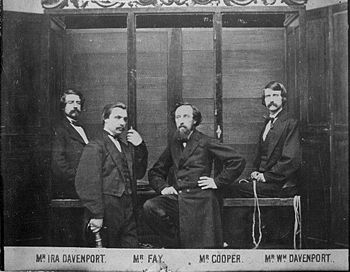
However, for their latest show, The Infamous Brothers Davenport goes some way towards shutting my stupid mouth. Enlisting Peter Arnott on script duties, they are teaming up with a playwright known for his engaged, intelligent and political writing (he was part of Wildcat's legendary line up, when satire still hoped to make theatre impact on society). And while past Vox Motus works have been been undermined by poor scripting -Bright Black was the victim of a faux-classical poetry - the Arnott alliance hints at a new potential.


While they were in rehearsal for Bros Davenport, I bothered the company - and they generously supplied answers to my questions.


Vox Motus has a reputation amazing use of theatre's architecture, diverse techniques and playing with theatrical tropes, but how did you get involved with Peter Arnott?
We had begun a partner project with Playwrights Studio Scotland to bring new playwriting voices into our process. Peter was the perfect collaborator for this project as he's a theatrical wordsmith with a real ability to conjour the period through his text and dialogue." He's also a real team player and that is key for any level of involvement in a Vox Motus production. We're a very collaborative bunch. I think Peter's really helped us to tell a dark, compelling tale of two brothers in conflict woven around acts of illusion and Vox Motus theatricality.


Where did your interest in the "magic" of the 19th century come from? 
Jamie has worked as a magician since he was a teenager. It's a job that taken him all over the world. Nowadays his focus is on illusion for theatre (e.g. creating the flying flame Tinkerbell for NTS's Peter Pan). So we're often reading about magic and illusionists. The 19th century really was the golden era for magic - and indeed the manifestation of spirits and spiritualism.

Is this a period piece, or does it have an immediate contemporary resonance?
Surely every period piece should have an immediate contemporary resonance - otherwise why are we telling this modern audience this story? We are interested in a gripping, human story rather than a history lesson. The 1860's is framing for this piece - a time and space in which we understand spiritualism was finding its voice and magic was celebrated across the western world. Regardless, communication with spirits is still very much a part of many people's lives today. It's a means of offering hope and that is a universal need and quest.

Vox is known for adding to its repertoire of theatrical techniques with each production - as well using some great music. 
We are definitely using some great music! We have commissioned musician and composer Phamie Gow, who is performing her original soundtrack live alongside the production. It's not every day you work with a musician who has performed at Carnegie Hall, NYC, at the request of Philip Glass. She has just spent a period in the States (where the Davenport Brothers came from) and there is a beautiful American sensibility to her composition.


Is there anything new that you have added for this production? Or anything familiar from past shows?
I think another exciting prospect is that a small number of audience members will be able to opt in to taking part in the Brothers' seance. It's going to be a very immediate experience for the audience - and the actors who are taking them on this journey.


Greed

A sharp and immediate response to Glasgow's elected officials' apparent familiarity with certain businessmen, Greed has the qualities of a scratch performance: raw, under-rehearsed and precocious. While none of the cast will be winning awards for their acting, the timeliness of the message and savage rhetoric of the script make this a strong argument for directly political theatre.

The director may have been careful to avoid labeling each character with their real life inspiration, but the moral is clear: elected official are corrupted by their power, and easily manipulated by the wealthy when they pose as philanthropists. The villain is almost pantomime obvious - the use of a fat suit and the iconic stove-pipe hat puts him firmly in the tradition of Soviet propaganda drama - all schemes and soliloquies. His victims, a chorus of sweet children who hope that their school will be upgraded, are equally stereotypical. The only depth is in the Councillors, all male, who are both deceived and willingly deceive. A more rounded treatment might have found a tragic depth in their predicament.

But this is not author Margaret Kirk's intention: she wades through the sleaze of modern politics, hammering home the easy points and evoking a powerful sense of outrage. As the final lines, given to the chorus and addressed to the audience, explain: "Imagine if this was not just on the stage, but happened in life... Oh, I am sorry, it did.

Friday, 23 December 2011

You Say You Want a Revolution


Although the only politics that I really understand are those that have been made into contemporary dance and  I have a severe distrust of ideology because it tends to lead to dogmatic scripts that make an obvious point, I am heartened by the students who have occupied various university building throughout December. That they held G12, once an accessible theatre, made the protests more poignant, a reminder that drama, as a public event, always has a political subtext.

Since students aren't the only ones facing cuts, I am rather hoping that performance communities take the hint, and demonstrate their feelings about this government's attitude to the arts. While I am ambivalent about the importance of state funding - it comes with a hidden cost and a certain complicity - I don't want to see the money that used to get spent on scenery slipping off to support another bank bail out or pay-rise for MPs.

I believe in performance because it is a rare example of a public meeting that offers the potential for intelligent discussion: unlike football, it is more likely to lead to romance or debate than a fight in the car park. Attacks on funding for the arts are, by extension, an attempt to undermine the possibility of dialogue and new communities.

In any case, I have a fantasy about a Performance Demonstration. Can you imagine the massed ranks of ballet and contemporary dancers, burlesque acts, vaudeville hoofers, directors and pantomime stars, musicians, comedians, conceptualists getting together to fight the power?

Thursday, 8 December 2011

Latitude 2009 Part 2: When Tricky attacks...


I am lost in the woods. There are neon signs on the trees, above my head, proclaiming PURITY, TRANQUILLITY  PEACE and TRUTH. There are faeries from the Royal Opera House appearing around me. I thread my way past a collection of apparently random road-signs suspended from the branches and out into the Film and Music arena.
SonVer have created an instrumental suite exploring alchemical transformation. Accompanied by films that illustrate the stages of a simple alchemical process, they go heavy on the moaning cellos and rippling, chiming guitar, the percussive effects gradually rising into an urgent, martial drumming. They build and ebb, clearly indebted to Godspeed You Black Emperor and evoking far more of alchemy’s mysterious exoticism than the videos, which are either simple narratives on a theme or sparkling, psychedelic light shows. The attempt to merge film and music is as sadly unsuccessful as the quest for alchemical gold, even if SonVer’s extended instrumentals are uplifting and driven, standing alone without the unimaginative short films.
I lost track of Tricky when the clash between his pop sensibility and abrasive beats was resolved into a dense obscurity. He starts off slowly, wearing a dress, backless and black, facing away from the audience and letting his band introduce his deep-frozen rhythms. The set is initially formless, lurching uneasily between heavy rock and his pulsating, erotic bass vibrations, his voice hoarse and fragments of piano slipping in and out of the harsh but muddy sound. A man next to me begins to flirt with a girl in a red tracksuit top. He lights a cigarette and she sips shyly at her drink. He puts his arms around her and talks about his festival in a loud voice. Even a rousing 'Black Steel' can’t distract from his seduction, and Tricky seems to be struggling. He has gone topless now, pacing about the stage, disappearing.
Image: Luke Winter
The man’s friends arrive with shouted greetings. They hug each other, and ignore the girl. I notice her look of utter disgust when, suddenly, Tricky tears into 'Ventoline'. The asthmatic bass takes up the melody, Tricky wheezes out disgust and desire and movement radiates out from the stage in concentric half-circles. The guitar takes up the melody, rougher and harsher, Tricky’s voice floating, bruised on the surface, the dancing becoming wilder. He pauses, the band stops, the only sound the bass, barely breathing. The man shouts out.
The band kick back in, and around me an eruption of dancing. A sixteen-year-old girl in a wedding dress is propelled backwards, striking the 3 friends who slip backwards, lost in the crowd. A stray fist strikes me in the throat, knocking me over two bodies lying on the floor, curled together. Tricky moans. “I can hardly even breathe.”
He strikes himself on the chest. My head goes beneath the line of the crowd and for a moment, the music is muffled, as if I am hearing it beneath the water. The band pauses. Tricky is at the front of the stage, his hands in prayer and he kneels, penitent. The band kicks back in. Dark blue light, Tricky slides into the crowd, surfing above them and out of the hall. The vicious bass still pulses steadily.

Thursday, 1 December 2011

Joe Egg

It’s a stunning script, torn from the author’s experience of bringing up a severely disabled child. It takes the traditional soliloquy and electrifies it with stand-up comedy and music hall routines, shattering the fourth wall and allowing the actors to connect directly with the audience. It revels in uncomfortable humour and draws complex characterisation from possible stereotypes – the failing teaching, the manipulative mother-in-law. It even presents a public debate, complete with unsavoury bigotry, on an apparently intractable problem. It flickers between genres, refuses a pat finale and shows compassion to nearly all of the characters.
That A Day in the Death of Joe Egg was written in 1967, when the stage was still subject to censorship is not necessarily a cause for celebration. There has been little writing since that is so sharp, so complete, so precise. A litany of its qualities reads like a check-list for contemporary drama’s ambitions.
Not being a proper scholar, and lacking access to the latest texts on theatre practice – my disappointment is tempered by their apparent fascination with “getting back to the roots” and blathering on about tangentially related performance – my library is dominated by second hand books that were terribly modern in 1975. Having grown up as an enthusiast for radical, devised theatre, mainly thanks to the imaginative programming at Tramway by Steve Slater, these references tend to miss many of the processes that have defined my experience. Devised work is lumped together in a category called “Fringe”, alongside agit-prop, rock opera and happenings. The script is still king in 1975: one preface moans that the Arts Council has recently suggested that language is not necessarily at the heart of theatre.
I often say that “I hate scripts.” Yes, it’s a lazy line, a slogan that I roll out when I am about to explain why I am rather fond of David Harrower, or think Dunsinane is David Greig’s most important play. And there is a great deal of “performance” in my critical persona. I never really mean what I say when I am making proclamations: for the record, I have big ideas but struggle to articulate them, knowing that they inevitably contradict each other. When I say “I hate scripts”, I am really repeating the Arts Council’s 1970s declaration that they don’t necessarily form the foundation of theatre, plus a vague complaint that they are given too much emphasis. Oh, and that I have seen too many Shakespeare remixes that have little justification beyond another outing for the Bard’s poetry.
A Day in the Death... is one of those awkward plays that highlights the stupidity of my published catch-phrase. Any reservations I have about it are down to its original cultural context – the do-gooder industrialist socialist is a stereotype I cannot recognise, his wife is a cruel two dimensional bitch, and the best lines do go to the guys. It doesn’t really give a vision of the family that I can recognise – a stay at home mother? But as The Citizens’ production demonstrates, it is willing to address a serious question and still keep the jokes flowing. Writer Peter Nichols told director Philip Breen to go for comedy, not Strindberg. Yet the compassion at the centre ensures that the gags don’t become a nasty rush of spastic humour – and thanks for Ricky Gervais for bringing that one up again, to boost his flagging career and advertise his particular soullessness.
If anything, Breen is reverential of the text: he spoke at a post-show discussion about locating his version in a pop-art late 1960s, and his cast aren’t always comfortable getting down with the audience. Miles Jupp kicks off well, using them as his unruly class, and Miriam Margoyles offers a master-class as the mother-in-law: it may have been her excellence that kept her from being a one-note joke, culled from Bernard Manning’s Greatest Jibes. But Breen does bring out the comedy, holds the pathos gently. The choice not to update the action makes this a museum piece, but suits the production. A more modern take would have opened up questions about the different attitudes we now have to disability, weakening the bold strokes of the moral debate (should Joe Egg be offed?).
Of course, I am not suggesting for one moment that the play offers any special insight into disability. The real drama lies in the way that Joe Egg’s parents battle, and how Joe becomes a symbol of an intractable problem that neither science nor religion can handle and an icon for the parents’ personal failures. The father is a moral coward – his final escape is craven, somehow more morally objectionable than his attempted murder of the child. And times have changed: a piece like Girl X, created by Robert Softly, is a more bracing take on contemporary attitudes.
The Citizens are offering something important: the chance to see a classic of British Theatre, in an unfussy interpretation. It allows the script to shine – something new Citz’s artistic director Dominic Hill will appreciate, since he is all about the writing – and sets the author’s interests front and centre. Not only does this ensure that the casual audience – by this, I mean people who still cling to theatre as entertainment, not their profession – will be attracted, it offers an opportunity for anyone working in theatre to see a classic work in a clear production. There’s plenty of food for thought in A Day in the Death..., both in terms of its look at social attitudes to disability and the potential of the script as... the foundation of drama.

Footnote: Ah. I have noticed that I have fallen into one of my own traps here. I am banging on about the “theatricality” of A Day in the Death and not fully engaging with its broader social impact. I am especially guilty because it deliberately deals with an issue, and had quite a big impact in the 1970s. There’s space for a different article, that thinks about how it addresses disability, and lets dad off the hook for trying to kill his daughter. And while the most vociferous advocate of euthanasia is a caricature and obviously unsympathetic, there’s no positive reason given to keep Joe alive. The disabled daughter is an object, passed from person to person. The entire drama depends on this. That might be too.. conservative for me.
I have also added to this by calling Josephine, the child, “Joe Egg”, conflating the title and the character. If you’ve seen the play, you’ll understand why. If you haven’t... well, be a dear and see it before responding.