Showing posts with label Uninvited Guests. Show all posts

Sunday, 2 December 2012

Make Better Please

Uninvited Guests' Make Better Please is another entry in what appears to be a bumper year for political theatre. Although the definition of what makes theatre is increasingly vexed - most of the productions avoid the earnest analysis of the classic 1970s agit-prop dramas - Make Better Please has, at its heart, a satirical impersonation of David Cameron. He might be wearing a cock made out of newspapers, and channelling half a dozen celebrities, including Sir Jimmy Saville, but he is still recognisable as the leader of the nation. And in the previous hour, subjects as serious as the UKIP foster care controversy and the state of Brian May's haircut had already been covered.

After their previous visit to Tramway 1 with Love Letters, this new direction is disruptive. For the first hour, it's classic Uninvited Guests audience interaction: a nice bit sit down and a cup of tea, a chat about the day's news. Of course, the media is full of horror stories - sexual exploitation, murders, sweat shop conditions, Brian May hunting animals - and these headlines become the substance of the second act, when the break out groups reconvene in a large circle to report back.
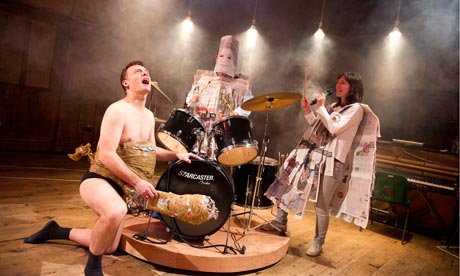
The slide towards mayhem and shouting is gradual. The various news reports are shared, the performers organise the information, then role-play characters. A woman is Alex Salmond, Donald Trump, inviting questions from the floor. Then the audience are asked to visualise specific moments of terror, ripped from the papers. From sunday social to encounter session: it's going all a bit ritualistic.

After the audience has been invited to wear masks of the recently deceased, the lights dim and the drums come out. The demonic David Cameron routine begins and is baptised in tea. The music gets louder, the atmosphere heavier. By the time the full force of the ritual is released, Cameron is half naked, howling and ready to be sacrificed.

The shift is awkward: it doesn't quite freeze the smile on the face, but peels back the gentle liberalism of  the early discussions to reveal a vicious demonology lurking behind the headlines. The mood is abruptly darkened, almost deceitfully. Fortunately, they conclude by ritually burning the headlines, letting the ask scatter with a plea to "make better please."

The politics are vague: sure, they have a crack at Cameron and Clegg, but the parodies are more mockery than serious satire. The subjects that come up - selected by the audience - are uncontroversial in their nastiness, and strangely not especially timely. UKIP's implicit racism, sex slavery, Israel and Palestine, Third World factory conditions: these are, sadly, timeless. There's a general distaste for the excesses of capitalism but the over-riding message is the way that media bombards the bad news. Even The Sunday Post is filled with scare stories.

The rock'n'roll interlude does have the vitality of direct protest, all rage and disgust. Yet the finale contains the anguish, hopes for forgiveness and redemption with an almost Christian piety. The power, the rage, the glory of anger are left behind and the audience is asked to leave quietly.


Friday, 30 November 2012

Originally Published in The Skinny: Uninvited Guests in the past


Although I was tempted by the Speed Dating- the closest thing I have had to a date lately is a death threat from a burlesque dancer- I hauled myself back into a tent to catch Uninvited Guests and Fuel: Love Letters Straight from Your Heart. Uninvited Guests are National Review of Live Art veterans. I hoped for a little old school physical theatre.
Love Letters is partially improvised from ‘dedications’ made by the audience. We are invited to dedicate a song to somebody that we love, with a brief explanation. Between the two performers own musical selections and stories, the dedications are played, the explanations read out. Reasoning I was far enough from home for anonymity, I offered my own guilt-ridden secret love.
I spend the first half of the performance wondering whether they’d read mine out. Other people would smile wistfully or wipe away a tear when their choices emerged. We drink toasts to lovers, are reminded about love rituals and celebrations around the world, laugh at The Darkness’ cock-rock insincerity. Then, suddenly, I recognise the opening chords.
It feels odd to have my words read out. I try not to twist in my chair, knowing that the brief conversation that I had had with the people next to me had been long enough to make it clear that this was my dedication. I squirm and compose my features. I notice how my words are so tormented against the gentler, earlier requests. Someone had managed to describe their grandfather’s escape from a civil war with less mania than my brief declaration. My attempt to describe the battle between taste and expectation is an absurd melodrama, something I ought to remember the next time I am critical of a script’s insincerity.
Love Letters exploits the ability of a pop song to become saturated with emotion, to give profound meaning to memories, while celebrating the way it can connect people. It makes sense of the musical domination of Latitude, genuinely working a fusion of theatre and pop. As the performance ends- the actors on the floor, embracing beneath thrown flowers and the audience dancing together in awkward pairs- a storm opens up the sky and rattles the tarpaulin.

Of Course It's F-ing Political

There used to be this really irritating advert in which one cartoon figure told another that he "didn't do politics." Cue a series of scenarios in which all conversation was shut down by the character who smugly commented "that's politics, too." This was famously parodied in The Vile Arts' notorious broadcast, when an artist claimed not to read criticism , leading to ninety minutes of the host shouting "that's criticism" every time a guest tried offer an opinion.

The point there is that politics, like criticism, is one of those ideas that tries to apply itself to each circumstance, aggrandising those involved in it and adding to its sense of self-importance. The current debate about "political theatre" is stuck in a similar rut. As long as no-one cares to closely define the parameters of politics, all theatre comes into the discussion. The simple assumption is that political theatre has roots in the agit-prop enthusiasms of the left, weaving back through time to the Bolshevik plays (parodied in the ballet The Golden Age) and flourishing in the 1970s, when 7:84 were relevant and bold, and every playwright in collected editions was banging on about the revolution.

There is, however, a rise in the amount of performance that is explicitly concerned with matters political. Scotland's own Gary McNair and Kieran Hurley have been touring their Crunch and Hitch, Cora Bisset made Glasgow Girls based on a campaign to support asylum seekers, and even Tommy Sheridan had his moment in I, Tommy. By addressing economic meltdown, the protest against the G8, immigration and the rise and fall of Scotland's favourite swinging socialist, the creators have examined subjects that are susceptible to change through the electoral process. Add in Uninvited Guests and it looks like a trend.

It's fortunate that most of these plays also contain high levels of contemporary performance practice, since the 1970s' plays have dated, in some cases, very badly. Both Crunch and Hitch are driven by the presence of their creators and while Glasgow Girls might be a musical, it has a hip, post-modern self-awareness. And although they deal with specific situations - Crunch is one of the most immediate responses to the financial crises - they all contain enough broad philosophy to be applicable in different eras and use the magic of theatre to entertain as well as educate.

Despite all of this, Dennis Kelly - he wrote Pulling, and a play about a boy who liked Osama - has claimed that he doesn't see much point in political theatre. He prefers, quite rightly, to consider whether plays have any meaning rather than define them as political. Unlike that advert telling the nation how bloody important politics is, Kelly is suggesting that a better foundation is to think about quality.

Of course, this won't happen as long as the internet has a tagging system, and "political theatre" is a nice catch-all. For all this obsession with definition, all labels are only short-cuts to appreciation: if lumping Glasgow Girls  in with Hitch gets either piece more attention, the categorisation is worth making. And if the definition opens up the possibility of more criticism....


Wednesday, 28 November 2012

Uninvited Feeling

Somewhere towards the end of Make Better Please, there is a moment of audience interaction that distresses me. I think we'd just seen one of the cast run around the room half-naked wearing a papier-mache cock while having tea spat on him... he was being possessed by half a dozen newsworthy figures including Jimmy Saville and that one that runs the country... the lights were flashing red and the drummer was having some...

It was the moment of calm after the mayhem. Another cast member invited the audience to tell us any stories that they had which might act as an anchor of hope against this storm of media-manipulated misery. A few people got up and said a few words.

And I had nothing. No single story I could consider that wasn't compromised by my belief that moments of hope or beauty are inevitably crushed by the march of events. Even the few words from the other audience members left me cold - with all due respect for their bravery and sincerity, it all felt inevitably irrelevant in the face of the bloody mayhem we'd been reading about in our break-out groups.

This bothered me for many reasons, not least that it suggests that I have succumbed to the stereotypical persona of the critic: cynical, pessimistic, unable to make a leap of faith and always waiting to be impressed. Sure, I'll do my proper critique later, and dissect the structural implications of Uninvited Guest's mash-up of tea-party, discussion group, mentalist live art rock'n'roll and secular rituals of purification. But it seems far more important to get a clearer picture of my mental state first...

I am wondering whether this wasn't part of the show's point: having bombarded the audience with bad news, this moment of reflection allowed me to understand how it impacted on my psyche. Despite a few reservations about the process - I don't like to be lulled into security before being provoked to respond in public - Uninvited Guests are using some contemporary techniques to get back to theatre's earliest definitions: a place for catharsis of difficult emotions.

Back to me, sitting as part of a circle, alone with my rather dark prognosis of humanity. I cannot tell you a single thing that gives me hope against the behaviour of our politicians, the sex-traffic ring exposed in Edinburgh, the scandal of the UKIP supporting foster-parents, against homophobia. Isn't there a fairy-tale where an angel asks a human to give a justification for allowing our species to live? And wouldn't we be stuffed if the angel asked me?

I'm hoping that Make Better Please wanted to point out the way our minds are manipulated towards negativity by the media. If we'd been listening to Arvo Part for half an hour, and reading spiritual texts from across different cultures, I am sure I would have come up with something.

Either way, I was in my favourite theatre venue, and in a very dark place.

I'm going to be even more pessimistic. Works like Make Better Please have a habit of confronting me in my belief that criticism has a purpose. As it stands, the lovely little review I intended to write has been rendered meaningless. The format, the clever tricks, the symbolism of tea, how we all got to wear masks: fascinating, but useless to the purpose of the work.

The company may have ended on a further ritual to dispatch the darkness but, frankly, that's not enough. The meaning of this work is not revealed by itself, but through discussion. Sending us off into the night was not enough. It needed some kind of critical support, a mutual support session, a conversation.