Mark MacNicol is a dynamic writer. I can't afford to support his projects myself, although I know he manage to get his Fringe show through a similar process. The best I can do is offer this short blog post, and a link to his plea for crowd sourcing an attempt to put celtic mythology on the little screen in a big manner.
Sunday, 3 March 2013

NTS Auteurs (Part Two)
Although the NTS' Auteurs season is a collaboration with The Arches - appropriately, given that all of the artists have a connection to what has become the home of experimental performance in Glasgow - the "theatre without walls" slogan has impacted the venue. The Behaviour strand has had a tendency to roam in the past - last year saw a visit to Kelvingrove and a trendy hairdressers in the West End - but only two of the auteurs are using The Arches as a base: Kieran Hurley is off to the Pearce Institute in Govan, Rob Drummond is nipping down to Tramway and Nic Green is keeping her destination quiet for the moment.
Site specific became a performance buzz-word a few years back - perhaps thanks to Minty Donald's scenographic fascination with location or David Leddy's interest in using unexpected parts of buildings - but The Arches has always added an element of itself to every production: between the sporadic trains passing above and the walls that evoke a medieval dungeon - never mind the smells of clubbing and drinking that linger into the following evening - The Arches likes to stamp productions with its distinctive presence. The decision of The Arches to encourage artists to perform beyond their walls is a natural extension.
Neither Nic Green nor Rob Drummond are especially dependent on their site to add drama: Green is comfortable touring her Trilogy through converted churches to London's Barbican complex, while Drummond is taking a trip across the Atlantic for Bullet Catch. Coming from very different backgrounds - Drummond a playwright, Green emerging from the live art scene centred around the former RSAMD (now the RCUS) - they have become ambassadors for the diversity and vitality of Scottish theatre.
 Green's Shadowlands is, however, a site specific piece. Throughout her work, she has explored ideas ecological and feminist, articulating a consistent philosophy that is grounded in both. If Trilogy is recognised as an important feminist cycle, the manner of its devising, built around a community for each performance, revealed that Green's interest in ecosystems forms a crucial component of her art.
Her preoccupation with place - recently, Motherland and Fatherland asked questions about belonging, and video footage in Trilogy featured some smashing landscapes - naturally leads to site specific productions. That Shadowland is going to think about waste, and its environmental impact, adds purpose to the trip from The Arches.
Like the other artists in Auteurs, it is the importance of her presence that makes Green's performances unique. Her own academic interests in ecology and feminism are balanced by an insistence on her own experiences and belief - this is appropriate to her underlying philosophy, which refuses to deny the individual for abstract ideals and is shot through with a warm compassion. Her gentle yet firm vision guides her plays, and offers scope for discussion as well as serious analysis.
 Rob Drummond is shaping up to be one of Scotland's most remarkable playwrights. He defied death in Bullet Catch. He wrote a play on the spot for Mr Write. He won a fight against a trained warrior in Wrestling. If his plays have a single theme, it is Drummond's own adventures into understanding the world through his desires.
The Riot of Spring is the second leg of Drummond's assault on audiences this Spring - Quiz Show is the Traverse's main event this season. He has involved a musician and a dancer in this quest to consider Stravinsky and Nijinsky, who got together to irritate ballet audiences in 1913 with The Rite of Spring.
Drummond's reasons for the selection of this epoch changing moment are characteristically unpredictable: enchanted by the idea of artists making something original, he draws on the central myths of The Rite and the rite within The Rite to link virgin sacrifices, insane artists and jigging tourists.
Site specific became a performance buzz-word a few years back - perhaps thanks to Minty Donald's scenographic fascination with location or David Leddy's interest in using unexpected parts of buildings - but The Arches has always added an element of itself to every production: between the sporadic trains passing above and the walls that evoke a medieval dungeon - never mind the smells of clubbing and drinking that linger into the following evening - The Arches likes to stamp productions with its distinctive presence. The decision of The Arches to encourage artists to perform beyond their walls is a natural extension.
Neither Nic Green nor Rob Drummond are especially dependent on their site to add drama: Green is comfortable touring her Trilogy through converted churches to London's Barbican complex, while Drummond is taking a trip across the Atlantic for Bullet Catch. Coming from very different backgrounds - Drummond a playwright, Green emerging from the live art scene centred around the former RSAMD (now the RCUS) - they have become ambassadors for the diversity and vitality of Scottish theatre.
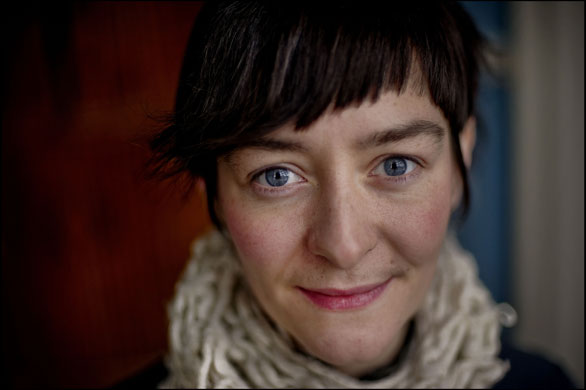
Her preoccupation with place - recently, Motherland and Fatherland asked questions about belonging, and video footage in Trilogy featured some smashing landscapes - naturally leads to site specific productions. That Shadowland is going to think about waste, and its environmental impact, adds purpose to the trip from The Arches.
Like the other artists in Auteurs, it is the importance of her presence that makes Green's performances unique. Her own academic interests in ecology and feminism are balanced by an insistence on her own experiences and belief - this is appropriate to her underlying philosophy, which refuses to deny the individual for abstract ideals and is shot through with a warm compassion. Her gentle yet firm vision guides her plays, and offers scope for discussion as well as serious analysis.

The Riot of Spring is the second leg of Drummond's assault on audiences this Spring - Quiz Show is the Traverse's main event this season. He has involved a musician and a dancer in this quest to consider Stravinsky and Nijinsky, who got together to irritate ballet audiences in 1913 with The Rite of Spring.
Drummond's reasons for the selection of this epoch changing moment are characteristically unpredictable: enchanted by the idea of artists making something original, he draws on the central myths of The Rite and the rite within The Rite to link virgin sacrifices, insane artists and jigging tourists.
NTS The Arches Auteurs (Part One)
It's natural to assume that The Auteurs season is the result of The National Theatre of Scotland's pause between artistic directors. With Vicky Featherstone now at The Royal Court and new director Laurie Sansom yet to arrive, The Auteurs are a creative development programme that looks back to Featherstone's emphasis on artistic led projects and lines up some of the artists who are likely to play a part in the NTS' future.
The selections are bold and diverse: Claire Cunningham, dancer and aerialist, currently touring her previous NTS production Menage a Trois across the world; Gary McNair taking on the comments that his work is analogous to stand up comedy; Kieran Hurley, already an award winning monologuist now pushing himself further into collaboration and format busting; Trilogy designing and break out live artist Nic Green, furthering her interest in ecology; Rob Drummond, who has decided to learn yet another skill after the overwhelmingly popular and intelligent Wrestling.
There is little to connect these artists in terms of style or subject. They share a home city in Glasgow, but their approaches and interests vary. Although McNair and Hurley have toured together, they cast very different lights on matters personal and political. Cunningham began her career as a singer, before demonstrating astonishing choreographic skills. Nic Green's most famous work has integrated community engagement with focussed, polished performance. And Drummond's restless script-writing has seen him tackle old school vaudeville tricks, men in lycra having a fight, instant authorship and now, the myth of The Rite of Spring's first performance.
Between them, however, there is a shared energy and a belief in a theatre that can change things. And while none of them comfortably fit the simplistic tag of "political" theatre makers, they are unashamed to address complex issues and engage with tough philosophical quandaries.
 Hurley has perhaps the most political history: early work at The Arches saw him Hitch to the G8 Summit and bring back a report that was half reportage, half personal reflection on the protests, and his contribution to Oran Mor's A Play, A Pie and A Pint was a collaboration with Julia Taudevin which responded to the London riots of 2011. But Hurley is no mere ideologue in the mood of the 1970s' playwrights who sought to examine Marxist theory and potential in theatrical form. At his best, as in Beats, he is capable of taking the most personal story and demonstrating how it relates to grand cultural movements.
Throughout his career to date, rather like Drummond, he has shown a willingness to expand his repertoire of styles. Hitch and Beats were collaborative monologues, using music as an integral device. Rantin takes this further by offering a show that is "part living room gathering, part play, part gig session." Yet his writing is precise, using the telling detail to open up landscapes and pining his thoughtful intellect on specific lives and circumstances.
 After a deeply personal Menage a Trois, Claire Cunningham is heading towards the global in Pink Mist. Teamed up with sound artist Zoe Irvine, Cunningham's research into land-mines during a trip through Cambodia has inspired a show that "takes it time. Gradual creeping time. The kind of time it takes to slowly demine a strip of land one metre wide and ten metres long."
Past pieces from Cunningham have revealed an artist with a cheeky sense of humour and an eye for the dramatic: Mobile/Evolution, her Fringe success, demonstrated a danger-defying panache and a bold aesthetic sense. Again, she is a restless artist, connecting her experiences both to her performances and the wider world.
The selections are bold and diverse: Claire Cunningham, dancer and aerialist, currently touring her previous NTS production Menage a Trois across the world; Gary McNair taking on the comments that his work is analogous to stand up comedy; Kieran Hurley, already an award winning monologuist now pushing himself further into collaboration and format busting; Trilogy designing and break out live artist Nic Green, furthering her interest in ecology; Rob Drummond, who has decided to learn yet another skill after the overwhelmingly popular and intelligent Wrestling.
There is little to connect these artists in terms of style or subject. They share a home city in Glasgow, but their approaches and interests vary. Although McNair and Hurley have toured together, they cast very different lights on matters personal and political. Cunningham began her career as a singer, before demonstrating astonishing choreographic skills. Nic Green's most famous work has integrated community engagement with focussed, polished performance. And Drummond's restless script-writing has seen him tackle old school vaudeville tricks, men in lycra having a fight, instant authorship and now, the myth of The Rite of Spring's first performance.
Between them, however, there is a shared energy and a belief in a theatre that can change things. And while none of them comfortably fit the simplistic tag of "political" theatre makers, they are unashamed to address complex issues and engage with tough philosophical quandaries.

Throughout his career to date, rather like Drummond, he has shown a willingness to expand his repertoire of styles. Hitch and Beats were collaborative monologues, using music as an integral device. Rantin takes this further by offering a show that is "part living room gathering, part play, part gig session." Yet his writing is precise, using the telling detail to open up landscapes and pining his thoughtful intellect on specific lives and circumstances.

Past pieces from Cunningham have revealed an artist with a cheeky sense of humour and an eye for the dramatic: Mobile/Evolution, her Fringe success, demonstrated a danger-defying panache and a bold aesthetic sense. Again, she is a restless artist, connecting her experiences both to her performances and the wider world.
Meditating on Traverses

Perhaps. Alongside the Tron, the Traverse has a programme that is made up of both guest companies and in-house productions. Unlike the Tron, or the Citizens, it has had a specific vision built into its programming from the beginning: it is concerned with "New Writing." Under Dominic Hill, now artistic director at The Citizens, the definition of new writing was expanded - a dance season was added, but the Traverse Fifty programme has reasserted the script as the heart of the theatre's process. Add in the various engagement programmes, which often focus on getting young people writing, and the Traverse is actively engaged in maintaining the importance of the word made drama.
The venue's choice of collaborators is telling: on the one extreme, pitching in with A Play, A Pie and A Pint for a series of midday specials to the other, hosting Platform 18's double bill, from The Arches. PPP is radical in format - short new plays given week long runs over lunch - but conservative in style - the script is still the thing, mostly. Platform 18, on the other hand, is always experimental. Past winners include Nic Green, who used it to develop part of her Trilogy, while this year has Amanda Monfrooe, a master of matching eclectic influences to her darkly post-modern take on reality and Peter McMaster, who is interpreting Wuthering Heights through a feminist perspective and all-male cast.
From these collaborations, the position of the Traverse as a broad, inclusive venue is clear, and it does sketch out something of Scottish Theatre's breadth. Although the choices in the PPP runs are often energetic and youthful - rising star Sabrina Mahfouz is no polite chronicler of drawing room society, and Douglas Maxwell has plenty of fun taking a respectable widow to vulgarity - their audience is traditionally older (the edition at Oran Mor is often packed with peckish pensioners). The Arches, meanwhile, has a younger audience, coming from the diverse artistic communities of Glasgow and well versed in the outrage and idioms of Live Art.
Spreading out to their various visiting companies reveals an even bigger perspective on Scottish Theatre - which expands to include Firebrand (from the Borders), Lyceum Youth Theatre (from the next door theatre), Clerkinworks (straight out of London), Gare St Lazare and Blue Raincoat (Irish) and Pepperdine University (visiting from Malibu). The work flowing through Scotland is international in character - perhaps inevitably from English speaking nations, although manipulate upped the European quotient back in February.
There's more than a touch of politics in this season - Clerkinwork's The Bear gets stuck into the criminal justice system, White Rose uses the Soviet defense of Stalingrad to examine gender politics, Mahfouz has three female criminals getting up to tricks, and Why Do You Stand In The Rain? returns to the aftermath of WWI for a story of state savagery. Yet there is a far more potent theme that carries beyond this: the personal politics of First Love (an adaptation of a Beckett novella), Jenna Watt's meditation on Flaneurs who fail to intervene, and in the double bill of Chapel Street and Bitch Boxer, a lively look at the impact of Cameron's Broken Britain on individual lives.
Perhaps this collision of public and private is best demonstrated by the Traverse's big production this Spring Quiz Show by Rob Drummond. Drummond is undeniably becoming of the most important authors of his generation - recent success has seen his Bullet Catch head to the USA - and Quiz Show demonstrates his ability to use a popular subject to delve deeply into philosophical ideas.
Apart from a rude health, this spring at the Traverse suggests that Scottish theatre is not only enthused by an interest in international theatre - with England providing only one of the possible areas of influence - but that it integrates the politics of the personal into wider contexts. It's easy to say that theatre has become suddenly political, or that it is obsessed with national identity, but the emphasis on particulars, on the specifics of life rather than the grand narratives of dogma, make this political theatre distinctive from its earlier incarnations, such as in the 1970s, when it was driven by Marxist ideology.
- Quiz Sho
Friday, 1 March 2013
Not a Proper Christian
Yes, I am trying to
start a conversation.
Within my lifetime,
science has become the dominant public intellectual paradigm. The claims of
fundamentalist Christianity not withstanding, it has become the primary author
on matters both ontological and social. Atheism, once a minority interest, has
become a badge of pride and although its connection to science isn’t absolute,
scientific thought is frequently invoked to defend it.
Unfortunately, there
is a widespread misunderstanding of what science is. Contrary to popular
belief, science is not a bunch of facts and theories. Science is defined by its
use of a method: the investigation of the universe through experimentation.
Taking the conclusions from these experiments and repeating them does not make a
person a scientist, anymore than a parrot quoting Hamlet’s Great Speech is an
actor.
When Christian
fundamentalists attack science – ostensibly to defend their literal readings of
The Bible – they complain that scientific truth is in a constant state of flux.
While their alternative authority is increasingly unpalatable (as well as a
very post-modern and deliberate misreading of The Bible’s intention), they are
identifying the strength of science: it is constantly evolving and improving.
To claim that this is a weakness only suggests that they haven’t imbibed the
truth in St Paul’s claim that “the wisdom of God is the folly of Man.”

Using the Straw Man of
Christian fundamentalism, I move into the Straw Man of the scientist. The
mistake of seeing science as a bunch of facts lead to the suggestion that
science, in itself, can become a religion. And while I respect the right of
anyone to live their life according to the tenets of natural selection and
quantum theory, it’s not science.
If science is the
application of the experimental method, religion is more difficult to define.
For working purposes, I call it an interrelated collection of beliefs and
behaviours that seek to explain the relationship between consciousness and the
universe.
(I’ve used consciousness
to avoid the gendered language of “humanity” and include the possibility of
consciousness on other planets, yet undiscovered.)
It’s almost
incidental, but religions tend to rely on scripture.
As soon as “scientists”
goes to war with Christianity – or Islam, or Judaism – it seems to slip into
being religious. It might not have
had the same violent impact on human society as its competition – aside from
the eugenics movement – and the label “religion” is not an insult. It’s just a
clarification of what is at stake.
To end: an anecdote
from my past. It was Harrow, the 1990s. A skeptic (sic) and a street evangelist
were throwing down outside the cinema. The evangelist insisted that God had
made the universe in six days. The skeptic countered that there were
alternative cosmologies, which more readily explained the features of the
physical realm. I listened for a while: one would quote Genesis, the other the Origin
of Species. I have to admit that the skeptic was more convincing, but his
blanket condemnation of religion was arrogant.
I humbly suggested
that their conversation was not necessarily the only one possible. Without
wanting to decay their ideas into a bland Golden Mean, I wondered whether a
theory describing how the variety of species had evolved really undermined a
parable about how consciousness became corrupted.
They both turned on
me. They agreed that I wasn’t “a proper Christian.”
Yeah, I can live with
that.
Subscribe to:
Posts
(
Atom
)